


India’s cotton sector, which supports the livelihoods of nearly 6 million farmers and provides employment to 40-50 million people, is undergoing a significant transformation through a series of government initiatives aimed at improving productivity, strengthening farmer incomes and enhancing the country’s competitiveness in the global textile value chain.
The Centre has rolled out a multi-pronged strategy that includes higher minimum support prices (MSP), a ₹5,659.22-crore Mission for Cotton Productivity, digital procurement through the Kapas Kisan app and the Kasturi Cotton Bharat branding initiative to position Indian cotton as a premium global product.
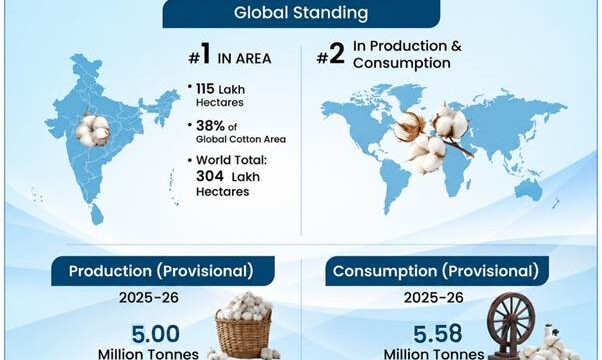
India remains the world’s largest cotton cultivator by area, with 114.84 lakh hectares under cultivation, accounting for around 38% of the global cotton acreage. The country is also the second-largest producer and consumer of cotton.
Cotton production stood at 297.24 lakh bales (5.06 million tonnes) during the 2024-25 season, while provisional estimates for 2025-26 place output at 290.91 lakh bales. Domestic consumption is estimated at 328 lakh bales, underlining the strong demand from India’s textile industry.
Mission to boost productivity
To raise yields and reduce dependence on imports, the government has launched a five-year Mission for Cotton Productivity beginning 2025-26.
With an allocation of ₹5,659.22 crore, the programme seeks to develop climate-resilient, pest-resistant and high-yielding cotton varieties, with a special emphasis on Extra Long Staple (ELS) cotton.
The mission will cover 24 lakh hectares across 140 districts in 14 cotton-growing states and is expected to benefit nearly 32 lakh farmers.
The government has set an ambitious target of increasing cotton production from 297 lakh bales to 498 lakh bales by 2031.
Higher MSP for farmers
To protect farmers from market volatility, the government has increased the MSP for the 2026-27 cotton season.
The MSP for medium staple cotton has been raised to ₹8,267 per quintal, while long staple cotton will fetch ₹8,667 per quintal, an increase of ₹557 per quintal over the previous season.
During the 2025-26 cotton season, the Cotton Corporation of India (CCI) procured 105.09 lakh bales worth ₹41,530 crore through around 24 lakh procurement transactions.
CCI has also expanded its procurement network from 508 centres in 2024-25 to 571 centres spread across 152 districts in 11 cotton-growing states.
Technology-led reforms
The government’s Kapas Kisan mobile application has digitised the procurement process by allowing farmers to self-register, book procurement slots and receive Aadhaar-linked payments.
More than 41 lakh farmers have already registered on the platform, significantly reducing waiting time and improving transparency in MSP operations.
Meanwhile, under the National Food Security Mission, large-scale demonstrations of High-Density Planting Systems and closer spacing technologies have recorded yield improvements of up to 40%, prompting the extension of the programme for another year.
Building a global brand
The Kasturi Cotton Bharat initiative is helping enhance the global image of Indian cotton through certification, traceability and branding.
As of June 30, 2026, more than 3.29 lakh certified cotton bales had been registered under the programme. QR-code certification and blockchain technology ensure end-to-end traceability, strengthening India’s positioning in premium global markets.
With strong policy support, technology adoption and a renewed focus on quality, India’s cotton sector is positioning itself to deliver higher farmer incomes, improved productivity and greater value addition while reinforcing its role as a key pillar of the country’s agricultural and textile economy.