


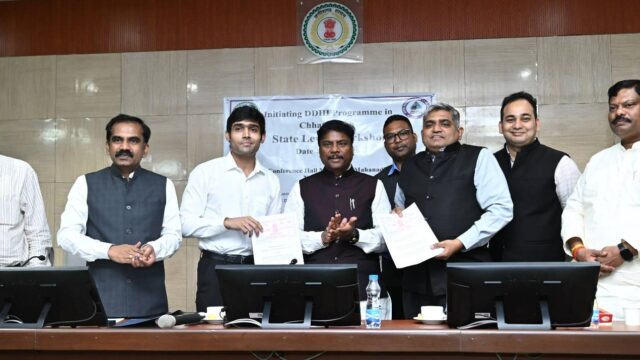
The Indian Institute of Technology Madras (IIT Madras) has partnered with the Government of Chhattisgarh to roll out a Data-Driven Hyperlocal Interventions (DDHI) programme aimed at reducing road accidents through district-level planning, engineering improvements and data-backed decision-making.
The initiative, spearheaded by the Centre of Excellence for Road Safety (CoERS) at IIT Madras, will focus on identifying accident-prone locations, strengthening institutional capacity and implementing low-cost, evidence-based interventions tailored to local conditions.
An MoU for the collaboration was signed in Raipur on Wednesday by Prof. Venkatesh Balasubramanian, Head, CoERS, IIT Madras, and S. Prakash, Secretary & Commissioner, Transport Department, Government of Chhattisgarh.
Focus on tribal and mining regions
The programme will place special emphasis on improving road safety in Chhattisgarh’s tribal and mining-dominated regions, where challenging terrain, unique traffic patterns and mobility requirements demand customised solutions rather than a one-size-fits-all approach.
The first phase will cover nine priority districts—Raipur, Raigarh, Surajpur, Balod, Baloda Bazar, Jashpur, Surguja, Mahasamund and Janjgir.
Under the programme, IIT Madras will provide technical support through road safety assessments, engineering recommendations, administrative interventions, training programmes and capacity building for district and state officials.
Part of national road safety mission
The DDHI programme is a national initiative launched by CoERS in partnership with the Ministry of Road Transport and Highways (MoRTH) to help district administrations identify local road safety challenges using crash data and community feedback.
The interventions are designed to be low-cost, enabling district authorities to implement corrective measures quickly without lengthy approval processes.
With Chhattisgarh joining the initiative, CoERS is now working with 17 state governments to strengthen road safety across India.
Technology-driven interventions
A key component of the programme is the Sanjaya platform, developed by CoERS, which enables officials to identify accident black spots and emerging crash locations for timely interventions.
The platform is expected to help authorities prioritise engineering improvements and enforcement measures based on real-time and historical data.
Leaders emphasise safer roads
Chhattisgarh Transport Minister Kedar Kashyap said every road accident results in an irreparable loss to families, making road safety a shared responsibility.
“Our endeavour is not just to reduce accidents but to build a safe road system where every citizen can return home safely. This partnership reflects our commitment to reducing road fatalities and ensuring safer roads across the state,” he said.
S Prakash, Secretary & Commissioner, Transport Department, Government of Chhattisgarh, said the Sanjaya platform would help officials identify black spots and emerging crash locations for timely, evidence-based action.
He added that the collaboration is designed as a long-term initiative with continuous monitoring across the nine identified districts.
Academia- government collaboration
IIT Madras Director Prof V Kamakoti said the programme demonstrates how academia and governments can work together to solve complex societal challenges through technology and data-driven governance.
Prof Venkatesh Balasubramanian, Head, CoERS, said road safety challenges in tribal and mining regions differ significantly from other parts of the country.
“DDHI’s interventions are designed specifically around these hyperlocal realities rather than a one-size-fits-all model,” he said.
The collaboration aligns with the Government of India’s goal of halving road accident fatalities by 2030 through evidence-based planning, institutional capacity building and faster implementation of targeted safety measures.