


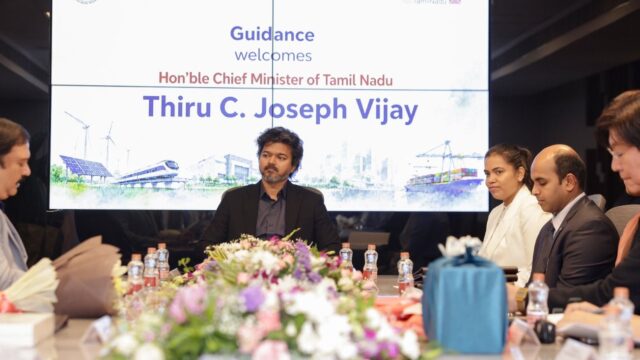
Tamil Nadu has sharpened its strategy of becoming India’s preferred destination for knowledge-led investments, signing a series of memoranda of understanding (MoUs) with global corporations and an international university that will bring global capability centres (GCCs), a research and development (R&D) hub, advanced manufacturing and the State’s first international university campus.
The agreements, signed in the presence of Chief Minister C. Joseph Vijay at Guidance Tamil Nadu in Chennai on Thursday, are expected to generate around 2,920 direct and indirect jobs, with a significant share comprising high-value technology and research roles.
The latest investments underline the State’s evolving industrial strategy. While Tamil Nadu has traditionally attracted large manufacturing investments, the government is now increasingly focusing on sectors that generate higher-value employment, including GCCs, engineering design, research, innovation and higher education.
GCC and R&D gain momentum
Swiss insurance giant Chubb will establish its first Global Capability Centre in Tamil Nadu, creating around 220 jobs, while German wind turbine manufacturer Nordex will set up its maiden R&D centre in the State, employing nearly 1,000 professionals.
Combined, the two projects are expected to create 1,220 high-skilled jobs, reinforcing Chennai’s emergence as one of India’s fastest-growing GCC destinations.
The addition of a global engineering and research centre by Nordex also reflects Tamil Nadu’s growing attractiveness for companies looking to undertake product development and engineering from India rather than merely manufacturing.
First international university campus
In a significant boost to the State’s higher education ecosystem, the University of Western Australia (UWA) will establish its first India campus in Chennai, making it the first international university to set up a campus in Tamil Nadu.
The Australian university, ranked 77th in the QS World University Rankings 2026, plans to invest around ₹125 crore in the Velachery campus, which is expected to create more than 200 direct and indirect jobs.
The move is expected to strengthen the talent pipeline for multinational companies establishing operations in Tamil Nadu while enhancing the State’s appeal as a destination for global education.
Manufacturing investments continue
Complementing the knowledge-sector investments, South Korean automotive component maker MotiveLink will invest ₹300 crore to establish a manufacturing facility at the SIPCOT Industrial Park in Pillai Pakkam, Kancheepuram district.
The project is expected to create around 1,500 jobs and follows Industries Minister S. Keerthana’s investment outreach visit to South Korea in June this year.
The investment reinforces Tamil Nadu’s position as India’s automotive manufacturing hub while expanding its supplier ecosystem.
Beyond factories
The mix of investments signals a calibrated shift in Tamil Nadu’s investment strategy, from competing primarily for manufacturing projects to building an integrated ecosystem encompassing advanced manufacturing, research, digital services and global education.
For Chennai in particular, the addition of new GCCs, an international university and an engineering R&D centre strengthens its credentials as a knowledge economy hub capable of attracting multinational investments beyond conventional back-office operations.
Chief Minister C. Joseph Vijay said the investments were aligned with the government’s long-term vision of attracting high-value investments, fostering innovation-driven growth and creating quality employment opportunities for the State’s youth. He also assured investors of continued government support for speedy implementation of their projects.