


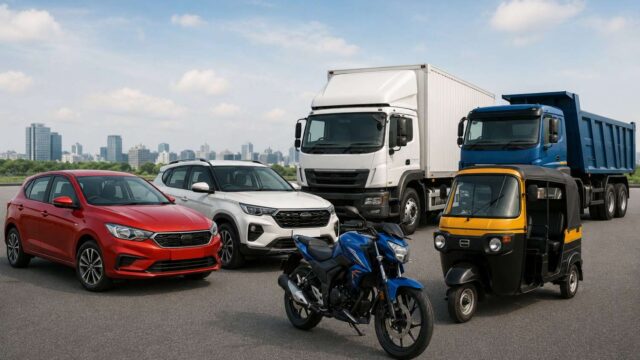
India’s automobile industry is entering a new phase of accelerated growth, driven by strong domestic demand, supportive government policies, rising exports and rapid technological transformation, according to a new report by Rubix Data Sciences.
The report, titled “Passenger Vehicles and Commercial Vehicles Industry Insights,” says India has emerged as the world’s third-largest automobile market in 2025 and is aiming to become the global leader within the next five years.
It notes that India already ranks second globally in the production of buses and coaches, third in passenger car production, fourth in commercial vehicle production, and third in sales of both passenger cars and commercial vehicles.
Production to touch 200 million units by 2047
Under the government’s Automotive Mission Plan 2047, total automobile production, including two-wheelers, three-wheelers, passenger vehicles (PVs), commercial vehicles (CVs) and quadricycles, is projected to rise from 34.71 million units in FY26 to 50 million units by 2030, eventually reaching 200 million units by 2047.
The report said passenger vehicle production grew from 3.06 million units in FY21 to 5.54 million units in FY26, representing a 13% CAGR, while domestic PV sales increased from 2.71 million units to 4.64 million units, registering an 11% CAGR.
Commercial vehicle production rose from 0.62 million units to 1.17 million units during the same period, while sales nearly doubled from 0.57 million units to 1.08 million units, reflecting a 14% CAGR.
FY26 sees demand revival
After a moderation in sales during FY25, both vehicle segments staged a strong recovery in FY26.
Passenger vehicle sales expanded by around 8% year-on-year, while commercial vehicle sales rose by 12.5%, supported by the rollout of GST 2.0, which reduced the tax burden on vehicles, and lower borrowing costs following RBI repo rate cuts, the report said.
SUVs dominate passenger vehicle market
The report highlights a significant structural shift in India’s passenger vehicle market, with Utility Vehicles (UVs) accounting for 65% of total PV sales in FY25, up sharply from 39% in FY21, reflecting consumers’ growing preference for SUVs and crossovers.
In the commercial vehicle segment, the share of Medium and Heavy Commercial Vehicles (MHCVs) increased from 28% to 39%, driven by rising demand from infrastructure projects, mining activity and long-haul freight transportation.
Exports hit record levels
India’s passenger vehicle exports grew at a 17% CAGR to reach a record 0.77 million units in FY25, led by compact cars and utility vehicles from manufacturers such as Maruti Suzuki, Hyundai and Volkswagen.
Maruti Suzuki alone recorded a 34% increase in exports, shipping an all-time high of 4.47 lakh vehicles during FY2025-26.
The report identifies Saudi Arabia, South Africa, Mexico, Japan and the UAE as key export markets. Saudi Arabia has emerged as the largest destination for Indian truck exports, while the UAE leads bus exports.
Policy support and technology to drive growth
According to the report, the next phase of industry growth will be supported by the Production Linked Incentive (PLI) Scheme for automobiles and auto components, rising vehicle financing, growth in the pre-owned vehicle market and replacement demand generated by the Vehicle Scrappage Policy.
Technology is also reshaping the sector. Penetration of Advanced Driver Assistance Systems (ADAS) in passenger vehicles increased from 6.2% in the first half of 2024 to 8.3% in the first half of 2025.
Meanwhile, the proposed BS-VII emission norms, aligned with Euro 7 standards and expected to be notified during FY27, are likely to trigger another cycle of investments in vehicles and components.
Electrification is also gathering pace. Battery electric vehicle (BEV) penetration in passenger vehicle registrations increased from 1% in 2022 to 4% in 2025, while overall four-wheeler EV penetration reached 5.35% in 2026, aided by an expanding range of electric and hybrid models.
Risks remain
Despite the positive outlook, the report cautions that the industry faces several near-term challenges, including geopolitical disruptions affecting supply chains and export markets, higher compliance costs arising from stricter emission standards, increasing engineering complexity due to advanced vehicle technologies and continued volatility in raw material prices.
Supply chain resilience will be critical
Rubix Data Sciences President Tushar Bhaskar said the industry is entering an unprecedented phase of expansion, but supply chain resilience will determine long-term success.
He noted that while OEMs continue to announce record exports and capacity expansion plans, the broader ecosystem of component manufacturers, dealers and logistics partners must also strengthen their financial and operational capabilities to support the industry’s rapid growth.
The report concludes that India’s passenger and commercial vehicle industry is becoming increasingly technology-driven, export-oriented and globally competitive, with localisation, innovation and policy support expected to reinforce its role as a key driver of the country’s long-term economic growth.