

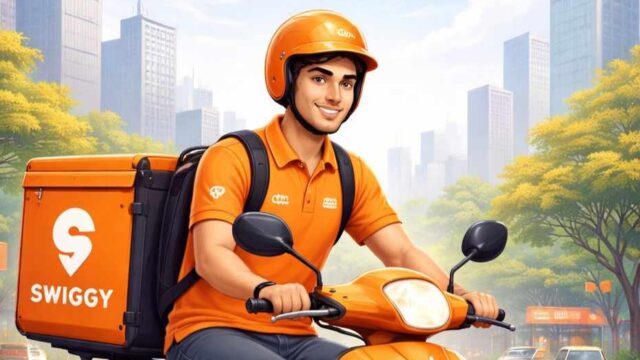
Food delivery and quick commerce major Swiggy has laid out an ambitious five-year growth roadmap, targeting an adjusted EBITDA of ₹10,000 crore by FY31 while aiming to more than triple its consolidated Gross Order Value (GOV) to around ₹2.5 lakh crore from ₹67,734 crore in FY26.
The company unveiled its long-term strategy at its Capital Markets Day 2026, projecting a 30%-plus compound annual growth rate (CAGR) in GOV through FY31, supported by sustained expansion across food delivery, quick commerce, dining-out services and AI-led operational efficiencies.
“Our confidence in achieving our five-year EBITDA goal is rooted in the strength of our fundamentals. We have always believed that if we stay focused on solving large consumer problems and execute with discipline, the financial outcomes will follow,” Swiggy Managing Director and Group CEO Sriharsha Majety said.
He said the company operates in three of India’s largest and fastest-growing consumer opportunity segments—food delivery, quick commerce and out-of-home consumption—each with significant long-term growth potential.
Food delivery to remain the profit engine
Swiggy expects its food delivery business to remain its biggest earnings contributor, with GOV projected to grow 2.5-3.5 times by FY31 and adjusted EBITDA reaching ₹5,000 crore.
The company believes India’s food services market will expand from about $90 billion in 2026 to $150 billion by 2031, with higher order frequency and affordability initiatives expected to drive category growth.
During the first quarter of FY27, Swiggy’s food delivery business reported ₹9,490 crore in GOV, up 18% year-on-year, while its adjusted EBITDA run rate rose to ₹292 crore, a five-fold increase compared with Q1 FY25.
Dineout eyes five-fold expansion
Swiggy’s dining-out platform Dineout is targeting nearly five-fold growth over the next five years, with GOV expected to increase from ₹4,600 crore in FY26 to ₹20,000-25,000 crore by FY31.
The business, which completed its first full year of positive adjusted EBITDA in FY26, aims to generate ₹1,000 crore in adjusted EBITDA by FY31, compared with ₹30 crore in FY26.
Dineout currently works with more than 52,000 monthly active restaurant partners across 75 cities.
Instamart scales up profitability
Swiggy’s quick commerce arm Instamart posted ₹7,907 crore in GOV during Q1 FY27, registering 40% year-on-year growth, while narrowing its contribution margin loss to 0.2% of GOV, reflecting improved operating efficiency.
The business serves over 14 million monthly transacting users across 130 cities through a network of 1,200 dark stores.
Swiggy said more than 45% of Instamart’s stores are now contribution-margin positive, with five of its seven largest cities, including Bengaluru, already operating profitably.
Instamart is targeting a ₹1.5 lakh crore-plus GOV business by FY31, representing a 4-5 times increase over FY26 levels. The company also plans to expand its monthly transacting user base to more than 40 million while strengthening its private brands and strategic partnerships.
AI to drive next phase of growth
Swiggy said artificial intelligence will play a central role in its future growth strategy, with AI integrated across customer demand forecasting, fulfilment, merchant services, monetisation and internal operations.
The company highlighted its proprietary AI tools, including SAGE, an analytics assistant developed for operating teams, as part of its broader push towards AI-native operations.
Strong balance sheet supports expansion
Swiggy expects its consolidated adjusted EBITDA margin to improve to around 4% of GOV by FY31, with earnings per share projected to rise from a loss of ₹16 in FY26 to ₹30-33 by FY31.
The company ended FY26 with a cash balance of ₹14,400 crore and remains debt-free, providing financial flexibility to fund future growth initiatives.
Swiggy also said domestic ownership in the company crossed 50% on July 1, 2026, while its board has approved increasing the foreign shareholding cap to 49.5%, subject to shareholder approval. The move is expected to facilitate Instamart’s transition to a first-party inventory model over the next two to four quarters.