


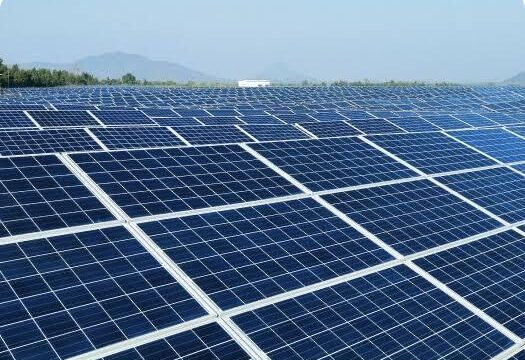
India has crossed a landmark 300 GW of installed non-fossil fuel-based electricity generation capacity, marking a major step towards its clean energy and climate goals.
According to the Ministry of New and Renewable Energy, India’s total non-fossil fuel capacity stood at 300.50 GW as of July 31, 2026, taking the country beyond 60% of its target of achieving 500 GW of non-fossil fuel capacity by 2030.
Non-fossil sources now account for more than 54% of India’s total installed electricity generation capacity of around 552 GW.
Solar leads clean energy expansion
Solar power remains the biggest driver of India’s clean energy expansion, with installed capacity reaching 164.59 GW as of July 31, 2026.
This represents a dramatic increase from just 2.8 GW in 2014.
Wind power capacity has also expanded significantly, reaching 58.14 GW, compared with around 21 GW in 2014.
The overall non-fossil capacity includes: Solar: 164.59 GW, Wind: 58.14 GW, Hydro: 57.24 GW, Bio-power: 11.75 GW and Nuclear: 8.78 GW, totalling 300.50 GW.
Record capacity addition in FY26
India added a record 55.29 GW of non-fossil fuel-based electricity generation capacity during FY2025-26.
Solar power accounted for the bulk of the additions at 44.6 GW, while wind contributed another 6 GW.
The rapid expansion in installed renewable capacity has also translated into higher clean electricity generation.
Renewable energy generation increased from 190.96 billion units (BU) in FY2014-15 to 477.79 BU in FY2025-26, highlighting the growing contribution of renewables to India’s electricity mix.
Domestic clean-energy manufacturing expands
The government is simultaneously focusing on strengthening domestic manufacturing capabilities to support the rapid expansion of renewable energy and reduce dependence on imports.
The Production Linked Incentive (PLI) scheme has supported the development of domestic manufacturing of high-efficiency solar modules.
The capacity enlisted under the Approved List of Models and Manufacturers (ALMM) for Solar PV Modules has crossed the 200 GW milestone, compared with just 2.3 GW in 2014.
The expansion of domestic manufacturing is expected to strengthen India’s clean-energy supply chain while supporting the broader objective of building an Aatmanirbhar energy ecosystem.
Green hydrogen push
The clean-energy transition is also increasingly being positioned as an industrial and economic opportunity rather than solely a climate objective.
The Ministry of New and Renewable Energy is driving industrial decarbonisation through the National Green Hydrogen Mission, which aims to position India as a global hub for the production, use and export of green hydrogen and its derivatives.
The government sees the expansion of non-fossil generation capacity, domestic renewable-energy manufacturing and green hydrogen as interconnected pillars of India’s strategy for greater energy independence and economic resilience.
With 300.50 GW of non-fossil capacity already in place, India has crossed the halfway mark towards its 2030 target and is now entering a critical phase in its push to add the remaining capacity over the next four years.