


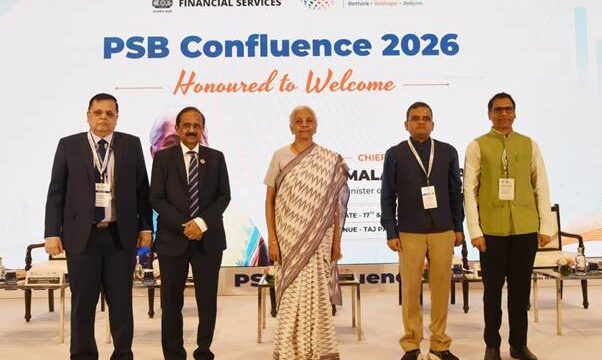
The first day of the two-day PSB Confluence 2026, organised by the Department of Financial Services (DFS), Ministry of Finance, brought together senior leadership of public sector banks (PSBs), public financial institutions (PFIs), government officials and domain experts to identify strategies for the next phase of India’s banking and financial sector growth.
The Confluence is structured around seven themes, with discussions focused on identifying practical and scalable solutions for PSBs and PFIs.
The event was addressed by Union Minister for Finance and Corporate Affairs Nirmala Sitharaman and the Secretary, Department of Financial Services.
Low NPAs give banks room for next phase
Sitharaman highlighted the importance of the seven themes being discussed, particularly in the context of banking sector growth, financial inclusion and credit.
She said the historically low level of non-performing assets (NPAs) has placed the banking sector in a position of strength to take forward the next phase of reforms.
The Finance Minister also underlined the need for the banking sector to respond to the aspirations of India’s young population.
With 29% of India’s population between 15 and 29 years, she said the future of banking must increasingly reflect the financial needs and aspirations of youth.
Four themes take centre stage
Four of the seven themes were taken up for detailed discussions on Day 1 such as deposit mobilisation, banking for youth, supporting the investment cycle and global capability centres (GCCs).
Discussions on deposit mobilisation focused on strengthening the deposit base through deeper customer engagement, while the banking-for-youth theme examined ways to develop financial products and services aligned with the needs of younger customers.
The investment-cycle discussions centred on strengthening institutional capabilities and developing financing solutions to support evolving investment requirements.
The GCC session examined how PSBs and PFIs can position themselves to capture opportunities arising from India’s expanding GCC ecosystem.
The deliberations included inputs from domain experts, including Seshagiri Rao MVS, Group CFO, JSW, on supporting the investment cycle, and Tanay Kediyal, GCC Enterprise Transformation Expert, on the evolving GCC ecosystem.
MY Bharat could deepen youth banking outreach
The discussions on Banking for Youth also explored the potential of leveraging Mera Yuva Bharat (MY Bharat), a national platform under the Department of Youth Affairs, Ministry of Youth Affairs and Sports, to expand engagement with young people.
MY Bharat CEO Dr. Priyanka Shukla participated as an expert speaker and shared perspectives on youth outreach.
With more than 2.60 crore registered users, MY Bharat could provide a platform for greater awareness among young people about formal financial services and opportunities related to education finance, entrepreneurship, internships and careers in the financial sector.
Three themes on Day 2
The remaining three themes will be taken up on the second day of the confluence: These are agriculture and horticulture value chain infrastructure, priority sector lending and reimagining the credit card business.
The second day will also feature presentations on actionable strategies and innovative solutions emerging from all seven thematic groups.
The broader objective of the confluence is to translate the discussions into concrete and implementable outcomes, while enabling PSBs and PFIs to learn from successful approaches across institutions and strengthen their collective ability to support India’s evolving growth requirements.
The initiative comes as the government seeks to build on improvements in the banking sector and strengthen the competitiveness and institutional capabilities of PSBs and PFIs in support of the country’s Viksit Bharat 2047 ambition.