


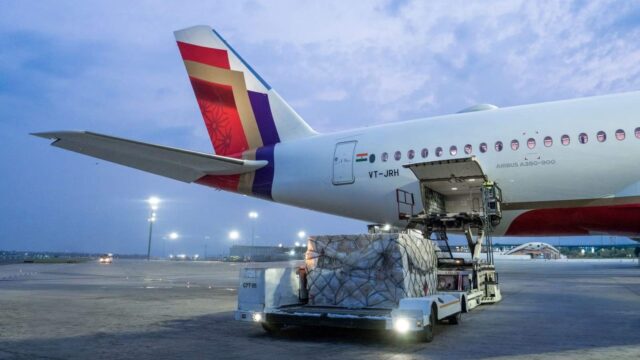
Air India’s latest cargo transshipment numbers offer more than evidence of an operational improvement. They provide an early indication of how a regulatory change could help India capture a larger share of international air cargo that currently moves through overseas hubs.
The airline said it has successfully operationalised the Government’s new cargo transshipment policy through an ongoing Proof of Concept (PoC) on the Chennai-Delhi-Frankfurt corridor, launched on June 20, 2026.
The policy allows eligible cargo to remain securely packed during transit, removing the need for piece-level re-screening at the connecting airport. For the air cargo industry, the significance is straightforward: fewer handling stages can mean shorter connection times, lower operational complexity and better shipment reliability.
Chennai pilot delivers sharp gains
The two-month performance of the Chennai-Delhi-Frankfurt PoC provides the clearest evidence yet of the policy’s potential.
Average cargo volumes on the corridor more than doubled, from 2.2 metric tonnes a day to 4.5 MT, while Air India moved 300 MT of cargo from Chennai to Frankfurt via Delhi between June 20 and August 20.
More strikingly, average cargo connection time at Delhi Airport fell from 36-48 hours to just 5-8 hours.
The airline also reported that its Flown-as-Booked (FAB) performance improved from 76% to 100%, with zero cargo loss or damage during the period.
For exporters and freight forwarders, the time saving could be particularly important. In air cargo, predictability is often as important as headline transit time, particularly for time-sensitive manufacturing components, electronics, pharmaceuticals and high-value goods.
Delhi could challenge overseas hubs
The bigger strategic question is whether the improvement seen on one corridor can be replicated at scale.
Following Government approval to expand the pilot, Air India will enable eligible cargo originating from Ahmedabad, Bengaluru, Chennai, Hyderabad and Mumbai to move through Delhi to Copenhagen, Frankfurt and London Heathrow.
Air India’s Head of Cargo Ramesh Mamidala estimates that Delhi alone could potentially attract more than 2 million MT of additional annual transshipment cargo across 95-plus addressable international corridors.
That is a substantial opportunity, but converting potential into actual volumes will depend on more than policy reform. Cargo infrastructure, customs and security processes, warehouse capacity, handling efficiency, airline schedules and connectivity will determine whether India can compete effectively with established international cargo gateways.
From airline benefit to logistics ecosystem
For Air India, seamless transshipment could improve utilisation of aircraft belly capacity while opening additional cargo flows through its expanding network.
The impact, however, could extend well beyond the airline. Higher transshipment volumes would create opportunities for freight forwarders, warehouse operators, ground handlers, trucking companies and e-commerce logistics providers.
The Government’s policy therefore has the potential to shift the competitive proposition of Indian airports from being primarily origin-and-destination gateways to becoming transshipment hubs for international trade.
The execution challenge
Traditionally, cargo moving from Chennai to Frankfurt through Delhi could require consignments to be unpacked and individual packages re-screened at Delhi before being rebuilt for the onward flight. This added handling could extend transit times and increase the risk of damage, pilferage and discrepancies.
Under the revised framework, eligible shipments can remain securely packed in the same Unit Load Device (ULD), subject to prescribed security controls.
Air India’s PoC, authorised by the Bureau of Civil Aviation Security (BCAS), is effectively testing whether this model can deliver the promised efficiency without compromising security.
The early results are encouraging. But the real test will come with scale.
If the process can be implemented consistently across airports and corridors, India’s cargo sector could gain a meaningful competitive advantage. The policy could also help reduce India’s dependence on foreign gateways for connecting international cargo and strengthen Delhi’s position as a regional cargo hub.
The proposed phased expansion to domestic-to-international, international-to-domestic and international-to-international transshipment could ultimately make the initiative much larger than the current Air India pilot.
For now, the Chennai-Delhi-Frankfurt corridor has demonstrated that reducing one regulatory and operational bottleneck can produce a disproportionate improvement in cargo flows. The next challenge is turning that proof of concept into a nationwide logistics advantage.