


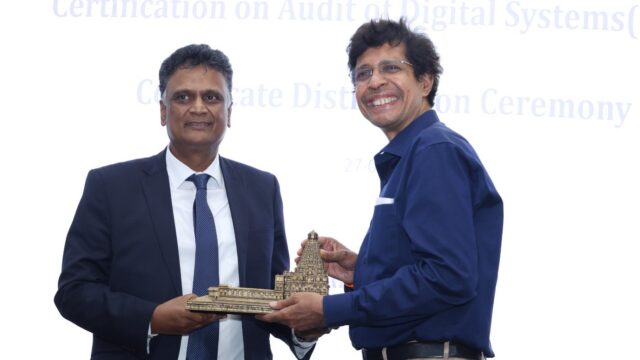
The Comptroller and Auditor General of India (CAG) and the Indian Institute of Technology Madras (IIT Madras) have launched the Certification on Audit of Digital Systems (CADS), a first-of-its-kind certification programme to build capabilities for auditing digital government and enterprise systems.
With governments and organisations increasingly relying on Digital Public Infrastructure (DPI), artificial intelligence (AI), cloud platforms and data-driven services, the demand for professionals capable of auditing complex digital systems is rising.
The CADS programme has been designed to equip learners with specialised competencies to strengthen transparency, accountability and governance in the digital era.
Foundation-level certification launched
Comptroller and Auditor General of India K Sanjay Murthy launched the Foundation-level certification under the three-tier CADS programme at the IIT Madras campus on August 27, through SWAYAM Plus, in the presence of IIT Madras Director V. Kamakoti,and other stakeholders.
“As government becomes increasingly digital, our audit must be capable of giving assurances on the robustness of the systems. For this Department, that capability is central to discharging our constitutional mandate and add value to the efforts of good governance. CADS will, in time, be a mandatory requirement for officers auditing digital systems,” said Murthy.
Building advanced audit capabilities
Murthy said the nine-month course on Data Analytics, AI, ML and Cybersecurity conducted by IIT Madras for CAG officers had added significant value to audit efforts.
He said the first batch of officers receiving certificates had already begun applying advanced analytics and AI/ML knowledge in field audit assignments, helping bring greater scale and depth to audits of complex systems.
IIT Madras focuses on digital governance
Kamakoti said the CADS initiative was aligned with the emphasis of the National Education Policy (NEP) 2020 on inclusive and skill-based education.
“Technology adaptation is impacting all walks of life and hence it is imperative to build capacity towards audit of these digital domains to ensure transparency and accountability,” said Kamakoti.
He added that offering the programme through SWAYAM Plus would help bridge the gap in providing industry-related skill sets.
Four-month online programme
The curriculum has been jointly designed by domain experts from CAG, IIT Madras and IITM Pravartak. It is aligned with NEP and the National Credit Framework (NCrF), providing recognised academic credits alongside a structured pathway for professional skill development and capacity building in digital systems auditing.
The programme is open to anyone holding or pursuing an undergraduate degree across India. The four-month programme will be delivered fully online, while learners will be assessed through proctored Computer-Based Tests (CBTs) conducted in person.
Three-tier certification pathway
CADS is envisioned as a three-tier certification pathway. After completing the Foundation level, learners will subsequently be able to pursue Proficient and Expert-level certifications.
The progression is designed to take learners from foundational digital audit competencies to the ability to lead complex, multi-domain digital audit engagements.
Geography-neutral certification
Additional Deputy Comptroller and Auditor General and Chief Technology Officer Bijay Kumar Mohanty said the CADS had been conceived as a world-class professional certification programme.
He said the certification would not only add value to individual careers but also contribute to the institutional pool of expertise.
Mohanty said the programme had been designed as a geography-neutral course, enabling anyone interested in digital systems auditing to enrol and get certified. The programme is eventually expected to be opened to global participants.
Hosted on SWAYAM Plus
The programme is hosted on the IITM Pravartak Learning Management System through SWAYAM Plus. It combines online learning with practical case studies, self-assessment modules and industry-relevant audit scenarios.
The geography-neutral framework reflects the global nature of digital transformation and the audit challenges emerging from it. The programme is envisaged to be extended to auditors and institutions internationally in due course.