


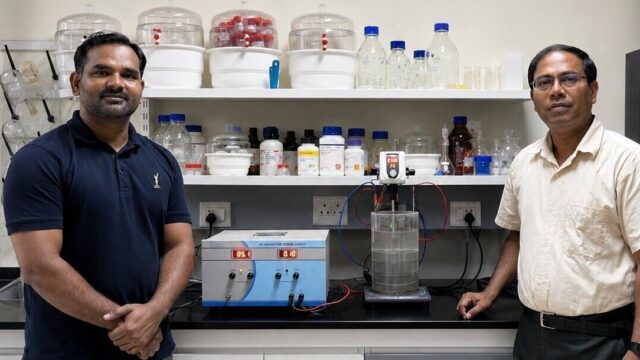
Researchers at the Indian Institute of Technology Guwahati (IIT Guwahati) have developed a low-cost water treatment technology that can simultaneously remove arsenic and fluoride from contaminated groundwater, potentially offering an affordable solution for communities dependent on groundwater for drinking water.
The technology uses a rotating-anode electrocoagulation (RA-EC) reactor, which achieved up to 98.2% removal of arsenate and 91.8% removal of fluoride within minutes. The initial demonstration indicates an estimated operating cost of ₹18–₹58 per 1,000 litres of treated water, depending on contaminant concentration.
The development could be particularly relevant to regions where groundwater is naturally contaminated with both arsenic and fluoride and where conventional treatment systems can be expensive or difficult to deploy.
Tackling two contaminants together
Arsenic and fluoride present a difficult combination for groundwater treatment because they behave differently during conventional purification processes and can compete for removal sites.
Prof Mihir Kumar Purkait of the Department of Chemical Engineering, IIT Guwahati, said groundwater is the primary source of drinking water for millions of people in India, but several regions face contamination from both arsenic and fluoride.
According to the researchers, treating the two contaminants simultaneously has remained challenging, creating a need for treatment systems that are both efficient and economically viable.
Rotating electrode improves treatment
The IIT Guwahati team has redesigned conventional electrocoagulation by replacing a stationary aluminium electrode with a rotating aluminium anode.
The rotating electrode continuously improves mixing inside the reactor, enhances mass transfer and renews the electrode surface. It also promotes the formation of aluminium hydroxide flocs capable of capturing contaminants.
When electricity passes through the reactor, aluminium ions and hydroxide ions combine to form microscopic flocs. These flocs interact with arsenic and fluoride and facilitate their removal through adsorption, coagulation and precipitation.
The rotation of the electrode is designed to improve the efficiency of this process while reducing electrode passivation, which can limit the performance of conventional electrocoagulation systems.
Tested under realistic conditions
The researchers evaluated the influence of operating parameters including rotational speed, current density, electrode spacing and treatment time on the reactor’s performance.
The technology was also tested under groundwater conditions containing naturally occurring ions such as calcium, magnesium, bicarbonate, sulphate and phosphate. Real groundwater samples collected from Assam were also used during the research.
IIT Guwahati Department of Chemical Engineering research scholar Mukesh Bharti said the testing under realistic groundwater chemistry was intended to assess how the system would perform beyond controlled laboratory conditions.
This aspect is important for eventual field deployment, as groundwater composition can vary substantially from one location to another.
Cost could support decentralised treatment
The estimated operating cost of ₹18–₹58 per 1,000 litres is one of the key features of the technology.
If the cost estimates can be sustained at larger scale, the system could potentially support community-level drinking-water treatment, particularly in rural and decentralised settings where access to sophisticated treatment infrastructure may be limited.
The technology could also find applications in treating arsenic- and fluoride-contaminated groundwater, industrial wastewater remediation and as a complementary process alongside adsorption and membrane filtration.
However, the current results represent an initial demonstration rather than proof of large-scale commercial viability. Long-term performance, maintenance requirements, energy consumption and treatment costs at scale will need to be established before widespread deployment.
Moving towards a pilot system
The next stage of the research will focus on developing a pilot-scale continuous-flow reactor suitable for practical deployment.
The team also plans to incorporate sensor-based automated process control for real-time monitoring of parameters such as pH, conductivity, electrical current and rotational speed.
Such automation could help maintain consistent treatment performance while reducing the need for manual intervention, an important consideration for decentralised water-treatment systems.
Research published internationally
The findings have been published in the Chemical Engineering Journal, a peer-reviewed international journal covering chemical engineering, materials, energy, environmental technologies and process engineering.
The paper was co-authored by Prof Mihir K. Purkait and Mukesh Bharti of IIT Guwahati.
The development illustrates the potential of combining electrochemical treatment with improved reactor design to address multiple groundwater contaminants simultaneously. The more important test now will be whether the laboratory-scale performance and cost advantage can be replicated in continuous operation and eventually translated into affordable community-scale water treatment.