


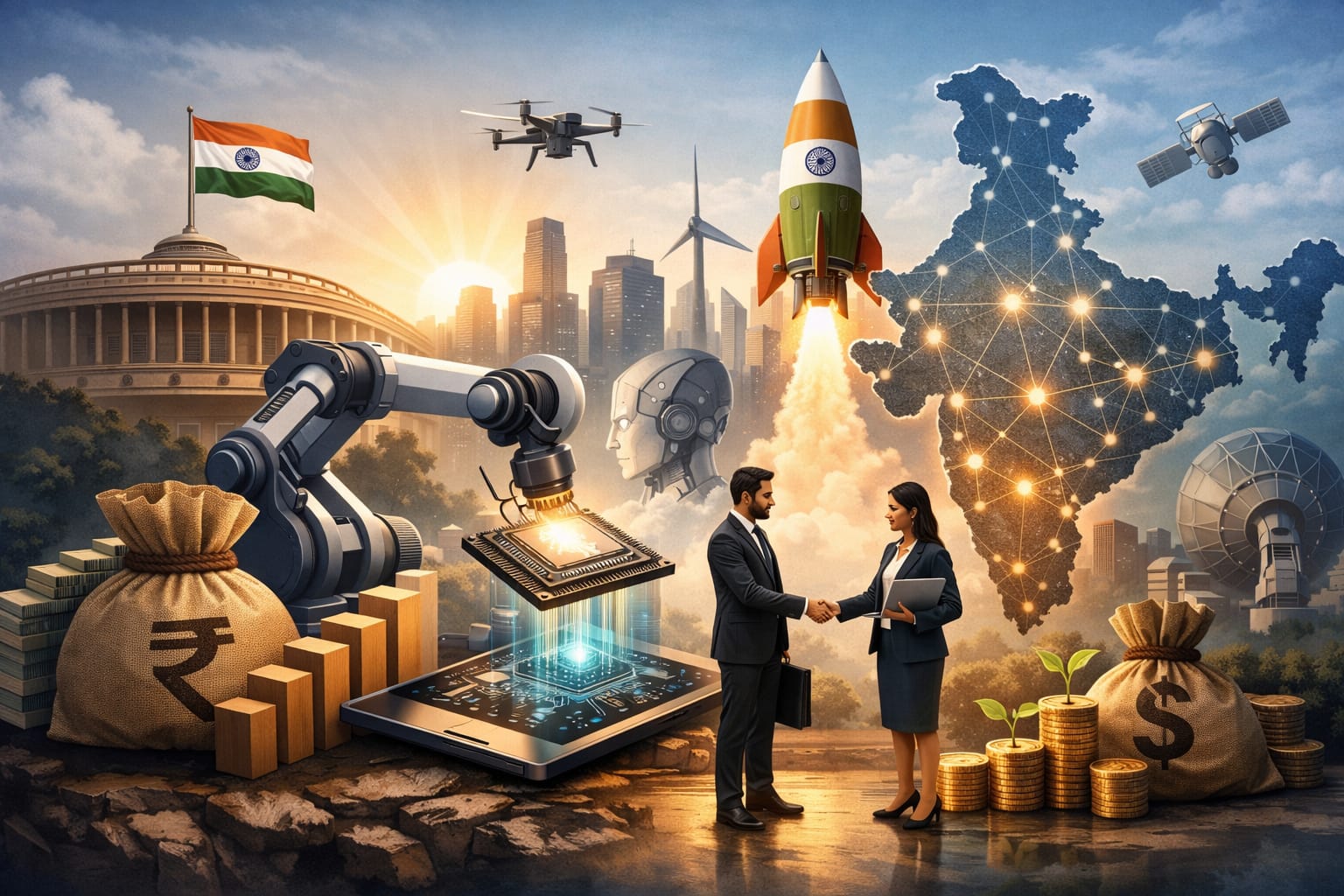
India and Japan are looking to take their startup relationship beyond conventional investment and market-access partnerships, with deep technology, advanced manufacturing, semiconductors and strategic industries emerging as the next big areas of cooperation.
The direction was outlined by Union Minister of Commerce and Industry Piyush Goyal at the India–Japan Startup Roundtable in Tokyo, where he positioned India’s expanding startup ecosystem as an increasingly important partner for Japanese capital, technology and manufacturing capabilities.
From scale to strategic depth
India has emerged as the world’s third-largest startup ecosystem, with nearly 250,000 startups established over the past decade, according to the government. While the sheer size of the ecosystem provides scale, the more significant shift is its changing composition.
India’s startup landscape is increasingly moving beyond internet-led businesses and software services towards artificial intelligence, semiconductors, healthcare, aerospace, defence, robotics, drones, advanced manufacturing and other deep-tech areas.
This transition creates a stronger strategic fit with Japan, whose competitive strengths lie in precision engineering, advanced manufacturing, technology development, quality standards and long-term investment.
For India, the opportunity is not merely to attract Japanese capital. The larger objective is to integrate Indian startups into Japanese technology ecosystems and global supply chains.
Four pillars for the next phase
Goyal proposed a four-pillar framework that could give the relationship a more institutional structure.
The first is a Japan–India Deep-Tech Capital Corridor, aimed at mobilising patient capital for early-stage research, deep-tech innovation and commercialisation. This addresses one of the biggest funding challenges facing deep-tech startups, where development cycles are considerably longer than those of conventional technology businesses.
The second is a Two-Way Innovation Bridge connecting universities, incubators, R&D institutions, laboratories and testing facilities in both countries. Such linkages could help startups move faster from laboratory-level innovation to commercially viable products.
The third focuses on manufacturing and technology integration. India brings scale, engineering talent, digital capabilities and entrepreneurial speed, while Japan contributes precision manufacturing, technology expertise and established quality systems.
The fourth involves joint startup pitching platforms, providing a regular mechanism for Indian founders to engage with Japanese corporations, venture funds and strategic investors.
Together, these pillars suggest a shift from episodic business meetings to a more continuous innovation pipeline.
The funding equation
The proposed second Fund of Funds of around US$1 billion could become another important component of this ecosystem, particularly if a significant portion of the capital is directed towards deep-tech enterprises.
The challenge, however, is not simply the availability of capital. Deep-tech companies need investors willing to support lengthy product-development cycles, regulatory approvals, testing and commercialisation.
This is where Japanese investors could have a distinctive role to play. Japan’s long-term industrial orientation and corporate ecosystem could complement India’s relatively faster startup formation and scaling capabilities.
Greater Japanese participation in India’s deep-tech funding ecosystem could therefore help bridge the gap between innovation and industrial deployment.
Japan gets access to India’s scale
For Japanese companies, the attraction is equally compelling.
India offers a large domestic market, a deep STEM talent pool and digital public infrastructure that can provide startups with the ability to develop and test solutions at scale.
JICA Senior Vice President Shohei Hara’s emphasis on a two-way partnership is significant in this context. Japan can bring technology and industrial expertise to India while Japanese companies can learn from Indian startups that have developed scalable solutions to complex social and developmental challenges.
This makes India more than a destination market. It can increasingly serve as an innovation and product-development base for Japanese companies seeking growth in India and other emerging markets.
From pitching to supply chains
The India–Japan Pitching Series has already connected 65 Indian startups with around 100 Japanese corporations and facilitated more than 30 business tie-ups.
The next challenge is to convert such interactions into deeper commercial relationships.
The participation of around 40 leading Japanese companies at the Tokyo roundtable indicates that corporate interest is broadening. For startups, the potential value of these relationships extends beyond equity investment to technology validation, precision manufacturing, market access and integration into Japanese and global supply chains.
This is particularly relevant for sectors such as aerospace, defence, mobility, healthcare, robotics and industrial automation, where startups require access to sophisticated manufacturing and testing capabilities to scale.
MSMEs could be the missing link
An important dimension of the discussions was the integration of MSMEs with startups and global supply chains.
India’s startup ecosystem can generate new technologies and business models, but large-scale industrialisation requires a wider manufacturing base. MSMEs can potentially provide that bridge by becoming suppliers, manufacturing partners and technology adopters.
Providing plug-and-play infrastructure to companies looking to manufacture and expand in India could further reduce the time and cost involved in moving from innovation to production.
For Japan, this could open opportunities to combine its technology and manufacturing systems with India’s extensive supplier network.