


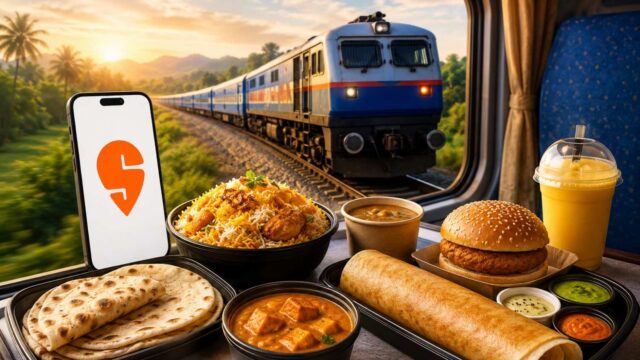
Swiggy, the on-demand convenience platform, has reported a 12-fold growth in its Food on Train offering over the last two years, from August 2024 to August 2026, as online food ordering gains traction among railway travellers.
The company said adoption in tier-2 and tier-3 markets is growing twice as fast as in metro cities, highlighting the expanding demand for food delivery beyond India’s major urban centres.
Swiggy has also significantly expanded its Food on Train network, increasing the number of stations served to 201 from 66 in 2024. Newly added stations include Kolhapur, Wardha, Shahdol, Kakinada, Bharatpur, Chittoor, Thanjavur, Raigarh, Jamnagar, Indore and Tundla.
The Food on Train service was launched in March 2024 to enable passengers to order meals from restaurants and have them delivered directly to their seats at designated railway stations.
New features
Swiggy has introduced two new product features aimed at making food ordering during train journeys faster and more convenient.
The ‘Search by Train’ feature allows passengers to enter their train number or train name and instantly view food options mapped to their specific route and schedule, eliminating the need to search through restaurants manually.
The company has also introduced the ‘99 Store Widget’, a dedicated section within the Swiggy app that enables passengers to quickly access budget-friendly meal options.
Business catches up
Swiggy, Chief Business Officer, Sidharth Bhakoo, said, “Over the years, online food delivery has evolved from being used during special occasions to serving a wider set of use cases. We are seeing consumers increasingly embrace convenience across diverse moments. Food on Train is a strong example of how technology is creating entirely new consumption occasions, with travellers not only planning meals around their journeys, but also using the opportunity to discover regional favourites along the way.”
He added that Food on Train has recorded multifold growth since its launch and has seen adoption across different consumer cohorts, including Gen Z.
“We are also seeing a huge opportunity for our affordability offerings and have launched a special widget for 99 Store. As consumer behaviours evolve, the opportunity for the food ecosystem lies in making every consumption moment more convenient, accessible and relevant to the consumer,” Bhakoo said.
Regional flavours drive orders
Swiggy’s data also points to a shift in the food preferences of railway passengers, with travellers increasingly opting for traditional, regional and refreshing food and beverages.
Compared with last year, orders for lassi have risen 60%, while buttermilk orders have increased 40%. Mojito orders have jumped 90%, even as demand for standard carbonated drinks has declined considerably.
Traditional full meals are also gaining prominence, with thalis accounting for more than 65% of all Food on Train orders.
Sweet demand surges
Demand for sweets has risen sharply as well, with orders increasing 110%, led by rasgullas.
Passengers are increasingly using train journeys to explore regional cuisines, ordering popular local specialities from stations along their routes.
At Jaipur Junction, pyaz kachori is the top-selling item, while poha features among the top-10 breakfast choices in Bhopal. Local biryani variants dominate orders at several stations across South and Central India and also rank prominently in Lucknow, alongside Tunday Galouti Kebabs.
In Nagpur, Haldiram’s thalis lead station-level orders, while local seafood thalis feature among the top choices at Madgaon in Goa.
The trends underline how food delivery on trains is evolving from a convenience service into an avenue for passengers to discover regional food while travelling, while also creating new opportunities for Swiggy in smaller cities and emerging markets.