

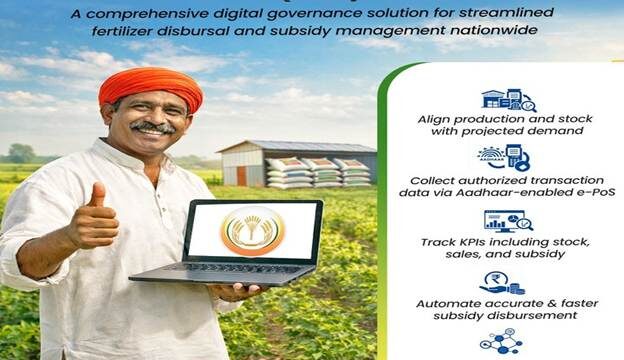
India’s Integrated Fertilizer Management System (iFMS) is evolving from a transaction-monitoring platform into a wider digital decision-support system, with new initiatives aimed at improving fertilizer availability, supply-chain transparency and data-driven monitoring.
Developed and technically supported by the National Informatics Centre (NIC) for the Department of Fertilizers, iFMS connects key stages of the fertilizer ecosystem, covering production, imports, movement, stocks, retail sales and subsidy processing.
The platform currently covers more than 14 crore Aadhaar-linked fertilizer buyers, over 2.5 lakh retailers and around 7 crore metric tonnes of fertilizer sales annually. It also supports administration of fertilizer subsidies of nearly ₹2 lakh crore a year.
From transactions to intelligence
The Department of Fertilizers has expanded iFMS beyond recording transactions by adding dashboards and analytical tools that provide a consolidated view of production, imports, dispatches, movement, stocks and retail sales.
The system enables monitoring at the national, State, district and retailer levels, helping officials identify unusual trends and potential supply situations at an early stage.
The large volume of transaction data is also being analysed across buyer categories, landholdings, crops, districts and fertilizer types. This is helping shift the focus from tracking individual sales to understanding consumption patterns and improving decision-making.
Linking fertilizer demand to farm data
Another major development is the integration of iFMS with farmer, land and crop databases maintained by States and other government platforms.
Integration with Meri Fasal Mera Byora (MFMB) in Haryana and subsequent work towards AgriStack has enabled mechanisms to link fertilizer purchases with farmer and land records.
The experience has highlighted both the potential and challenges of combining fertilizer transactions with agricultural data, including issues around the availability, completeness and quality of land and crop information.
Booking layer adds verification
The Framework for Fertilizer Sale (FFS) builds on this experience by integrating a mobile app-based fertilizer booking system with the existing iFMS Point of Sale (PoS) network.
Under the framework, farmers can book fertilizer based on an AgriStack ID after verification of land and ownership details. A QR-based booking is generated and accessed at the PoS device, enabling verification between the fertilizer requirement and the quantity ultimately purchased.
The phased implementation is enabling the Department and participating States to study booking behaviour, fertilizer consumption and operational issues.
The framework also enables analysis of fertilizer use per hectare, consumption across landholding categories, product- and crop-wise usage, and the gap between booked and actually purchased quantities.
Tracking fertilizer on the move
Digital monitoring of fertilizer logistics has also been strengthened through the Vehicle Location Tracking System (VLTS).
By linking dispatch information with vehicle-location data, VLTS provides greater visibility into consignments in transit and can help identify delays or unusual movement patterns.
Combined with dispatch, goods-in-transit and stock information available through iFMS, vehicle tracking provides a more complete view of fertilizer movement from dispatch to destination.
Digital subsidy processing
iFMS continues to support fertilizer subsidy administration, with payments linked to actual sales recorded through the PoS network.
Further work undertaken from January 1, 2026 towards electronic processing of subsidy bills and integration with financial systems, including PFMS/e-Bill processes, is aimed at reducing manual intervention and improving traceability.
Random verification and analytical checks are also being introduced to strengthen scrutiny of DBT-related bills and transactions.
The evolution of iFMS represents a shift towards an integrated digital ecosystem connecting production, imports, logistics, stocks, farmer and land data, fertilizer booking, retail transactions and subsidy payments.
The objective is to give policymakers a more comprehensive and timely view of fertilizer demand, movement and availability while strengthening transparency across the supply chain.