


By Venkatachari Jagannathan
Natural rubber prices have risen sharply in India this year, with RSS-4 at Kottayam touching around ₹274 per kg on September 2, 2026, compared with an average of about ₹192 per kg in January.
The surge has put pressure on rubber manufacturers, particularly micro, small and medium enterprises (MSMEs), even as India continues to face a substantial gap between domestic production and consumption.
Yet the industry’s challenge is not merely about managing higher raw-material costs.
With demand rising across automobiles, electric vehicles, railways, defence, infrastructure, healthcare, electronics and aerospace, India has an opportunity to emerge as a major global manufacturing base for value-added rubber and elastomer products.
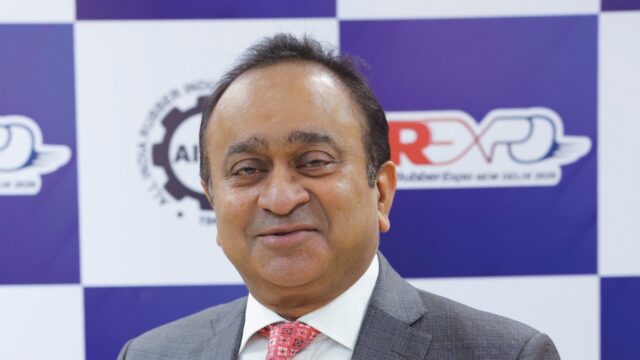
In this interview, Anay Gupta, President, All India Rubber Industries Association (AIRIA), discusses the price outlook, raw-material security, the pressures facing manufacturers and exporters, and how India can use the next two to three years to scale up its rubber industry. Excerpts:
Natural rubber prices have remained elevated in 2026. What are the key factors driving the current price trend, and how are manufacturers coping?
Natural rubber prices today are being influenced by much more than domestic production alone. Weather-related interruptions in the major producing countries, seasonal tapping patterns, freight and currency movements, geopolitical uncertainty and steady downstream demand are all playing a part.
The domestic market has strengthened considerably during 2026. Rubber Board data showed Ribbed Smoked Sheet-4 (RSS-4) at Kottayam (in Kerala) at around ₹274 per kg on September 2, 2026, while Ribbed Smoked Sheet-5 (RSS-5) was around ₹270 per kg. For comparison, the average domestic RSS-4 price was about ₹192 per kg in January and ₹212 per kg in February 2026. So, manufacturers have seen a very sharp escalation within a relatively short period.
The global market is also not loose. Association of Natural Rubber Producing Countries (ANRPC) currently expects world natural rubber production of about 15.28 million tonnes in 2026 against projected consumption of about 15.36 million tonnes. That is a fairly balanced market with very little room for major supply shocks.
Large manufacturers can partly manage this through inventory planning, long-term sourcing and product-mix changes. The difficulty is much greater for smaller non-tyre manufacturers. They often purchase in smaller lots, have limited working capital and cannot revise selling prices every time raw-material prices move. Their ability to absorb volatility is therefore quite limited.
India continues to depend on imports to bridge the gap between domestic production and consumption. What can be done to strengthen domestic rubber supply?
The gap is structural, although domestic production is improving. Natural rubber production increased from 8.75 lakh tonnes in 2024–25 to about 9.05 lakh tonnes in 2025–26, a growth of 3.4%. Consumption, however, increased from 14.10 lakh tonnes to about 14.27 lakh tonnes. This still leaves a production-consumption gap of roughly 5.22 lakh tonnes.
There are two answers to this. One is to bring new areas into production; the second, equally important, is to increase output from plantations that already exist.
The development taking place in the Northeast is significant. Under Project INROAD, 1,79,376 hectares of new rubber plantations have already been established across 113 districts, benefiting more than 2.07 lakh growers. These plantations will become increasingly important as the trees mature.
At the same time, India should focus strongly on productivity, scientific tapping, rain guarding, better planting material, mechanisation where feasible, and bringing untapped or irregularly tapped plantations back into economic use. Increasing acreage is important, but improving yield per hectare will give faster results in several established growing regions.
Rising costs of natural and synthetic rubber, energy and other inputs are putting pressure on MSMEs. How serious is the impact?
For many MSMEs, the issue is no longer one input becoming expensive; several costs are moving together.
Rubber itself is expensive, synthetic rubber and chemical costs remain sensitive to petroleum prices and international freight, power and labour costs have increased, and working-capital requirements rise automatically when inventory becomes more expensive.
The impact is particularly severe in general rubber goods—hoses, seals, moulded components, belting, industrial products, rubber-to-metal products and numerous specialised components—where thousands of manufacturers work on negotiated prices or annual supply contracts.
This is important because growth within the rubber sector is no longer coming only from tyres. Rubber Board data for April 2025–January 2026 showed general rubber goods consumption of natural rubber rising strongly even while the auto-tyre segment recorded a decline in natural rubber consumption over the corresponding period.
For an MSME supplying an Original Equipment Manufacturer (OEM), a 10% or 15% movement in raw-material costs cannot automatically be passed on to the customer. The result is margin compression and pressure on cash flow, rather than necessarily an immediate fall in production.
Global supply disruptions and geopolitical tensions are adding uncertainty to raw-material availability. How can India build a more resilient rubber supply chain?
Resilience comes from avoiding dependence on any one source, one country or one form of material.
India must first raise domestic production, but imports will remain necessary for some time. Therefore, manufacturers also need access to diversified overseas sourcing, efficient ports, adequate storage and predictable trade policy.
There is another issue which requires attention. Direct natural-rubber imports actually fell by about 16.7% in 2025–26 to approximately 4.59 lakh tonnes from 5.51 lakh tonnes in the previous year. However, imports of compounded rubber increased sharply from about 2.45 lakh tonnes to 3.49 lakh tonnes.
That shift deserves policy examination because the objective should be to encourage genuine value addition in India without creating an unintended distortion between domestic rubber, natural-rubber imports and compounded-rubber imports.
Over the longer term, domestic natural rubber, synthetic rubber, reclaimed rubber and circular-material streams all need to be viewed together as part of India’s strategic raw-material security
How are current raw-material costs affecting the competitiveness of Indian rubber-product exporters?
Indian manufacturers have demonstrated that they can compete globally on quality. The concern now is increasingly about cost.
Tyre exports provide a useful indicator. India’s tyre exports reached a record ₹27,312 crore in financial year (FY) 2025–26, up around 9% from ₹25,057 crore in the previous year. In the first quarter (Q1) of FY 2026–27, tyre exports reportedly grew another 16% to about ₹7,700 crore.
That is a strong performance and shows the credibility Indian-made products have built internationally. But one should not assume that the entire rubber industry has the same ability to absorb input costs as large tyre manufacturers.
Non-tyre exporters are often much smaller and compete against manufacturers from Thailand, China, Vietnam, Malaysia and other Asian economies. A few percentage points in raw-material, freight or energy costs can decide whether an Indian supplier wins or loses an export order.
Therefore, export competitiveness today is not simply about exchange rates or labour costs. Reliable raw-material availability at internationally competitive prices has become equally important.
What policy measures should the government consider to support manufacturers while ensuring sustainable returns for rubber growers?
Grower viability and manufacturing competitiveness should not be treated as opposing objectives. India needs both.
A farmer will continue tapping and investing in plantations only when rubber cultivation provides a reasonable return. At the same time, downstream manufacturers cannot remain competitive if domestic raw materials are structurally far above comparable international prices.
Policy should therefore concentrate on increasing supply rather than artificially suppressing prices. Productivity improvement, replanting support, rain guarding, better clones, tapping support, farmer aggregation and development of the Northeast can raise grower income through higher output.
For manufacturers, there is a need to examine the duty structure and import treatment across natural rubber, compounded rubber and important rubber chemicals so that one part of the value chain is not unintentionally disadvantaged.
We would also favour stronger testing infrastructure, technology support, common facilities and export assistance for MSMEs. The objective must be simple: farmers should earn more because they produce more efficiently, while manufacturers should become competitive because India has a deeper and more reliable raw-material base.
With automotive, tyre and industrial demand continuing to grow, do you expect rubber prices to remain elevated in the coming months?
We should expect prices to remain firm and volatile rather than assume a straight-line increase.
ANRPC’s latest July 2026 outlook projects global production growth of around 2.1% for the year, but global demand is still expected to remain marginally higher than production. In July itself, global production was estimated to be more than 5% lower year-on-year, while consumption increased.
India is also entering this period with strong automotive, mobility and industrial demand and a sizeable domestic supply deficit.
There may be corrections when seasonal production improves or international prices soften. We have already seen different rubber grades moving in different directions internationally. But unless supply improves substantially, we do not expect the market to return quickly to the much lower price environment seen in earlier years.
Manufacturers should therefore plan for volatility rather than plan their businesses around a particular price point.
Looking ahead, what are the biggest opportunities and challenges for India’s rubber industry over the next 2–3 years?
The opportunity is much larger than the current discussion about raw-material prices.
India is building demand across automobiles, electric vehicles (EVs), railways, defence, infrastructure, healthcare, construction, electronics, aerospace and a wide range of industrial applications. Each of these sectors consumes increasingly specialised rubber and elastomer products.
India also has a real opportunity to become a stronger global manufacturing base. The export performance of the tyre sector shows what is possible when capacity, technology, quality and international market development come together.
The next opportunity is in value-added non-tyre products, where India has a very broad MSME manufacturing base. Many of these companies already possess strong technical capability but need support in automation, testing, international certification, product development and market access.
The challenges are equally clear: the domestic raw-material gap, volatile input prices, availability of specialised grades, technology adoption, environmental compliance and growing international traceability requirements.
For AIRIA, the priority is therefore not merely to seek short-term relief whenever prices rise. The bigger task is to help build an industry which has secure raw materials, competitive manufacturing, technically stronger MSMEs and a much larger presence in global markets. If India gets these fundamentals right, the next few years can be a period of genuine scale-up for the rubber industry.
(Venkatachari Jagannathan can be reached at venkatacharijagannathan@gmail.com)