


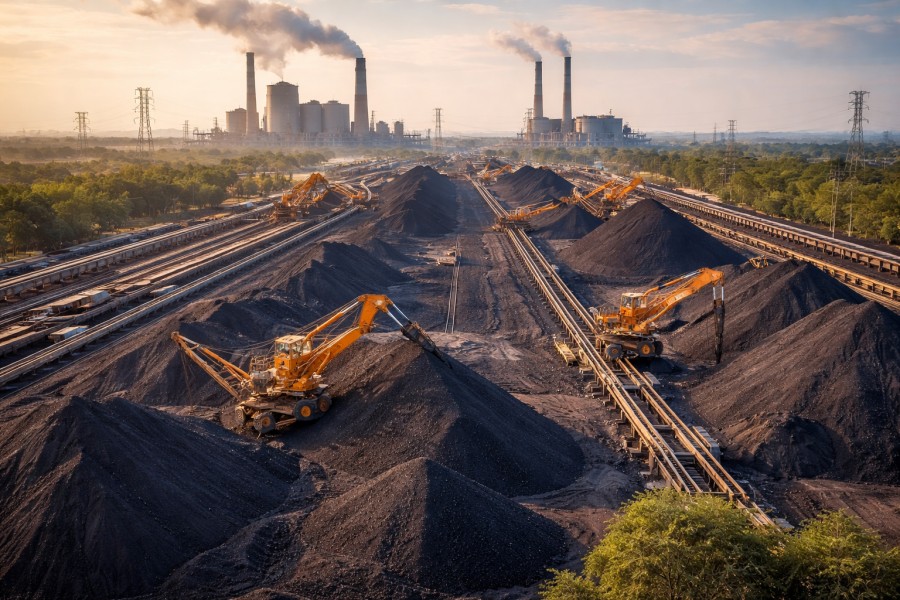
India’s commercial coal mine auction regime has emerged as a major structural reform in the mining sector, with 147 coal blocks auctioned across nine states since the policy was launched in 2020 and 44 new companies entering coal mining.
The commercial coal mine auction process, launched by Prime Minister Narendra Modi on June 18, 2020, was designed to replace the earlier allocation-based approach with a transparent, rules-based mechanism.
The reform followed the Supreme Court’s cancellation of 204 coal blocks in 2014, after which the government moved towards an auction-led system for coal block allocation.
Technology-driven transparent bidding
The commercial coal mine auctions are conducted online in two stages through the MSTC platform. Bid documents are decrypted and opened live in the presence of bidders, providing greater transparency to the allocation process.
The regime also removed end-use restrictions, allowing successful bidders greater flexibility in the utilisation of coal.
The policy permits 100% foreign direct investment through the automatic route, while upfront payments have been kept relatively low and can be adjusted against future revenue-share payments.
The structure has been aimed at keeping the sector accessible to newer and smaller participants while encouraging wider investment.
Private and government miners compete
The auction mechanism has attracted private-sector participants as well as established public-sector coal companies.
Coal India subsidiaries Western Coalfields Limited (WCL) and Northern Coalfields Limited (NCL), which traditionally operated as coal producers and sellers, have participated as bidders in recent auction rounds.
Their participation means government-owned miners are competing for coal blocks on the same auction platform and terms as private companies.
States stand to gain from multiple revenue streams
The auction system has created several revenue streams for coal-bearing states.
These include the competitively bid revenue share, statutory royalty, contributions to the District Mineral Foundation (DMF), contributions to the National Mineral Exploration Trust (NMET) and GST.
According to the government, the 147 coal blocks auctioned since 2020 are projected to generate approximately ₹47,500 crore in annual revenue, alongside around ₹55,000 crore in capital investment and 4.9 lakh jobs.
In FY2025-26, revenue generated from upfront and premium payments from allocated commercial mines stood at about ₹3,090 crore.
The revenue-share mechanism is significant because states receive the competitively bid share in addition to statutory royalty and other applicable payments.
Commercial coal production nearly doubles
The auction regime has also coincided with a sharp increase in commercial coal production.
Coal output from commercial mines increased from 12.55 million tonnes in FY2023-24 to 23.51 million tonnes in FY2024-25.
When captive and commercial coal blocks are combined, production reached around 210 million tonnes in FY2025-26, crossing the 200-million-tonne mark for the first time.
A decade earlier, captive and commercial blocks together produced just 28.8 million tonnes.
This represents a compound annual growth rate of around 22% over the period, according to the government.
Cutting import dependence
The rise in domestic coal production has a direct bearing on India’s energy security.
Every additional tonne of coal produced domestically reduces the requirement for imports, supporting the government’s broader Aatmanirbhar Bharat objective.
Higher domestic production also provides greater certainty of supply for industries and power generation, while generating economic activity and employment in coal-bearing regions.
A win-win for industry and states
Six years after the launch of commercial coal mine auctions, the government views the policy as a model combining transparency, technology and revenue sharing.
The auction process has widened participation, including the entry of new companies, while allowing established public-sector miners to compete alongside private players.
For states, the combination of revenue share, royalty, DMF, NMET and GST creates multiple fiscal benefits. For mining companies, the removal of end-use restrictions and a transparent bidding mechanism provide greater flexibility and predictability.
For local communities, the flow of DMF resources and employment generated by mining activity adds another dimension to the economic impact.
The government’s assessment is that the combination of transparent technology-enabled auctions, a level playing field and a multi-layered revenue-sharing model has strengthened the coal sector while supporting India’s energy security and push towards greater self-reliance.