


India’s data centre industry is entering a high-growth phase, with installed capacity rising from around 375 MW in 2020 to 1.57 GW as of August 2026, driven by the rapid expansion of digital services, cloud computing, digital payments and emerging technologies such as artificial intelligence.
The capacity is projected to increase further to nearly 8 GW by 2030, highlighting the growing importance of data centres as critical infrastructure for India’s digital economy.
Investments of nearly $70 billion are already underway in the sector, while another $90 billion worth of projects have been announced. The scale of investments reflects growing demand for computing capacity, data storage and high-speed connectivity as businesses and government services become increasingly digital.
Why data centres matter
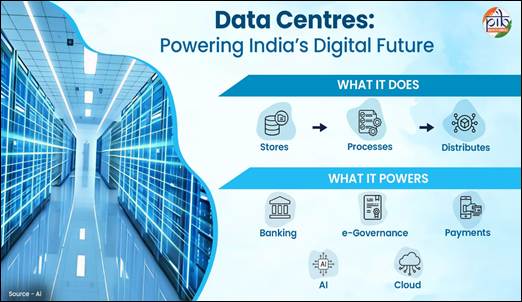
A data centre is a secure facility that houses computing, storage and networking equipment used to store, process, manage and distribute large volumes of digital information.
From online banking and digital payments to e-Governance, cloud computing and AI applications, a growing number of everyday services depend on data centres operating continuously.
Modern facilities bring together servers, storage systems, networking equipment, power infrastructure, cooling systems, security and management software to ensure reliable and secure operations.
As digitalisation reshapes productivity, competitiveness and service delivery across sectors, resilient data centres are increasingly becoming strategic infrastructure for the economy.
Power and cooling keep data centres running
Continuous availability is fundamental to a data centre. Computing equipment must remain operational without interruption, making reliable power infrastructure a critical requirement.
Uninterruptible Power Supplies (UPS) provide immediate backup when there is an electrical interruption, while generators and electrical distribution systems provide additional resilience during longer power disruptions.
Cooling is equally important because computing equipment generates substantial heat during continuous operation. HVAC systems regulate temperature and airflow, while advanced airflow management and liquid-cooling technologies can improve thermal efficiency and reliability.
Servers, storage and networks do the heavy lifting
The IT infrastructure inside a data centre performs the core computing functions.
Servers process information and run applications, while storage systems hold large volumes of data through technologies such as Hard Disk Drives (HDDs) and Solid-State Drives (SSDs).
Networking equipment, including high-speed switches and routers, enables data to move within the facility and between the data centre and external networks. Fibre-optic connections provide high-speed communication with other networks and users.
Security systems protect both the physical infrastructure and digital assets from a range of threats.
Virtualisation improves resource utilisation
Management software plays a key role in monitoring and optimising the use of computing resources.
Virtualisation allows several virtual machines to operate on a single physical server, improving resource utilisation. In simple terms, it is similar to dividing one large house into several independent apartments, with each virtual machine operating as a separate computing environment.
Automation tools can manage workloads, support maintenance and identify operational problems, helping data centres operate efficiently at scale.
What happens when you open an app?
A simple action such as checking a bank balance, opening an app or accessing a document can trigger a complex sequence of processes inside a data centre.
The request first passes through a security layer, which checks the request and helps protect the system from cyber threats.
A load balancer then directs the request to an available server, distributing workloads across the infrastructure.
The application server processes the request and determines what information or service is required. Where necessary, it communicates with other applications or services through an Application Programming Interface (API).
The database server retrieves the required information and sends it back to the application server. The processed information then travels through the network and reaches the user’s device.
The entire process can take just 1–2 seconds, creating the seamless experience users have come to expect from digital services.
Government data centres support e-Governance
India’s data-centre journey has evolved alongside the expansion of e-Governance and digital public services.
The National Informatics Centre (NIC) has established National Data Centres at Delhi, Pune, Hyderabad and Bhubaneswar, along with 37 smaller data centres at various State capitals.
These facilities provide digital infrastructure for government institutions at different levels, supporting round-the-clock operations, system management and on-site technical expertise.
As citizen demand for online government services rises, the need for reliable, secure and scalable government data infrastructure is also increasing.
Policy support strengthens the sector
The government has introduced policy measures aimed at strengthening India’s data-centre ecosystem.
A significant step came in the Union Budget 2022–23, when data centres were included in the Harmonised List of Infrastructure.
The infrastructure status has facilitated greater access to credit for data-centre projects and supported investment in the expansion of digital infrastructure.
AI adds a new layer of demand
The rapid adoption of artificial intelligence is expected to further increase demand for data-centre capacity. AI workloads require substantial computing power, high-speed networking and large-scale data storage.
At the same time, the growth of cloud services, digital payments, connected devices, online commerce and e-Governance is creating a broader and more persistent requirement for computing infrastructure.
With capacity rising from 1.57 GW in August 2026 towards a projected nearly 8 GW by 2030, India’s data-centre expansion is emerging as a key component of the country’s broader digital infrastructure build-out.
The combination of rising digital consumption, AI adoption, government policy support and large-scale investment is positioning data centres as one of the critical infrastructure segments underpinning India’s next phase of digital growth.