


Researchers at Indian Institute of Technology Madras (IIT Madras) have developed an integrated framework to assess the impact of climate change on India’s coastal regions and identify adaptation measures for protecting critical infrastructure, ecosystems and vulnerable communities.
The framework brings together climate science, coastal engineering, water resources and environmental engineering to assess risks from cyclones, storm surges, coastal flooding, shoreline erosion, sea-level rise and extreme rainfall.
Mapping risks along the coast
India’s coastline supports major ports, fishing harbours, power plants, industrial facilities and densely populated urban settlements. Increasing climate variability and extreme weather events are adding to the risks faced by this infrastructure and the communities dependent on coastal ecosystems.
The research is being carried out through IIT Madras’ Centre of Excellence on Climate Change Impacts on Coastal Infrastructure and Adaptation Strategies, supported by the Department of Science and Technology (DST).
The Centre has developed climate, cyclone, storm-surge, wave, hydrodynamic and morphodynamic models specifically tailored to Indian coastal conditions.
One of its key technical developments is a novel wind-merging technique designed to improve storm-surge predictions. The researchers have also undertaken flood-inundation modelling and mapping for Chennai, with applications in disaster preparedness and urban planning.
Vulnerability maps for Chennai and Karaikal
The Centre has produced Coastal Vulnerability Index (CVI) maps for Chennai, Ennore and Karaikal, incorporating the effects of sea-level rise and storm surges.
The researchers have also developed structural-health monitoring approaches to track climate-driven deterioration of port infrastructure and proposed climate-resilient reservoir management strategies for flood-prone urban areas.
Another area of study has been saltwater intrusion in coastal regions, with the Centre analysing different prevention and mitigation measures to protect freshwater resources.
Focus on water and environmental resilience
The Centre’s work extends beyond physical infrastructure to water and environmental sustainability.
Researchers have developed climate-resilient wastewater treatment solutions, including a patented in-stream wastewater treatment method. They have also introduced the BASIEC framework, aimed at supporting community-based adaptation to sea-level rise and other coastal hazards.
The approach seeks to connect changes in climate and cyclone behaviour with their downstream effects on flooding, infrastructure and communities, rather than treating individual hazards in isolation.
IIT Madras, Principal Investigator, Centre of Excellence on Climate Change Impacts on Coastal Infrastructure and Adaptation Strategies, and Faculty, Department of Ocean Engineering, Prof. S. A. Sannasiraj, said India’s coastline hosts critical infrastructure and supports millions of livelihoods, making climate resilience an urgent priority.
“Our Centre has adopted a systems-level approach that integrates climate modelling, engineering solutions and community adaptation to provide actionable strategies that can help reduce risks and improve preparedness across coastal regions,” Sannasiraj said.
Research combines modelling and field observations
IIT Madras, Centre Coordinator and Faculty, Department of Civil Engineering, Prof. B. S. Murty, said climate adaptation requires more than understanding individual hazards.
The Centre is developing solutions using advanced simulations, field observations and stakeholder engagement, with an emphasis on open-source tools and locally appropriate adaptation measures, Murty said.
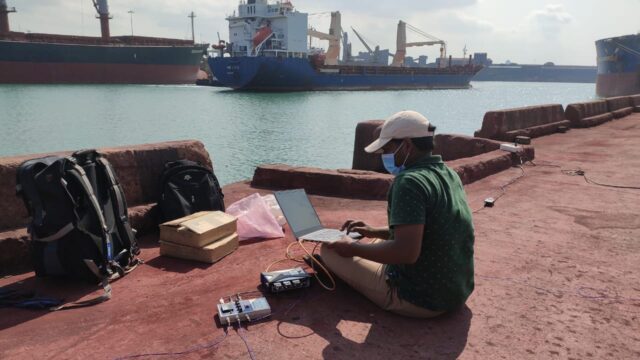
The research integrates field measurements, laboratory experiments and numerical simulations to develop solutions that can be applied to coastal planning and adaptation.
73 journal papers and one patent
The Centre brings together 15 Co-Principal Investigators from four IIT Madras departments and has generated substantial research output.
Its work so far includes 73 journal articles, six book chapters, one edited book, 60 conference papers and one patent.
The findings were presented at the IAHR World Congress 2025 in Singapore through a paper on climate-change impacts and adaptation strategies for coastal infrastructure, water and waste-management facilities.
A major output from the project is also an edited volume, Climate Change Impacts and Adaptation Strategies for Coastal Infrastructure, Water Resources, and Waste Management Along the Coasts, published by Springer Nature.
The researchers said the work could support protection of ports, fishing harbours, power plants and transport networks, while strengthening flood management in coastal cities, safeguarding groundwater resources and promoting nature-based approaches to coastal protection.