


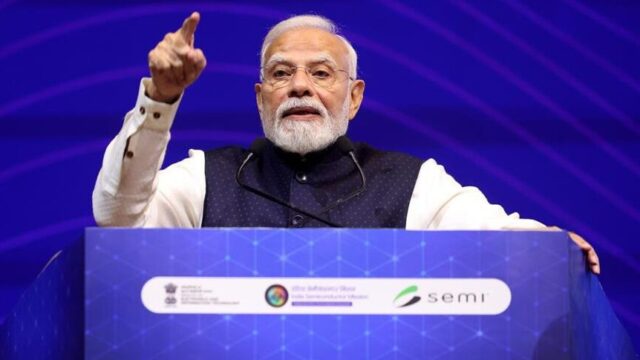
Prime Minister Narendra Modi has identified energy security as a major challenge for the global semiconductor industry as rising artificial intelligence (AI) adoption drives demand for computing power and electricity.
Speaking at the inauguration of SEMICON India 2026, Modi said AI data centres use thousands of high-performance processors to process large volumes of data. As AI expands, the demand for computing power and, consequently, electricity is expected to rise significantly.
Power infrastructure key to chip manufacturing
Modi said investment in the power sector is therefore critical for the semiconductor ecosystem, with manufacturing plants requiring reliable electricity in the required quantity and at the right time.
He highlighted India’s expansion in renewable and nuclear energy, saying installed solar capacity had increased from around 2 GW to more than 160 GW over the past decade. The government is also opening nuclear energy to private players and working on small modular reactors, while expanding the country’s transmission network.
According to Modi, the expansion of power infrastructure is strengthening India’s proposition as a destination for semiconductor manufacturing.
AI reshapes chip industry challenges
The Prime Minister said the semiconductor industry is now dealing with challenges beyond transistor size and chip-level computing efficiency.
He noted that the global semiconductor market has grown by more than 20% over the past two years, with a significant portion of the growth driven by AI demand.
The industry must now address issues such as bringing memory closer to processors, connecting multiple chips to function as a single system, moving large volumes of data with minimal latency, and managing heat and power consumption.
Modi said the emergence of these challenges increases the need for new and reliable manufacturing locations, adding that India is preparing to meet this requirement.
Semiconductor Mission enters second phase
Modi said India has started the second phase of its Semiconductor Mission, with an outlay of $13.5 billion, compared with about $8 billion for the first phase.
He said further reforms have enabled international companies to collaborate with Indian startups, design companies and OCI-owned companies.
The government is also seeking to expand India’s fabless semiconductor ecosystem and intellectual property creation, while developing capabilities in compound semiconductors, silicon photonics and AI infrastructure.
Supply chain and talent opportunities
Modi said India is strengthening semiconductor supply chains and urged companies involved in equipment, chemicals, gases and materials to tap the opportunities emerging from the expanding ecosystem.
So far, 12 semiconductor projects have been approved, with the government planning to expand the scope in the next phase.
He also highlighted India’s engineering talent pool, saying the country produces lakhs of engineers every year. The government has set a target of training one lakh engineering students for the semiconductor industry and has already trained more than 70,000 youth, according to Modi.
He said the combination of infrastructure, policy support, manufacturing opportunities and skilled manpower is aimed at building a broader semiconductor ecosystem in India.