


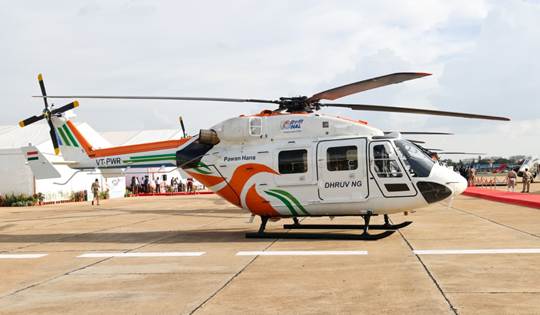
Hindustan Aeronautics Ltd (HAL) has handed over two LCA Tejas Final Operational Clearance (FOC) twin-seater trainers and three HTT-40 basic trainer aircraft to the Indian Air Force (IAF), along with four Dhruv Next Generation (NG) helicopters to Pawan Hans Ltd (PHL).
The handover took place in Bengaluru in the presence of Defence Minister Rajnath Singh and Civil Aviation Minister K Rammohan Naidu.
Tejas trainers complete FOC deliveries
The two Tejas twin-seater trainers are the final two aircraft under the FOC contract. The trainers will support IAF pilot training and provide an indigenous training platform aligned with frontline fighter operations.
HTT-40 strengthens basic pilot training
The three HTT-40 aircraft handed over to the IAF are indigenously designed and developed basic trainer aircraft. The platform is equipped for basic flying training, including aerobatics, general handling, instrument flying, navigation, night flying and close formation flying.
The HTT-40 programme is also intended to reduce dependence on imported aircraft for basic training requirements.
Dhruv NG enters civil operations
The four Dhruv NG helicopters handed over to Pawan Hans mark the platform’s induction into civil operations. The helicopters feature modern avionics and an upgraded powerplant and are intended for applications including passenger transport, emergency medical services and offshore logistics support.
HAL, CMD Ravi K, said the handover demonstrates the company’s capability to develop and deliver platforms for diverse defence and civil aviation requirements.
Focus on aerospace ecosystem
Rajnath Singh described the handover as a milestone in India’s efforts to develop indigenous aerospace capabilities. He called for greater public-private collaboration and development of capabilities spanning aircraft design, avionics, propulsion, composites, flight-control systems, manufacturing and certification.
Civil Aviation Minister K Rammohan Naidu said the certification and induction of Dhruv NG into civil operations marked an important milestone for India’s indigenous civil aviation ecosystem.
Singh also called for realistic project timelines to minimise delays, cost escalation and technology obsolescence, while urging greater investment in research and development and next-generation technologies including artificial intelligence, autonomous systems, unmanned aerial systems, electronic warfare, cyber technologies and advanced propulsion