


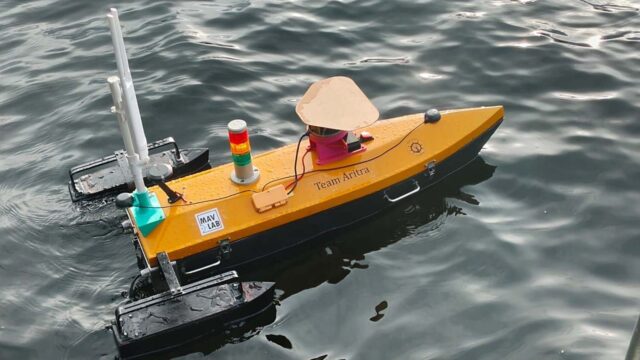
Students of the Department of Ocean Engineering at Indian Institute of Technology Madras (IIT Madras) have won the 2026 Njord Challenge, an international competition in Norway that tests autonomous surface vessels under real-world maritime conditions.
Team Aritra secured the overall championship at the competition held in Trondheim from August 10 to 14, finishing with 90.42 points. MYS YAVUZ from Türkiye scored 79.90 points, while AGH Solar Boat from Poland finished third with 79.63 points.
Team Aritra leads international competition
The victory marks another milestone for IIT Madras’ programme in marine autonomous systems. An earlier cohort of Team Aritra finished third globally and won the Sustainability Award at the 2023 edition of the competition.
The 2026 Njord Challenge, organised by the Norwegian University of Science and Technology (NTNU), brought together 23 teams and around 150 participants from nine countries — India, Türkiye, Norway, Poland, Canada, Japan, Spain, Croatia and Scotland.
The competition gave students an opportunity to develop and deploy autonomous vessels in realistic maritime conditions.
Real-world tests for autonomous vessels
The 2026 edition featured challenges including autonomous docking, collision avoidance, manoeuvring and pathfinding. Teams were also assessed on technical inspection, technical reporting and presentations.
A surprise autonomy challenge was introduced to test the teams’ ability to adapt their systems to an unfamiliar situation.
Extensive testing at the wave basin in IIT Madras’ Department of Ocean Engineering and the institute’s campus lake played an important role in Team Aritra’s preparations.
IIT Madras Director Prof. V. Kamakoti met Team Aritra after its victory and congratulated the students. He encouraged them to build on the achievement and take their work forward to ensure that their expertise contributes to the country.
Marine autonomy has multiple applications
Autonomous surface vessels have potential applications in coastal and harbour surveillance, monitoring of ports and strategic infrastructure, environmental and oceanographic data collection, hydrographic surveys and other persistent maritime operations.
Such systems can reduce the need for continuous human presence in certain operations, with potential benefits for safety and operational efficiency.
The team was mentored by IIT Madras Department of Ocean Engineering Associate Professor Dr. Abhilash Sharma Somayajula and Prof. M.A. Atmanand. Dr. Prabhakaran Jay and senior members of the Marine Autonomous Vessels (MAV) Laboratory also supported the students in the development, testing and deployment of the vessel.
Students combine perception, controls and navigation
Team Aritra was represented by Aarav Patel, S. Gurukesav and Madhava Sai, who led the development and deployment of the autonomous surface vessel.
IIT Madras, Faculty Advisor and Associate Professor, Department of Ocean Engineering, Dr. Abhilash Sharma Somayajula, said, “The success of Team Aritra is a testament to what students can achieve when they are given the freedom to explore, experiment and build.”
He said the Marine Autonomous Vessels Laboratory aims to build capabilities that India will require as marine autonomy becomes increasingly important, while providing students with an environment to explore marine robotics and tackle real engineering problems.
Competition exposes unexpected engineering challenges
The competition also tested the team beyond the challenges specified in advance.
Strong magnetic interference at the competition arena caused drift in the vessel’s Inertial Measurement Unit (IMU), affecting measurements used for autonomous navigation. The students had to identify and address the problem to maintain reliable localisation and navigation.
The team also encountered electromagnetic interference between the camera and GPS systems. This required the students to investigate interactions between sensors and electronics across the integrated vessel rather than treating the problem as an isolated software issue.
The experience highlighted the challenges involved in deploying autonomous marine systems in real-world environments, where imperfect sensors, physical disturbances and unexpected hardware-software interactions can affect performance.
Team credits months of preparation
IIT Madras, Team Aritra member, S. Gurukesav, said, “Winning first place was the goal from day one. Winning it by this margin is what makes it special.”
He said the team scored full points in the pathfinding and manoeuvring tasks and attributed the performance to months of fine-tuning perception, controls and navigation systems for real-world conditions on the fjord.
IIT Madras, Team Aritra member, Aarav Patel, said, “NJORD 26 had its share of highs and lows, but every challenge taught us something and pushed us forward.”
He said the team hoped its journey would encourage people to pursue unconventional ideas and remain committed to areas they believe are worth exploring.
The 2026 Njord Challenge victory adds to IIT Madras’ work in marine autonomous systems and highlights the role of student-led engineering projects in developing technologies for future maritime applications.