


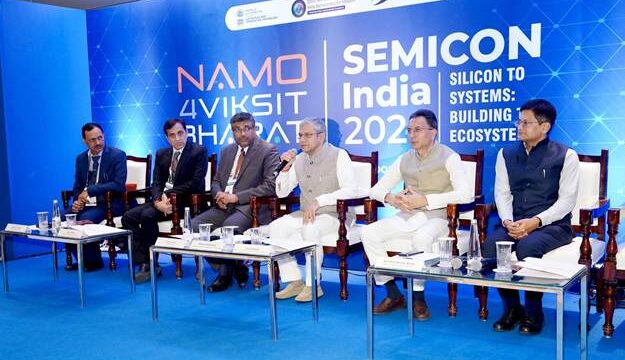
India’s semiconductor ecosystem is attracting growing interest from global companies, with the second day of SEMICON India 2026 witnessing 25 announcements and collaborations spanning semiconductor manufacturing, materials, logistics, chip design, advanced packaging, power electronics and workforce development.
The three-day event, being held at Yashobhoomi in New Delhi until September 19, has brought together more than 600 companies, including around 300 international exhibitors. Nearly 12,000 visitors attended the first day, with industry participants accounting for the bulk of the footfall.
Global participation rises
Union Minister for Electronics and IT Ashwini Vaishnaw said participation was higher on the second day, with strong business-to-business engagement and several agreements being concluded during meetings.
Country roundtables also saw significant participation, with more than 30 companies each from Japan and Singapore represented in their respective pavilions. Companies from South Korea and European countries including Belgium, the Netherlands and Sweden also participated.
Vaishnaw said the participation reflected increasing global interest in expanding semiconductor-related activities in India. He also highlighted investment interest emerging from the event, with industry leaders indicating their willingness to scale up investments based on their ability to execute projects.
Semiconductor supply chain gets focus
Supply-chain localisation emerged as an important theme, with the India Semiconductor Mission signing an MoU with Nippon Express.
Under the partnership, Nippon Express will provide expertise in logistics, warehousing, customs and related supply-chain requirements as India’s semiconductor ecosystem expands.
Vaishnaw also highlighted opportunities for Indian entrepreneurs, stressing that semiconductor companies would need to compete globally on cost and quality while considering manufacturability, product life cycle and power consumption.
India unveils indigenous System-on-Module
A key announcement on Day 2 was the launch of India’s first indigenous System-on-Module, the ISC VegaSOM, developed by IndieSemiC.
The module integrates C-DAC’s Vega-Thejas32 processor with IndieSemiC’s globally certified LoRa-RF module. Developed under C-DAC’s Industry Support Centre initiative, the product represents progress in translating indigenous chip-design capabilities into commercial products.
The development also demonstrates the role of the Design Linked Incentive (DLI) programme in supporting Indian design companies in moving from innovation towards product commercialisation.
Sustainability gains importance
Sustainability also featured prominently at the event, with the government highlighting resource-efficient technologies being adopted as semiconductor and technology infrastructure expands.
Semiconductor fabs are increasingly using extensive water-recycling systems, while data centres are adopting closed-loop cooling systems to improve resource efficiency.
The 25 announcements and collaborations on Day 2 underline activity across multiple segments of the semiconductor value chain, ranging from manufacturing and advanced packaging to logistics, skills, deep-tech investment and product development.
SEMICON India 2026 is expected to attract around 50,000 visitors, with participation from 52 countries, more than 400 executives and over 150 speakers. The exhibition includes six country pavilions representing Japan, South Korea, Malaysia, the Netherlands, Singapore and Sweden, besides 12 state booths, a Startup Pavilion, Innovation Showcase, Student Hackathon and Workforce Development Pavilion.