


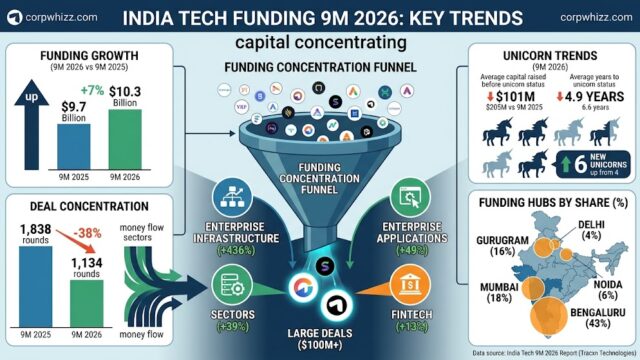
India’s technology companies raised a combined $10.3 billion in the first nine months of 2026, up 7% from $9.7 billion in the same period a year earlier, even as the number of funding rounds and first-time funded companies fell sharply.
The funding was also 3% higher than the $10 billion raised in 9M 2024, according to the India Tech 9M 2026 Report released by Tracxn Technologies, a data intelligence platform.
The report shows that capital is increasingly concentrating in fewer, larger rounds, with Enterprise Applications, FinTech and Enterprise Infrastructure emerging as the leading sectors.
Capital concentrates as deal volume falls
India Tech recorded 1,134 funding rounds in 9M 2026, down 38% from 1,838 rounds a year earlier, even as total funding increased.
There were 18 funding rounds of $100 million or more during the period. These included Nxtra’s $1 billion private-equity round for data-centre expansion, Neysa’s $600 million Series B and CRED’s $540 million Series H.
A significant share of the mega-rounds went into AI Infrastructure, Digital Lending and Payments, indicating a shift towards larger investments in established companies and infrastructure-led opportunities.
The pullback was particularly visible at the seed stage. Seed funding fell 37% to $698 million, while early-stage funding rose 27% to $4.2 billion. Late-stage funding remained broadly stable at $5.4 billion.
The number of first-time funded companies declined 30% to 338, while Series A and later-stage rounds fell 23% to 409.
Infrastructure and AI drive funding growth
Enterprise Infrastructure was the fastest-growing sector, with funding surging 436% to $1.6 billion from $292 million in 9M 2025.
Enterprise Applications followed with a 49% increase to $3.5 billion, while FinTech funding rose 13% to $2.2 billion.
AI Infrastructure was the most-funded business segment at $1.2 billion, followed by Digital Lending at $799 million and Payments at $773 million.
The funding pattern highlights the growing importance of computing infrastructure and financial technology in India’s technology investment landscape.
Unicorns raise less capital before reaching billion-dollar valuation
India added six new unicorns in 9M 2026, up from four in the corresponding period last year.
However, these companies reached the milestone with significantly less capital raised beforehand. New unicorns raised an average of $101 million before their unicorn round, compared with $205 million in 9M 2025.
They also crossed the $1 billion valuation mark an average of 4.9 years after their Series A, compared with 6.6 years a year earlier.
IPOs remain steady while acquisitions decline
India Tech recorded 29 IPOs in 9M 2026, unchanged from the previous two years, while acquisitions declined 31% to 91 from 131.
Fractal Analytics led the IPOs with a $1.7 billion market capitalisation, followed by Molbio Diagnostics at $973 million and Amagi at $858 million. Shiprocket also went public during the period.
The average time from first funding to IPO fell to 8.5 years from 13.7 years a year earlier. The average time to acquisition declined to 6.9 years from 14.7 years.
Innovist’s $434 million sale to L’Oréal was the largest acquisition of the period, followed by Adani Energy Solutions’ $319 million purchase of IntelliSmart and UpGrad’s $218 million acquisition of Unacademy.
Bengaluru retains funding lead
Bengaluru remained India’s largest technology funding hub, accounting for 43% of total funding with $4.4 billion, up from a 38% share a year earlier.
Mumbai followed with $1.8 billion, representing 18% of total funding, while Gurugram raised $1.6 billion. Gurugram’s share doubled to 16% from 8%, largely driven by Nxtra’s $1 billion round.
Noida attracted $660 million, or 6%, while Delhi accounted for $446 million, or 4%. Delhi’s share fell from 15% a year earlier.
In Bengaluru, CRED, with $540 million, Rapido with $240 million and Sarvam with $234 million were the largest-funded companies during the period, spanning fintech, mobility and AI.