


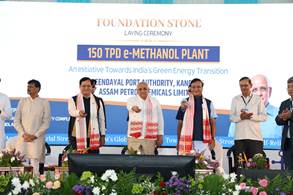
India is moving towards becoming a green-fuel exporter with a ₹2,300 crore port-based e-methanol plant being developed at Deendayal Port Authority (DPA) in Kandla, Gujarat, with the project expected to supply cleaner fuel to ships operating on the Asia-Europe trade corridor.
Gujarat Chief Minister Bhupendra Patel, Union Minister for Ports, Shipping and Waterways Sarbananda Sonowal and Assam Chief Minister Himanta Biswa Sarma laid the foundation stone for the project at the DPA Exhibition Ground in Gandhidham.
The 150-tonne-per-day plant is being jointly developed by DPA and Assam Petro-Chemicals Ltd (APCL), with production based on renewable power, water and biogenic carbon dioxide. The e-methanol produced at the facility is intended for use as a cleaner marine fuel.
Two-phase investment
The ₹2,300 crore project will be developed in two phases using scalable modules.
The first phase, involving an investment of ₹1,200 crore, will add 50 tonnes per day of production capacity and is targeted for completion by January 2027.
The second phase will involve an additional investment of ₹1,100 crore and add 100 tonnes per day, taking the total capacity to 150 tonnes per day. It is targeted for completion by March 2027.
DPA and APCL will contribute to the project in a 76:24 ratio. DPA’s contribution includes ₹567.32 crore in equity capital, 75 acres of land, desalinated water and renewable energy in the form of green hydrogen.
Green methanol aimed at global shipping
The project is expected to position Kandla as a green-fuel supply hub for international shipping, particularly vessels operating on the Asia-Europe International Trade Corridor.
According to the project proponents, the plant is expected to produce green methanol at around $750 per tonne, compared with a global rate of about $1,300 per tonne.
The cost advantage could support India’s ambition to emerge as a competitive supplier of green fuels to global shipping, while creating a new export-oriented segment around its ports.
Project to create 3,500 jobs
The facility is expected to create more than 3,500 direct and indirect jobs and stimulate a wider green-energy value chain around Kandla.
The ecosystem is expected to cover transportation, storage and supply of green molecules, along with ancillary activities linked to e-methanol production.
The project brings together Gujarat’s renewable-energy and port infrastructure with APCL’s chemical manufacturing capabilities in Assam.
Maritime infrastructure gets green push
The e-methanol project comes amid a broader expansion of India’s maritime and shipbuilding capabilities.
The government plans to add 100 ships to India’s merchant fleet over the next five years and has set an ambition for India to become one of the world’s five largest ship-owning nations by 2047.
Deendayal Port Authority is also developing a ₹1,520 crore shipbuilding project with Cochin Shipyard Ltd at Vadinar. A proposed greenfield shipbuilding and repair cluster at Kuchhadi in Porbandar has also received in-principle approval.
The emergence of green-fuel infrastructure alongside shipbuilding and port expansion could help create an integrated maritime ecosystem, covering vessel construction, fuel supply, cargo movement and related services.
Gujarat and Assam join hands
The project also represents an inter-state partnership between Gujarat and Assam, with APCL bringing its manufacturing capabilities from Namrup to a major western Indian port.
Gujarat Chief Minister Bhupendra Patel said the project would convert the state’s renewable-energy resources into an export opportunity and position Kandla as a gateway for India’s green energy to global markets.
Union Minister for Ports, Shipping and Waterways Sarbananda Sonowal said the project could help make Kandla a green-fuel hub on the Singapore–Rotterdam route while creating skilled employment.
Assam Chief Minister Himanta Biswa Sarma said the project demonstrated the role of the Northeast in India’s clean-energy transition, with Assam’s APCL contributing to the development of green-fuel capacity at Kandla.
The project supports India’s broader net-zero emissions target for 2070 and the government’s focus on energy self-reliance and the development of domestic capabilities for global markets.