


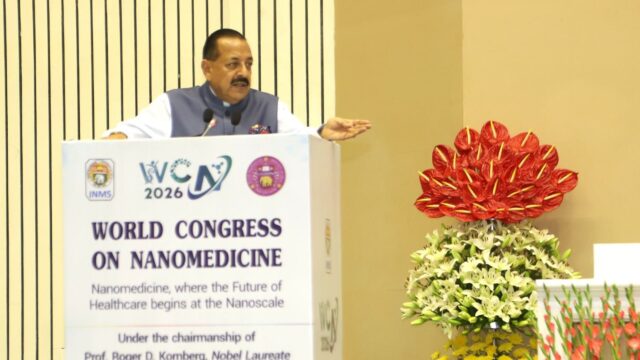
India is stepping up investments in nanomedicine as the government looks to build the next generation of precision and personalised healthcare, with ₹174 crore being committed to 210 research and development projects.
Union Minister of State for Science & Technology Dr Jitendra Singh said nanomedicine could transform medical treatment by enabling interventions at the cellular level and tailoring therapies to individual patient needs.
Speaking at the World Congress on Nanomedicine 2026 in New Delhi, he said future healthcare would increasingly consider a patient’s genetic profile, lifestyle, dietary habits and environmental factors while designing treatment.
₹174 crore backing for research
The Department of Biotechnology is supporting 210 nanomedicine R&D projects covering targeted drug delivery, cancer treatment, infectious diseases, nucleic-acid and vaccine delivery, nano-diagnostics and imaging, regenerative medicine, wound healing, nanotoxicology and regulatory science.
Among the research areas highlighted by the minister are oral insulin nanoparticles, nanobots for breast cancer, precision nanoinjection and targeted breast cancer nanomedicine.
Nanotechnology could potentially address some of the challenges that have historically limited oral insulin, including absorption and degradation by digestive enzymes.
From laboratory to healthcare market
The government is also seeking to strengthen the commercialisation pipeline around nanomedicine.
Dr Jitendra Singh said India’s ecosystem now extends beyond laboratory research to startups, infrastructure development, technology translation and regulatory support.
Through BIRAC, biotechnology enterprises can access programmes including Biotechnology Ignition Grant, PACE, SBIRI and BIPP to help convert research into enterprises and products.
India has also established a regulatory framework for nanopharmaceuticals through guidelines developed jointly by the Department of Biotechnology, ICMR and CDSCO, covering safety, quality and efficacy.
The emerging ecosystem could create opportunities across pharmaceuticals, diagnostics, medical devices and healthcare technology as research moves towards commercial applications.
Precision at the nanoscale
Nanomedicine applies nanotechnology to structures measured in billionths of a metre. Its potential lies in delivering therapies and diagnostics with greater precision, potentially improving treatment effectiveness while reducing unwanted effects.
Nobel Laureate Prof Roger D Kornberg said the field could enable the right amount of treatment to reach the right place at the right time, with applications spanning drug delivery, diagnosis, imaging and regenerative medicine.
At the same time, Dr Jitendra Singh cautioned against allowing technology to replace clinical judgement. He said artificial intelligence and nanotechnology should complement doctors’ clinical skills rather than diminish the importance of observation and physical examination.
The World Congress on Nanomedicine 2026, hosted by the Institute of Nano Medical Sciences, University of Delhi, has brought together more than 2,000 scientists, researchers and other participants.
The government sees India’s expanding research base, institutional capabilities and industry participation as a foundation for developing indigenous nanomedicine solutions with potential applications beyond the domestic healthcare market.