


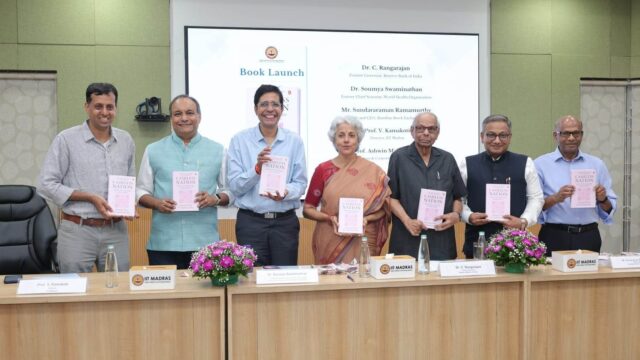
Indian Institute of Technology Madras hosted the arrival of Cashless Nation: How UPI Changed Everything, a new book that chronicles the evolution of India’s digital payments ecosystem and the rise of the Unified Payments Interface (UPI).
Authored by Dr. Santanu Paul and B. Sambamurthy and published by Penguin Random House, the book was presented at an event attended by Dr. C. Rangarajan, former Governor of the Reserve Bank of India, Dr. Soumya Swaminathan, former Chief Scientist of the World Health Organisation, and Sundararaman Ramamurthy, MD and CEO of BSE India. The event was hosted by Prof. V. Kamakoti, Director, IIT Madras.
From banking technology to UPI
Released in the year UPI marks its 10th anniversary, Cashless Nation traces the multi-decade journey that laid the foundations for India’s digital payments revolution.
The book examines how India developed a digital payments infrastructure capable of operating at unprecedented scale, transforming everyday interactions with money while establishing the country as a global reference point for interoperable, real-time payments.
It looks beyond the technology to the people, institutions, policy decisions and execution that shaped the payments ecosystem and ultimately enabled UPI to become a mass-market platform.
Rangarajan calls UPI an ‘envy of the world’
Delivering the keynote address, Dr. C. Rangarajan said India’s banking technology had gone through successive revolutions, moving from computing and communications to mobile and digital technologies.
He described Cashless Nation as a “brilliant narrative” of the events, policies and personalities behind the emergence of UPI, which he called an “envy of the world”.
Rangarajan also highlighted the inclusiveness of UPI, saying the platform was open to everyone “from a street vendor to a billionaire”.
According to him, the book’s use of flashbacks, anecdotes and insights makes it both educative and entertaining while documenting the evolution of India’s payments system.
IIT Madras highlights digital finance
IIT Madras Director Prof. V. Kamakoti said digital finance is driving the economy and prosperity of modern nations.
He said UPI had become a global role model for payments and was making an impact on India’s economic growth.
IIT Madras also highlighted the connection with the book’s co-author, noting that Santanu Paul is an alumnus of the institution.
“We are delighted that Cashless Nation has been written by Santanu Paul, our very own alumnus, in collaboration with B. Sambamurthy. This is an invaluable, authoritative book and we are delighted by the high acclaim it is receiving,” Prof. Kamakoti said.
Technology and banking perspectives
The authors bring different but complementary perspectives to the story of India’s digital payments transformation.
Dr. Santanu Paul, a technologist and entrepreneur, and B. Sambamurthy, a veteran career banker, had professional exposure to several developments that shaped India’s payments landscape.
Their engagement with institutions including the National Payments Corporation of India (NPCI) and the Institute for Development and Research in Banking Technology (IDRBT), along with their experience across boards and the wider financial sector, has brought technology, institutional and banking perspectives to the account.
The book has also received attention for its accessible treatment of what is otherwise a complex story involving technology, public policy and financial infrastructure.
At the recent Global Fintech Fest in Mumbai, Nandan Nilekani described the book as being “like a thriller” and recommended it to readers seeking to understand how India’s public digital infrastructure evolved to serve citizens at extraordinary scale.
UPI’s decade-long transformation
A decade after its introduction, UPI has become one of the defining components of India’s digital economy. Cashless Nation seeks to document the journey behind that transformation, from the early evolution of banking technology and digital infrastructure to the creation and rapid adoption of an interoperable payments platform.
The book’s arrival at IIT Madras brings the UPI story back to an institution that has played a significant role in India’s technology and innovation ecosystem, while celebrating one of the country’s most consequential digital transformations.