


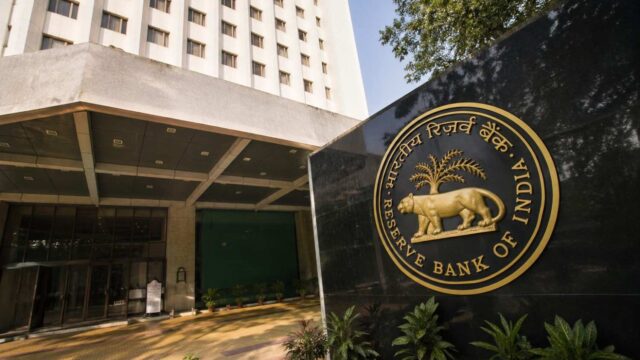
The Reserve Bank of India (RBI) has raised the policy repo rate by 25 basis points to 5.50%, citing rising inflation risks even as the Indian economy continues to maintain strong and broad-based growth momentum.
The Monetary Policy Committee (MPC) unanimously decided to increase the policy repo rate under the liquidity adjustment facility (LAF) by 25 bps following an assessment of evolving macroeconomic and financial conditions.
With the hike, the standing deposit facility (SDF) rate stands at 5.25%, while the marginal standing facility (MSF) rate and Bank Rate have been raised to 5.75%.
The MPC also changed its monetary policy stance to calibrated tightening, signalling that rate cuts are not on the table in the near term.
Rate hikes or pause ahead
The MPC said policy action going forward would be limited to either a rate hike or a pause, depending on the evolution of growth and inflation.
It said the duration and extent of the rate-hike cycle would depend on actual growth-inflation developments, particularly underlying inflation, the broadening of price pressures, second-round effects of supply shocks and the impact of demand impulses.
The central bank noted that while there is some evidence of elevated inflation expectations and a generalisation of inflation, there are limited signs of supply-side pressures becoming embedded in pricing behaviour.
Inflation outlook turns less benign
The MPC said inflation and its outlook are no longer as benign as they were last year.
Headline CPI inflation is expected to average almost 5.8% over the next three quarters, while core inflation is projected at 4.4% for FY2026-27.
The MPC noted that monetary policy primarily works by curtailing second-round effects of supply shocks, including changes in inflation expectations and firm-level pricing behaviour.
It also pointed to limited evidence of demand-side inflation pressures, while cautioning that strong growth in monetary and credit aggregates poses risks.
GDP growth projected at 7.1%
Despite global headwinds, the Indian economy continued to show resilience, with real GDP growth at 7.8% in Q1 FY2026-27.
Growth was supported by resilient private consumption and strong investment activity, while net exports also made a positive contribution.
High-frequency indicators suggest that economic activity maintained momentum in Q2, although growth moderated somewhat from the previous quarter.
Manufacturing activity remained resilient despite cost pressures, while services activity continued to be broad-based. Both manufacturing and services PMI remained in expansion territory during Q2.
Private consumption remained broadly resilient, supported by discretionary spending, while fixed investment continued to show strength.
Growth forecast raised by 40 bps
The RBI has projected real GDP growth for FY2026-27 at 7.1%, an upward revision of 40 bps, reflecting the underlying strength of economic activity despite global uncertainties.
Quarter-wise, GDP growth is projected at 7.2% in Q2, 6.9% in Q3 and 6.8% in Q4 FY2026-27. Growth for Q1 FY2027-28 is projected at 7.1%.
The RBI said the risks to its growth outlook are evenly balanced.
Global risks remain significant
The MPC flagged geopolitical developments, supply-chain disruptions, elevated international commodity prices, additional trade frictions and tightening global financial conditions as key risks to the growth outlook.
A weak and uneven southwest monsoon, coupled with strong El Niño conditions, could also affect the upcoming rabi season and rural demand.
At the same time, resilient non-farm activity is expected to support rural consumption, while sustained services activity and broadly stable employment conditions could support urban demand.
Government infrastructure spending, a rebound in private capital expenditure and strong credit flows are expected to support investment activity.
The RBI also expects services exports to remain buoyant, while recently operationalised bilateral trade agreements could support merchandise exports.