


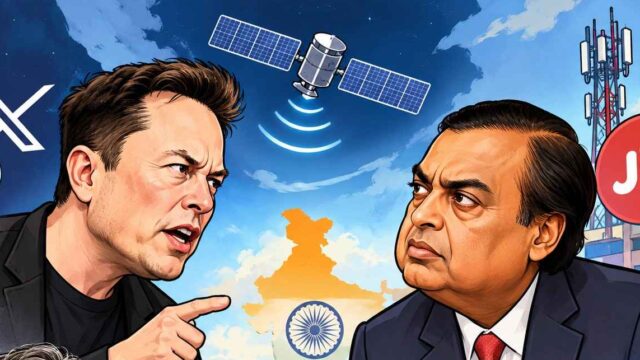
Elon Musk’s frustration over the delayed launch of his Starlink satellite internet service in India has escalated into a public confrontation with Reliance Industries chairman Mukesh Ambani, drawing the government, opposition politicians and technology entrepreneurs into an increasingly heated debate over competition, regulation and market access.
The Tesla and SpaceX chief executive has used X, the social media platform he owns, to allege that powerful business interests are obstructing Starlink’s entry to protect existing market positions. His posts have included a pointed question about Ambani’s influence over the Indian government, a sarcastic message addressing him as “Prime Minister Ambani” and, most recently, reports concerning Reliance-linked political donations and social-media campaigning.
The controversy has also prompted Zoho founder Sridhar Vembu to defend India’s digital economy, arguing that the country’s low mobile data prices and affordable digital payment systems demonstrate the benefits of competition. Congress leader Rahul Gandhi, meanwhile, has used the dispute to make a political point about the influence of powerful business interests.
At the heart of the argument is a question with significant commercial implications: is Starlink being held back by an unfair regulatory process, or must the company complete the same security and spectrum-related requirements that apply to other satellite internet operators?
Musk’s ‘real boss of India’ jibe
The confrontation intensified earlier this week when Musk alleged that unnamed business interests were preventing Starlink from entering India to preserve their dominance.
In a post on X, Musk accused certain “oligarchs” of maintaining what he described as a monopolistic hold over Indian consumers. He claimed that blocking Starlink would deprive people of access to better internet connectivity and described the alleged obstruction as a crime against the public.
Musk subsequently made his criticism more personal by questioning Ambani’s influence.
“Is Ambani the real boss of India?” he asked in another post, arguing that Starlink had spent years complying with Indian government requirements but was still unable to begin commercial operations.
The SpaceX chief then escalated the rhetoric with a sarcastic message addressed to “Prime Minister Ambani”. He suggested that the Reliance chairman would prefer to preserve his alleged market dominance but asked whether he would nevertheless allow Starlink to compete.
Musk argued that satellite internet could benefit people in areas with inadequate connectivity, opening up educational opportunities for children and allowing small businesses to reach customers in wider markets. He also highlighted Starlink’s potential role in maintaining communications during natural disasters when conventional networks fail.
The posts have transformed a regulatory delay into a wider public argument over corporate power, competition and the conditions under which foreign technology companies can enter India.
However, Musk has not publicly established evidence that Ambani or Reliance has intervened to block Starlink’s launch. Reliance has not publicly responded to the allegations, according to reports published on October 10.
The government rejects allegations of discrimination
The Union government has rejected suggestions that India’s regulatory framework is being applied selectively to prevent Starlink from entering the market.
The Ministry of Communications described allegations that satellite communication rules were being applied discriminatorily as baseless, maintaining that India has a fair and non-discriminatory authorisation framework for telecommunications services, including satellite communications.
Communications Minister Jyotiraditya Scindia subsequently reiterated that India does not permit monopolies in any sector.
The government’s position is that Starlink and the other licensed satellite communication operators are at broadly similar stages of the regulatory process. They must meet the applicable security conditions, while spectrum assignment and related requirements also need to be completed before commercial services can begin.
Starlink is not the only company seeking to offer satellite broadband in India. The other licensed operators include Jio Satellite Communications, associated with Ambani’s Reliance group, and Bharti-backed Eutelsat OneWeb.
This is an important distinction. A licence to provide satellite communication services does not, by itself, mean that an operator can immediately start selling services to customers. Security compliance and spectrum-related approvals remain crucial steps.
The government’s response therefore challenges Musk’s suggestion that the delay necessarily reflects an attempt to protect an incumbent player. At the same time, the dispute has put the pace and transparency of regulatory approvals under public scrutiny.
Rahul Gandhi joins the online exchange
The controversy has also acquired a political dimension.
Congress leader Rahul Gandhi responded to Musk’s initial allegations with a post on X welcoming him to India and adding: “Wait till you discover the other guy.”
Musk replied that the situation was troubling, drawing further attention to the political implications of his allegations.
The exchange allowed the Congress leader to link the dispute to wider questions about the relationship between government and big business. However, the political reactions do not establish that Ambani or Reliance has influenced the regulatory process in Starlink’s case.
Scindia, in turn, criticised the Congress’s position, questioning its response to the developments surrounding Starlink’s proposed entry.
The episode illustrates how a commercial dispute involving market access can quickly become part of India’s broader political debate over competition, business influence and government policy.
Sridhar Vembu defends India’s digital economy
One of the most prominent responses to Musk’s allegations came from Sridhar Vembu, founder of software company Zoho.
Vembu challenged the suggestion that India’s business environment should be viewed primarily through the lens of monopoly and market obstruction. Instead, he pointed to the country’s relatively low mobile data prices, affordable medicines and low-cost digital payment infrastructure as examples of how competition and policy have benefited consumers.
Vembu specifically credited Reliance Jio’s entry into the telecommunications market with helping bring down mobile data prices. The launch of Jio intensified competition among telecom operators and helped make large mobile data allowances widely accessible to Indian consumers.
He also highlighted the widespread use of dual-SIM phones and large data plans, arguing that these reflect the affordability of mobile connectivity in India.
Vembu extended his argument beyond telecommunications. He cited the Unified Payments Interface, or UPI, as an example of low-cost digital infrastructure and pointed to the growth of Indian startups as evidence of a competitive entrepreneurial ecosystem.
He also argued that Indian startups developing low-cost rockets could emerge as competitors to SpaceX, just as Chinese electric vehicle manufacturers have challenged Tesla in international markets.
His response was pointed: India’s achievements in digital services, payments and affordable connectivity should be considered when evaluating claims that the country’s business environment is designed to protect monopolies.
Vembu’s intervention is significant because it shifts the debate from the immediate question of Starlink’s regulatory approvals to the broader economic record of Indian telecommunications. It also highlights the tension between two competing arguments: Musk’s contention that new entrants should be allowed to challenge established players, and Vembu’s view that India’s existing competitive framework has already delivered substantial consumer benefits.
Neither argument, however, resolves the specific question of whether Starlink’s pending approvals have been handled appropriately. That requires an examination of the regulatory process and the requirements applicable to all operators.
Musk widens the attack with political-donation reports
On Saturday, October 10, Musk took his criticism further by sharing reports concerning a Reliance-funded firm’s alleged role in boosting political campaigns on social media and political donations made by a Reliance-linked company.
The material included a report about a Reliance-funded firm and political campaigning on Facebook, as well as an earlier report concerning electoral-bond donations by Qwik Supply, a company reported to be linked to Reliance.
The move broadened the confrontation beyond Starlink’s regulatory position, bringing questions about corporate political contributions and the relationship between business and politics into the discussion.
The reports shared by Musk should be distinguished from the allegation that Reliance has obstructed Starlink. The existence of reports about political donations or social-media campaigning does not, on its own, establish that Ambani or Reliance influenced the government’s decisions on satellite internet approvals.
The latest posts nevertheless show that Musk intends to keep the issue in the public domain rather than limit his criticism to the technical or regulatory aspects of Starlink’s proposed launch.
Reliance had not publicly responded to the allegations in the reports cited by news coverage on Saturday.
What is at stake for India’s satellite internet market?
Beyond the personal exchanges, the dispute has implications for the future of satellite broadband in India.
Starlink, operated by SpaceX, aims to provide internet connectivity through a network of satellites. Such services could be particularly relevant in remote locations, difficult terrain and areas where conventional terrestrial networks are limited or expensive to deploy.
The commercial opportunity is substantial, given India’s large internet user base and the continuing need to extend reliable connectivity to underserved regions. Satellite broadband could also serve businesses, institutions and customers requiring connectivity where fibre and mobile networks are inadequate.
However, the market is not without competitors. Jio Satellite Communications and Eutelsat OneWeb are also licensed to provide satellite communication services, while other global companies have shown interest in the Indian market.
For consumers, competition could potentially broaden the choice of connectivity technologies. The eventual benefits will depend on pricing, service quality, coverage, capacity and the ability of providers to operate commercially under India’s regulatory framework.
The government must balance these commercial opportunities with security requirements, spectrum management and the orderly development of the telecommunications sector. Those requirements apply even when a company has obtained an initial licence.