


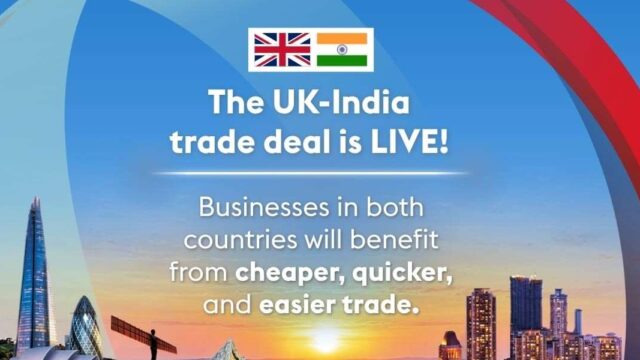
Mumbai will host the first UK-India CETA Marketplace on October 13, bringing together more than 100 British businesses, senior UK cabinet ministers and seven mayors from northern England to explore commercial opportunities under the landmark Comprehensive Economic and Trade Agreement (CETA).
The event, hosted by Harjinder Kang, His Majesty’s Trade Commissioner for South Asia and British Deputy High Commissioner for South Asia, aims to translate the trade agreement into tangible business outcomes by connecting companies from both countries and encouraging partnerships across key industries.
The initiative comes as the United Kingdom and India seek to strengthen bilateral trade, investment and industrial cooperation, with improved market access expected to create opportunities for businesses in manufacturing, clean energy, technology, healthcare, financial services and infrastructure.
Tariff reductions open new market opportunities
The trade agreement provides for tariff liberalisation covering 90% of UK goods exported to India, while 99% of Indian goods exported to the UK are set to benefit from duty-free or reduced-tariff access, according to the announcement.
The benefits extend across several product categories. Scottish salmon will enter India duty-free, while tariffs on Scotch whisky have been reduced. UK automobiles will also benefit from significant tariff reductions.
These measures are intended to improve market access, reduce trade barriers and encourage businesses to expand their presence in each other’s markets.
For British exporters, India offers opportunities to reach a large consumer market and establish long-term commercial partnerships. Indian companies, meanwhile, could benefit from greater access to British products, technology and expertise, alongside opportunities to strengthen supply chains and attract investment.
The extent to which businesses capitalise on these provisions will depend on how effectively they build partnerships, expand distribution networks and translate improved market access into actual trade.
Northern England and Scotland look to India
The participation of seven mayors from northern England, alongside a delegation of more than 100 British businesses, underlines the importance attached to developing commercial links with India beyond the UK’s traditional business centres.
Businesses from northern England and Scotland are increasingly looking at India as a long-term partner for exports, investment and innovation, particularly in sectors such as advanced manufacturing, clean technology and professional services.
The Marketplace will bring together companies and institutions spanning advanced manufacturing, healthcare, fintech, education, consumer products, infrastructure and clean technology.
The event is designed to help businesses identify potential partners, explore new markets and develop commercial relationships that can support growth in both countries.
Harjinder Kang, His Majesty’s Trade Commissioner for South Asia and British Deputy High Commissioner for South Asia, said the agreement had opened a new chapter in the two countries’ economic partnership.
“The CETA Marketplace is about bringing that opportunity to life, connecting businesses directly with the products, expertise and partnerships that can drive growth,” he said.
The focus, he added, was on converting the agreement into tangible commercial outcomes for businesses in both countries.
Rolls-Royce sees scope for deeper industrial collaboration
For established British companies operating in India, the agreement is expected to provide a framework for expanding trade, investment and industrial cooperation.
Rolls-Royce India Executive Vice President Sashi Mukundan,said the agreement could support deeper collaboration in aerospace and advanced manufacturing.
With more than 90 years of partnership with India, Rolls-Royce sees the agreement as an enabler of closer engagement with customers, suppliers and the wider industrial ecosystem.
Mukundan said the agreement would provide businesses with greater opportunities to trade, invest and collaborate, while offering the stability and confidence needed for long-term planning.
The aerospace and advanced manufacturing sectors are among the areas where stronger UK-India commercial ties could support technology cooperation, supplier development and industrial investment.
Major British companies back the initiative
The CETA Marketplace is supported by several prominent businesses and institutions, reflecting the breadth of commercial interests represented in the UK-India economic relationship.
The supporters include Rolls-Royce, British Airways, Carbon Clean, Smith + Nephew, Interpolitan Money, Queen Elizabeth’s Global Schools in Gurugram, part of GEDU Global Education, Virgin Atlantic and Diageo India.
Their participation highlights the range of sectors in which companies are seeking to build stronger cross-border connections, from aviation and healthcare to financial services, education, clean technology and consumer products.
The Marketplace will offer businesses an opportunity to explore how the trade agreement could help new products reach consumers, technologies find commercial partners and companies enter new markets.
From trade agreement to commercial outcomes
The Mumbai event marks a business-facing effort to move the UK-India trade agreement beyond policy commitments and towards practical commercial engagement.
While tariff concessions can improve competitiveness, the broader economic impact will depend on businesses using the agreement to expand exports, secure investment, establish partnerships and develop new products and services.
For Indian companies, closer engagement with British businesses could open access to technology, expertise and international networks. For UK companies, India offers opportunities to expand sales, develop supply chains and participate in one of the world’s major growth markets.
The CETA Marketplace is intended to bring these opportunities into sharper focus, with businesses at the centre of efforts to strengthen the economic partnership between the two countries.