


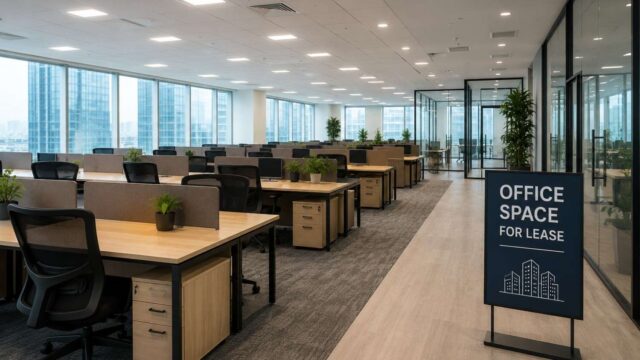
India’s coworking sector has emerged as the country’s largest office space occupier, overtaking the information technology and IT-enabled services (IT/ITeS) segment, even as overall office leasing across the top seven cities rose marginally by 2% year-on-year to 42.9 million sq ft in the first nine months of 2026.
Coworking operators accounted for 26% of total office leasing demand during January-September 2026, up from 23% in the corresponding period last year, according to Anarock Research & Advisory. IT/ITeS accounted for 25%, down from 29%, while banking, financial services and insurance (BFSI) increased its share to 21% from 18%.
The shift signals the growing importance of flexible workspace models in India’s commercial real estate market, as businesses seek greater flexibility in their office space commitments and workplace strategies.
Net office absorption across the top seven cities increased to 42.9 million sq ft in the nine months ended September 2026, compared with 42 million sq ft a year earlier.
“Coworking has overtaken IT/ITeS office space demand, at 26%, it now commands the highest overall leasing share in 9M 2026, followed closely by IT/ITeS with a 25% share and BFSI with 21%,” said Anarock Group managing director, commercial leasing and advisory, Peush Jain.
Global capability centres drive demand
Global capability centres (GCCs) strengthened their position in India’s office market, accounting for a record 44% of gross office leasing in the first nine months of 2026, against 40% in the year-ago period.
IT/ITeS accounted for 32% of GCC-related leasing, while BFSI contributed 27%, according to the report.
The growing contribution of coworking, BFSI and GCCs is diversifying office demand beyond the traditional dominance of technology companies. Manufacturing and industrial occupiers also increased their share marginally to 15% from 14%.
Consultancy businesses saw their share decline to 6% from 8%, while ecommerce remained unchanged at 4%. Other sectors accounted for 3%, against 4% a year earlier.
Bengaluru and Hyderabad lead office absorption
Bengaluru retained its position as India’s largest office market by net absorption, with leasing rising 20% year-on-year to 11.92 million sq ft from 9.95 million sq ft.
Hyderabad recorded the strongest growth among the seven cities, with net absorption increasing 54% to 8.8 million sq ft from 5.7 million sq ft. New office completions in the city surged 63% to 9.6 million sq ft.
Mumbai Metropolitan Region (MMR) recorded largely stable absorption at 6.65 million sq ft, against 6.6 million sq ft a year earlier.
The National Capital Region (NCR) saw absorption decline 11% to 7.32 million sq ft, while Pune recorded a 36% fall to 3.95 million sq ft. Chennai’s net absorption declined 21% to 3.56 million sq ft, and Kolkata recorded an 18% drop to 0.7 million sq ft.
The contrasting performance highlights the uneven pace of recovery and expansion across India’s major office markets, with Bengaluru and Hyderabad emerging as the principal growth drivers.
New office supply rises 5%
New office completions across the seven cities increased 5% year-on-year to approximately 41.1 million sq ft in the first nine months of 2026, compared with 39.21 million sq ft in the same period last year.
Bengaluru recorded the highest new supply at 12.35 million sq ft, up 19% from 10.41 million sq ft. Hyderabad followed with 9.6 million sq ft, a 63% increase.
Supply in MMR rose 21% to 4.1 million sq ft, while Chennai recorded a 9% increase to 3.8 million sq ft.
In contrast, new completions declined 25% in NCR to 5.05 million sq ft and 36% in Pune to 5.9 million sq ft. Kolkata recorded 0.3 million sq ft of new supply, compared with 0.1 million sq ft a year earlier.
The increase in national supply alongside lower vacancy indicates that the market has continued to absorb additional office space, although demand and supply conditions vary significantly between cities.
Office vacancy falls as rentals rise
India’s office vacancy rate declined to 15.15% in the first nine months of 2026 from 16.2% a year earlier, a reduction of 105 basis points. All seven cities recorded lower vacancy rates.
Chennai had the lowest vacancy rate at 8.75%, followed by Bengaluru at 11% and Pune at 11.6%. MMR’s vacancy rate declined to 13.3% from 14.9%.
Hyderabad continued to have the highest vacancy rate among the seven markets at 24%, although this was lower than 26.5% a year earlier. NCR’s vacancy rate fell to 20.6% from 22%.
Average monthly office rentals across the markets rose 8% to ₹97 per sq ft from ₹90 per sq ft in the year-ago period.
Hyderabad recorded the highest rental growth at 12%, with average monthly rentals reaching ₹77 per sq ft. NCR rentals rose 10% to ₹98 per sq ft, while Bengaluru recorded a 9% increase to ₹109 per sq ft.
MMR remained the most expensive office market, with average rentals rising 8% to ₹156 per sq ft per month. Chennai, Pune and Kolkata each recorded rental growth of 6%, taking average monthly rentals to ₹83, ₹91 and ₹66 per sq ft, respectively.
The combination of declining vacancy and rising rentals points to improving occupancy conditions at the national level. However, the slowdown in absorption in Chennai, Pune and NCR suggests that the benefits of the expanding office market are not evenly distributed.
The sustainability of the growth will depend on continued leasing activity, the pace of new supply and the ability of individual markets to absorb additional space, Anarock said.