


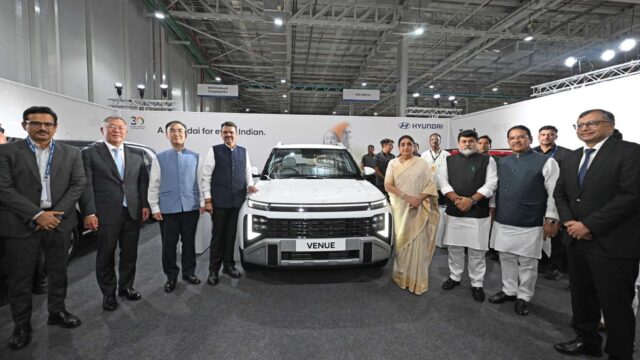
Hyundai Motor India Ltd (HMIL), the Indian subsidiary of South Korean automotive major Hyundai Motor Company, has inaugurated its manufacturing facility at Talegaon near Pune in Maharashtra, marking a major expansion of its manufacturing footprint in India with a phased investment of ₹11,000 crore.
The plant has an installed annual production capacity of 1.7 lakh vehicles, which the company plans to expand to 3.2 lakh units by 2030. Combined with its Chennai operations, Hyundai Motor India’s total annual manufacturing capacity is expected to reach nearly 11.4 lakh vehicles by the end of the decade.
The inauguration, led by Maharashtra Chief Minister Devendra Fadnavis, comes as Hyundai Motor India celebrates 30 years of operations in the country. The company also announced that its cumulative passenger vehicle exports from India have crossed 4 million units since 1999, while domestic sales have approached 10 million vehicles.
The export milestone reinforces India’s role in Hyundai Motor Group’s global manufacturing and supply chain network. HMIL said it is the largest cumulative exporter of passenger vehicles in India and the first automobile manufacturer in the country to reach the 4-million-export mark.
The inauguration was attended by Lee Seong-ho, Ambassador of the Republic of Korea to India; Maharashtra Deputy Chief Minister Sunetra Ajit Pawar; Euisun Chung, Executive Chair of Hyundai Motor Group; Jaehoon Chang, Vice-Chair of Hyundai Motor Group; José Muñoz, President and CEO of Hyundai Motor Company; and Tarun Garg, Managing Director and CEO of HMIL.
Industry 4.0 and AI-enabled manufacturing
The Talegaon facility has been developed as one of Hyundai Motor Company’s advanced global manufacturing plants, incorporating Industry 4.0 technologies, artificial intelligence-enabled production systems and an integrated digital manufacturing ecosystem.
The plant uses Hyundai’s E-FOREST digital factory platform, which supports digital simulations, predictive maintenance and data-driven production processes. AI-enabled systems are being deployed for quality inspection, defect detection, workforce safety and manufacturing efficiency.
The factory’s production systems are designed to accommodate multiple vehicle models and offer flexibility for future internal combustion engine and hybrid vehicle manufacturing.
The focus on digitalisation and flexible production comes as automakers increasingly invest in manufacturing systems capable of adapting to changing consumer demand, evolving vehicle technologies and stricter quality requirements.
The plant also houses an engine manufacturing facility with an annual production capacity of 1.5 lakh engines to support vehicle production.
Supplier ecosystem generates 18,000 jobs
Hyundai’s investment is expected to have a wider impact on Maharashtra’s automotive manufacturing ecosystem through supplier investments, employment generation and local sourcing.
According to the company, 55 supplier partners have already invested nearly ₹4,600 crore in the state. The Tier-I and Tier-II supplier ecosystem has generated more than 18,000 employment opportunities in Maharashtra.
Nearly half of the supplier sourcing network is located within a 50-km radius of the Talegaon facility, helping strengthen local supply chains and improve manufacturing integration.
Tarun Garg, Managing Director and CEO of Hyundai Motor India, said the Pune plant marked the beginning of the company’s next phase of growth in India.
“Beyond expanding manufacturing capacity, the facility will drive industrial development, innovation and employment generation in the region,” he said.
The company also acknowledged the support of the Maharashtra and central governments in developing the manufacturing ecosystem.
Maharashtra Chief Minister Devendra Fadnavis said the facility would contribute to economic growth, employment generation and the development of the state’s automotive industry through investments in advanced manufacturing, localisation and skill development.
Manufacturing expansion aligned with future mobility
Hyundai’s expansion in Pune is accompanied by investments in research, electrification and technology development.
Hyundai Motor Group has established industry-academia partnerships with seven leading institutions across India, with nearly 40 research projects under way in areas including battery technologies, electrification and future mobility solutions.
These initiatives are intended to strengthen India’s role in developing automotive technologies while supporting the industry’s transition towards more sustainable mobility.
The Pune plant’s flexible production architecture, which is designed to support internal combustion engine and hybrid models, provides the company with options to adapt its manufacturing mix as the market evolves.
The expansion to 3.2 lakh vehicles annually by 2030 would increase the plant’s production capacity by about 88% from its current installed level of 1.7 lakh units.
Focus on workforce and sustainability
The manufacturing campus includes training and skill-development infrastructure, augmented reality-enabled workforce training systems, medical facilities and employee wellness and recreation amenities.
Hyundai said the plant received the 2026 Red Dot Award for people-centric workplace design, reflecting its emphasis on employee well-being, collaboration and innovation.
Beyond manufacturing, the Hyundai Motor India Foundation is undertaking social and environmental initiatives in Maharashtra. The company’s IONIQ Forest programme has resulted in the planting of more than 1 million trees, according to the information provided by HMIL.
The Pune investment, alongside the company’s established Chennai operations, positions Hyundai Motor India to expand domestic production and exports while strengthening its supplier network and preparing for changing vehicle technologies.
With the new facility and its planned capacity expansion, Hyundai is seeking to deepen India’s role in its global manufacturing operations while building on its three-decade presence in the country’s passenger vehicle market.