


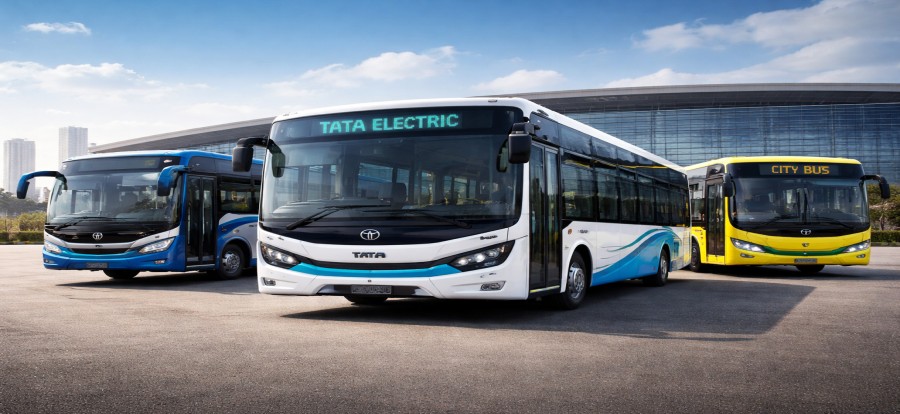
India’s electric bus (e-bus) share in new bus registrations is expected to rise nearly 2.5 times to 17% next fiscal from 7% last fiscal, driven by government procurement programmes, operational subsidies and payment security measures, according to Crisil Ratings.
However, inadequate charging infrastructure and depot readiness could delay deployment, while limited participation by private bus operators remains a key constraint to the sector’s long-term growth.
Government initiatives have facilitated the deployment of more than 20,000 electric buses as of September 2026, while the sector’s order book has expanded to approximately 29,000 units, Crisil Ratings said in its assessment based on publicly available data from six original equipment manufacturers (OEMs) accounting for 90% of the market and interactions with industry stakeholders.
The rating agency expects most of the existing orders to be ready for deployment within scheduled timelines, supported by adequate manufacturing capacity and funding availability. However, infrastructure constraints could limit actual deployment to 75-80% of the order book.
“Government policies have enabled creation of a strong pipeline for e-bus adoption, with the order book reaching approximately 29,000 buses as of September 2026,” said Crisil Ratings Senior Director, Mohit Makhija.
“Inadequate infrastructure readiness is likely to restrict deployment to only 75-80% of order book,” he said.
Government support drives demand
Government programmes have played a central role in expanding electric bus adoption in India.
Earlier initiatives, including the Faster Adoption and Manufacturing of Electric Vehicles (FAME) schemes and the National Electric Bus Programme (NEBP), primarily focused on urban centres. The PM e-Bus Sewa Scheme subsequently widened the scope by extending support to Tier 2 and Tier 3 cities.
Policy support has also evolved beyond procurement incentives to address operational and payment risks faced by bus operators and manufacturers.
Under the PM e-Bus Sewa Scheme, operational subsidies cover 30% of the committed per-kilometre rentals payable by State Transport Undertakings (STUs), according to Crisil Ratings.
The Payment Security Mechanism (PSM), notified in October 2024, is designed to mitigate counterparty risks arising from financially weaker STUs.
However, the framework’s long-term effectiveness will depend partly on the payment performance of participating transport undertakings. Establishing a track record of timely payments will be important to maintaining confidence among manufacturers, operators and financiers.
Charging infrastructure emerges as bottleneck
Despite a growing order book and increased manufacturing capacity, delays in charging infrastructure and depot upgrades remain a major obstacle to faster electric bus deployment.
Electric buses cannot enter regular operations until the necessary charging facilities, civil works and supporting power infrastructure are ready at their designated depots.
Obtaining grid connectivity and commissioning power transmission infrastructure can take around 12 months, delaying the operationalisation of buses even after procurement contracts have been awarded.
The PM e-Bus Sewa Scheme provides capital assistance for power infrastructure and depot upgrades to address these challenges. However, execution delays could continue to constrain deployment and moderate the pace of electrification.
The gap between buses ordered and those entering service highlights a key challenge for the industry: translating procurement commitments into operational vehicles.
With an order book of approximately 29,000 buses, infrastructure readiness will be critical to determining how quickly manufacturers’ production capacity translates into actual fleet deployment.
Private bus fleet offers growth opportunity
Increasing private-sector participation is another key requirement for sustaining the growth of India’s electric bus market.
Private operators in staff transportation, school transport, intercity services and tourism account for an estimated 85-90% of the country’s bus fleet, according to Crisil Ratings. Greater electrification in these segments could significantly expand the addressable market beyond government-backed urban transport programmes.
Nearly 40% of the private bus fleet is expected to become due for replacement over the next three to five years, creating a substantial opportunity for electric buses.
“Improving participation of private bus sector, including staff transportation, school, intercity and tourism segments, which account for 85-90% of India’s bus fleet can provide a meaningful growth opportunity in the road ahead,” said Pallavi Singh, Associate Director, Crisil Ratings.
However, the pace of adoption will depend on whether charging infrastructure, financing availability and operating economics become sufficiently attractive for private operators.
Unlike procurement programmes backed by government support, private fleet electrification will depend more directly on the ability of operators to justify the investment through operating costs, vehicle utilisation and expected returns.
Infrastructure and economics to determine growth
India’s electric bus market is entering a phase in which the challenge is shifting from generating demand to ensuring timely deployment and expanding adoption beyond public transport agencies.
Government-backed procurement and payment security measures have created a substantial pipeline, but delays in grid connectivity and depot readiness could prevent a significant portion of ordered buses from entering service on schedule.
At the same time, electrification of private fleets could open up a much larger market as vehicles approach replacement over the next three to five years.
The long-term growth outlook remains favourable, but sustaining momentum will require faster infrastructure development, efficient execution of existing orders and financing models that make electric buses commercially viable for private operators.