


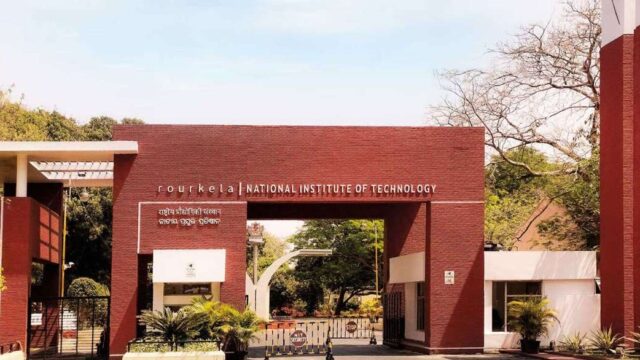
Researchers at the National Institute of Technology Rourkela (NIT Rourkela) have developed a patented material that removed more than 90% of fluoride from contaminated groundwater in laboratory tests, using activated carbon derived from discarded jackfruit peel.
The technology, which modifies the agricultural waste-based carbon with zirconium to improve its fluoride-adsorption capacity, could offer a sustainable approach to drinking water purification in regions affected by excessive fluoride in groundwater.
The researchers reported fluoride removal efficiencies exceeding 90-97% within 10-20 minutes under tested laboratory conditions, at fluoride concentrations of around 1-5 milligrams per litre.
The team has estimated the cost of synthesising the material at approximately ₹37 per gram, based on the electricity and chemicals used in the process. However, practical deployment costs and long-term performance are yet to be established.
Agricultural waste offers water purification solution
Fluoride contamination in groundwater is a public health concern in several parts of India. According to the World Health Organisation, excessive fluoride intake through drinking water can cause dental and skeletal fluorosis, affecting both children and adults.
Conventional fluoride removal methods have limitations that can affect their suitability for wider adoption.
Reverse osmosis, for instance, generates wastewater and can remove beneficial minerals such as calcium and magnesium. Other methods, including ion exchange and activated alumina, may require chemical inputs and regeneration processes that present environmental and operational challenges.
The NIT Rourkela team has sought to address these limitations by converting discarded jackfruit peel into activated carbon and modifying it with zirconium to improve its ability to capture fluoride from water.
The approach combines agricultural waste utilisation with water treatment, potentially offering a route to developing locally deployable purification materials.
More than 90% fluoride removal in laboratory tests
NIT Rourkela Professor in the Department of Chemical Engineering, Prof. Susmita Mishra, said the researchers used discarded jackfruit peel as a resource for developing a water purification material.
The activated carbon was modified with zirconium to enhance its fluoride-capturing ability. In laboratory experiments, the material removed more than 90% of fluoride within approximately 10 minutes under the tested conditions.
The team also recorded removal efficiencies exceeding 90-97% over 10-20 minutes at fluoride concentrations of around 1-5 milligrams per litre.
These results indicate the material’s potential for fluoride treatment, although its performance under varying groundwater compositions and real-world operating conditions will require further validation.
The research team, comprising Prof. Mishra and Dr. Pratima Minz, a research graduate at NIT Rourkela, has secured a patent for the technology.
Potential for decentralised water treatment
The technology could eventually support decentralised water purification systems in rural and semi-urban areas where access to reliable treatment infrastructure is limited.
Using an agricultural by-product could also help reduce waste while creating a potentially useful input for environmental applications.
Prof. Mishra said the material could contribute to cost-effective water treatment solutions in fluoride-affected regions in the long term, subject to further testing and validation.
However, the current results are based on laboratory-scale experiments. The estimated synthesis cost of ₹37 per gram does not, by itself, establish the overall cost of treating drinking water, which would also depend on factors such as material dosage, regeneration or replacement requirements, system design and maintenance.
Prototype development is next
The research has reached Technology Readiness Level 4 (TRL 4), indicating that the technology has been validated at the laboratory level.
The next phase will focus on developing a physical prototype and evaluating its practical deployment, long-term performance and operating costs.
Testing under real-world conditions will be important to determine whether the material can maintain its fluoride-removal efficiency when exposed to different groundwater compositions and continuous treatment requirements.
If these challenges are addressed, the technology could provide another option for communities seeking affordable and sustainable solutions to fluoride contamination, while demonstrating how agricultural waste can be repurposed for environmental and public health applications.