


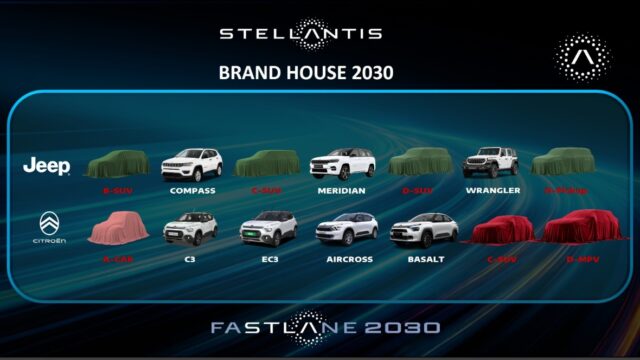
Stellantis, the global automotive group behind Jeep and Citroen, will invest an additional ₹4,000 crore in India over the next three years and introduce 12 products across the two brands, stepping up its expansion in the country as it targets a larger share of the passenger vehicle market.
The fresh investment will take the group’s cumulative investment in India from more than ₹11,000 crore to approximately ₹15,000 crore by 2030. Under its FaSTLAne 2030 roadmap, the company plans to launch seven all-new products and five major upgrades, with the first model scheduled for introduction in the second quarter of 2027.
The product offensive will span the B, C and D SUV segments, besides an MPV, an A-segment car and a premium pickup. The planned launches comprise five Jeep products and seven Citroën products, broadening the group’s presence across multiple passenger vehicle categories.
The investment announcement comes amid improving business momentum. Stellantis India grew 35% in the second quarter of calendar year 2026 compared with the first quarter, while Citroën’s retail sales increased 68% year-on-year during the same period.
From building foundations to scaling up
The new roadmap marks a shift in Stellantis’ India strategy from establishing its manufacturing and engineering presence to expanding its market reach through a more aggressive product pipeline, deeper localisation and a stronger sales and service network.
Stellantis Asia-Pacific Region Chief Operating Officer Tianshu Xin said India was both an important market for the group and an increasingly significant base for its regional and global operations.
He said the FaSTLAne 2030 strategy would give the Indian team greater ownership of decisions, supported by a stronger product pipeline, multiple powertrain technologies and the country’s capabilities in manufacturing, engineering, software and sourcing.
Stellantis India CEO and Managing Director Shailesh Hazela said the company would focus on scaling its business through the 12 planned launches, offering customers more choices across vehicle segments and powertrains.
The additional investment is intended to improve the group’s scale, competitiveness and market relevance while strengthening India’s role in its global operations, he said.
Jeep to target premium SUVs; Citroen to widen reach
The two brands will play distinct roles in Stellantis’ expansion strategy.
Jeep will focus on strengthening its position in the premium SUV market, extending its presence across segments with new products and advanced powertrain options. The strategy will build on the brand’s established positioning around off-road capability, SUV design and product differentiation.
Citroen, meanwhile, will seek to expand its reach across mainstream and higher-volume segments with products tailored to Indian consumers. Comfort, design, technology and affordability will remain central to its positioning.
The proposed product mix is significant because it extends Stellantis’ ambitions beyond its existing areas of strength. A broader presence across vehicle categories could help the group reach more customers, although the commercial outcome will depend on pricing, product-market fit, distribution and the competitiveness of individual models.
The company has not yet disclosed the names, specifications or prices of the 12 products. Further details and launch schedules will be announced closer to their market introductions.
Multi-energy strategy to shape product portfolio
Stellantis plans to adopt a multi-energy approach covering internal combustion engines (ICE), conventional hybrid systems, plug-in hybrid electric vehicles (PHEVs) and battery-electric vehicles (BEVs).
Rather than committing to a single technology, the group will align powertrain choices with customer demand, affordability, regulations, infrastructure readiness and the economics of individual vehicle segments.
The approach allows the company to address different stages of India’s transition towards lower-emission mobility. While electric vehicles are gaining ground, conventional powertrains and hybrid technologies continue to offer alternatives for customers with different budgets and driving requirements.
The mix of technologies across the 12 products will be an important factor in determining the competitiveness of the new portfolio.
Localisation target of 90%
Stellantis has invested more than ₹11,000 crore in India across manufacturing, engineering, software, sourcing and exports.
Its manufacturing footprint includes facilities at Ranjangaon in Maharashtra and Thiruvallur and Hosur in Tamil Nadu. The group also has engineering and software capabilities in Bengaluru, an information and communications technology presence in Hyderabad, and a domestic supplier network.
Under FaSTLAne 2030, Stellantis is targeting localisation levels of 90% across both Jeep and Citroën, wherever commercially and technically viable.
Higher localisation could help improve cost competitiveness, strengthen the domestic supplier ecosystem and reduce exposure to imported components. It will also be important in enabling the company to offer products at price points suited to the Indian market.
The localisation target is particularly relevant as the company seeks to expand into higher-volume passenger vehicle segments, where pricing and ownership costs are key purchase considerations.
India to play a bigger export role
Beyond domestic sales, Stellantis intends to increase India’s contribution to its global operations through exports.
The group currently exports vehicles and components from India to approximately 50 countries. About 95% of the engines and gearboxes produced at its Hosur facility are exported.
Under the new roadmap, India-developed vehicles are also planned for export as part of Stellantis’ Asia-Pacific strategy, serving both domestic and international markets.
This creates a potential opportunity for the group’s Indian manufacturing operations to support demand beyond the domestic market. The extent of that opportunity will depend on the export models selected, overseas demand and the company’s ability to maintain globally competitive manufacturing costs.
With ₹4,000 crore in fresh investment and 12 planned product introductions, Stellantis is positioning India as both a growth market and a manufacturing, engineering and export hub. The next phase will test whether a broader portfolio, higher localisation and an expanded retail network can translate into a more substantial presence in India’s competitive passenger vehicle market.