


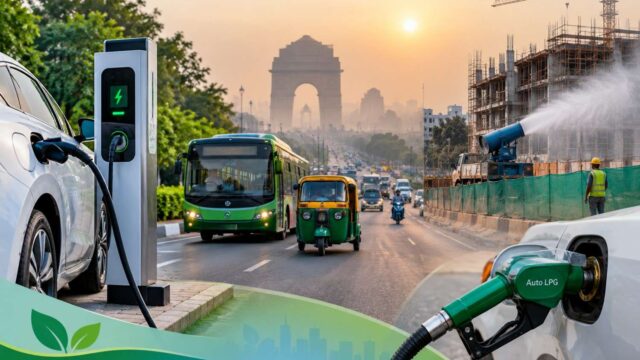
Industry leaders have called for a coordinated, year-round strategy to tackle Delhi-NCR’s air pollution, emphasising faster electric vehicle (EV) adoption, reliable charging infrastructure, cleaner automotive fuels and stricter controls on construction dust ahead of winter.
Delhi’s Air Quality Index (AQI) stood at 184 on the morning of October 21, according to AQI.in data cited by industry representatives. With winter approaching, experts have warned that falling temperatures and stagnant atmospheric conditions could worsen pollution unless emissions from transport, construction and other sources are addressed simultaneously.
The industry recommendations highlight the need to move beyond seasonal restrictions towards sustained measures combining technology, infrastructure investment and regulatory enforcement.
EV adoption hinges on charging reliability
Akshit Bansal, Founder and CEO of Statiq, said reducing vehicular emissions should remain a priority as Delhi prepares for another winter of poor air quality.
While electric vehicles can reduce tailpipe emissions, wider adoption will depend on affordability and convenient access to charging facilities, he said.
Bansal stressed that charging infrastructure must be reliable and accessible across networks, rather than merely increasing the number of installed chargers.
“A charger that is offline or locked to one app might as well not exist,” he said, calling for coordinated action by policymakers, automakers, charging infrastructure providers and power distribution companies.
Improving charger uptime and interoperability, alongside bringing EV prices closer to those of conventional vehicles, would make electric mobility a more practical option for commuters and help reduce road-level emissions.
Construction dust needs technology-led controls
Construction activity and fugitive dust are another major concern in the capital’s pollution management efforts.
Sanjay Kumar Sinha, Founder and Managing Director of Chaitanya Projects Consultancy, said environmental compliance could no longer be treated as a seasonal requirement by the infrastructure and civil engineering sector.
He advocated the use of anti-smog guns, dust barriers, covered transportation of construction materials and automated dust-suppression systems.
According to Sinha, automated site-level dust suppression systems can reduce local particulate matter concentrations by up to 70%.
He also called for integrating real-time Internet of Things (IoT) air-quality sensors, automated pollution thresholds, green procurement and life-cycle impact assessments into project execution.
Construction companies should align site operations proactively with the Graded Response Action Plan (GRAP), rather than waiting for work-stoppage orders, he said.
Sinha argued that data transparency, technology adoption and operational accountability could help reduce construction-related emissions without compromising project delivery timelines.
Auto LPG pitched as an immediate alternative
The Indian Auto LPG Coalition has called for a greater role for alternative automotive fuels, particularly in high-usage vehicles such as taxis and commercial fleets.
Suyash Gupta, Director General of the Indian Auto LPG Coalition, said Delhi needed measures capable of reducing transport emissions before winter pollution intensified.
He argued that Auto LPG could complement electrification and public transport by providing an alternative for suitable existing petrol and diesel vehicles without requiring owners to switch immediately to new vehicles.
Gupta cited industry estimates indicating that Auto LPG can deliver lower emissions of certain pollutants than conventional fuels. He said converting suitable high-usage vehicles could provide an additional avenue for reducing urban transport emissions.
However, the comparative environmental benefits depend on the pollutant measured, vehicle technology and operating conditions.
Gupta called for a technology-neutral clean-mobility strategy that combines electrification, alternative fuels, public transport, dust control and coordinated regional action on stubble burning.
Year-round action needed
The industry leaders agreed that emergency restrictions during severe pollution episodes would not be sufficient to address Delhi-NCR’s recurring air-quality problem.
Their recommendations span three key areas: reducing vehicle emissions through cleaner mobility, controlling particulate pollution from construction and improving coordination between policymakers, infrastructure providers and industry.
Transport emissions, biomass burning and dust are among the sources associated with winter particulate pollution in the region. Addressing them together would require consistent enforcement and sustained investment rather than action limited to the winter months.
As Delhi-NCR approaches another pollution season, the industry view is that cleaner mobility, technology-driven construction practices and a broader choice of lower-emission transport options must become integral to the region’s urban development strategy.