


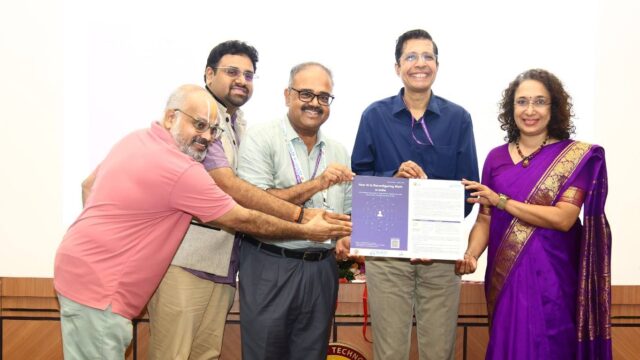
Indian Institute of Technology Madras (IIT Madras) researchers have called for a task-based assessment of artificial intelligence (AI) to understand its impact on employment in India, arguing that AI taking over certain tasks does not necessarily mean entire jobs will disappear.
A whitepaper released at the Industry Conclave on AI Governance 2026 highlights how AI could transform existing jobs, improve productivity and create new roles, while also raising concerns about job displacement and unequal access to emerging opportunities.
Beyond job losses
The whitepaper, titled How AI Is Reconfiguring Work in India: A Task-Based Framework for Understanding Augmentation, Displacement, New Roles and the Changing Structure of Jobs, was prepared by the Centre for Responsible AI (CeRAI), an interdisciplinary research group at IIT Madras’ Wadhwani School of Data Science and Artificial Intelligence.
CeRAI and WSAI, IIT Madras Head Prof. Balaraman Ravindran said the impact of AI depended on the tasks involved, industry conditions, regulatory requirements and the cost of deploying the technology.
The framework distinguishes between situations where AI performs most tasks under human supervision and those where people retain decision-making responsibilities while using AI to improve their work. The outcome could range from productivity gains and job redesign to displacement.
Cost could widen the technology divide
The paper introduces the concept of “AI-cost geography”, highlighting how the cost of AI tools and advanced systems could influence their adoption across businesses and regions.
Affordable, task-specific AI applications could spread across business process outsourcing, bookkeeping and quality inspection in medium-sized businesses. However, applications requiring advanced AI, such as legal analysis and medical imaging, could remain concentrated in larger companies and urban centres with better infrastructure and specialised skills.
The researchers warn that the benefits and risks will vary across industries and worker groups, including new and experienced employees, formal and informal workers, and urban and rural populations.
Three steps to prepare workers
The researchers recommend promoting affordable, task-focused AI tools, particularly for small businesses, to improve productivity and competitiveness.
They also call for India-specific research to identify which tasks and skills AI can perform effectively, while accounting for hidden costs involving quality, trust, safety and accountability.
The third recommendation is to establish clear pathways for workers to transition into emerging roles through reskilling, AI literacy and access to new opportunities.
CeRAI, IIT Madras Research Director Dr. Gokul S. Krishnan said the consequences of AI adoption depended on how organisations restructured work, alongside factors such as cost, capability, regulation and safety.
The researchers argue that India’s challenge is not merely to identify jobs that can be automated, but to redesign work and prepare workers to benefit from technological change.