


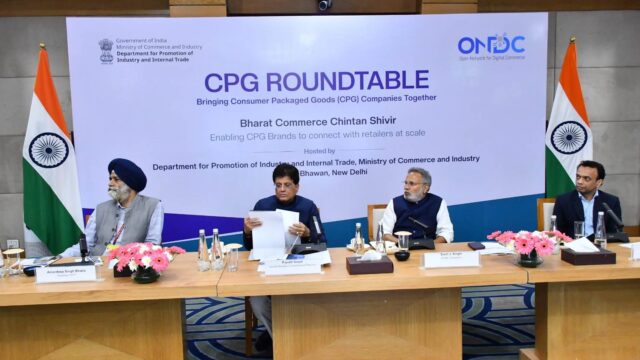
Union Commerce and Industry Minister Piyush Goyal has called on leading FMCG companies to work together to accelerate the digital transformation of India’s neighbourhood retail network through the Open Network for Digital Commerce (ONDC) DigiDukaan initiative.
Chairing the Bharat Commerce Chintan Shivir, a high-level CEO roundtable organised by the Department for Promotion of Industry and Internal Trade (DPIIT) and ONDC at Vanijya Bhawan, New Delhi, Goyal brought together more than 40 industry leaders to develop a common roadmap for strengthening India’s General Trade ecosystem.
The discussions focused on digitising procurement, improving supply-chain efficiency, expanding access to formal credit and strengthening the competitiveness of kirana stores, which remain a critical component of India’s retail economy.
Senior representatives from Hindustan Unilever, Coca-Cola India, ITC, Procter & Gamble, Marico, CavinKare, Pidilite, Britannia, Adani Wilmar, LT Foods, Haldiram’s and Emami, among others, participated in the deliberations.
DigiDukaan targets procurement-side digitisation
Unlike conventional kirana digitisation initiatives that focus on helping neighbourhood retailers sell products online, ONDC’s DigiDukaan model seeks to digitise them as buyers.
Through a single digital interface, kirana retailers can discover and order products from multiple brands, distributors and wholesalers, with greater visibility into prices, trade schemes and product availability.
The model is designed to strengthen existing distributor relationships rather than displace them. It also seeks to create common digital infrastructure through which retailers can eventually access shared logistics, micro-warehousing and formal credit facilities.
The approach is intended to reduce procurement complexity, improve inventory management and lower transaction costs across the General Trade value chain.
21,000 retailers connected with over 450 brands
DigiDukaan has connected more than 21,000 retailers with over 450 brands across Hyderabad, Jaipur and Mumbai as of September 2026, compared with over 12,000 retailers in the previous quarter.
Hyderabad has emerged as an important market for the initiative, with more than 16,000 retailers onboarded. Monthly repeat ordering rates in the city range between 73% and 78%, indicating encouraging adoption among participating retailers.
An initial ONDC study also found that 40% of surveyed retailers reported lower inventory holdings for products procured through DigiDukaan.
The finding points to the potential of digital procurement to improve inventory planning and working capital efficiency for small retailers by enabling more informed and potentially more frequent replenishment.
Five priorities for transforming General Trade
The roundtable identified several areas requiring coordinated action from FMCG companies, distributors, technology providers and logistics partners.
A key priority is developing a common digital identity for kirana retailers, allowing them to engage with multiple brands and service providers without repeatedly navigating different onboarding systems.
The initiative also seeks to develop shared logistics and micro-warehousing infrastructure to improve distributor reach, particularly in areas outside existing delivery routes, with the objective of enabling reliable next-day replenishment.
Access to formal credit is another important focus. Digital procurement and transaction histories could help create financing solutions for kirana stores, reducing their dependence on informal credit from distributors and improving working capital availability.
The discussions also highlighted the need for standardised product catalogues, plug-and-play Distributor Management System (DMS) connectors and common digital interfaces to simplify technology integration.
Equally important is the realignment of commercial incentives. FMCG companies will need to ensure that their sales teams, distributors and channel partners benefit commercially from digital ordering, wider retail coverage and sustained adoption by retailers.
Goyal seeks wider industry participation
Piyush Goyal said DigiDukaan demonstrated how open digital infrastructure built around the requirements of small retailers could accelerate technology adoption.
He called upon FMCG companies to collaborate in expanding the initiative across the country, noting that simpler and more transparent procurement could help kirana retailers release working capital and grow their businesses.
Department for Promotion of Industry and Internal Trade Secretary Amardeep Singh Bhatia said open digital infrastructure had an important role in accelerating the digitalisation of India’s retail ecosystem.
He said DigiDukaan could help neighbourhood retailers access digital procurement opportunities and participate more effectively in the evolving digital economy by bringing retailers, FMCG companies and distributors onto a common network.
FMCG, technology and logistics partnerships
DigiDukaan is building an ecosystem involving FMCG manufacturers, distributors, technology providers and logistics companies.
Hindustan Unilever, Marico, Colgate-Palmolive, Emami and Amul are participating through their distribution networks. ITC, Tata Consumer Products and Britannia are at various stages of integration or discussions.
On the technology side, Paytm for Business, Qwipo and Mulltiply.ai are live on the network, while Bizom, Botree, QuIDPe and ENS are progressing towards integration.
Logistics and warehousing partners, including ElasticRun, Shiprocket, India Post and Moeving, are also part of the expanding ecosystem.
ONDC Managing Director and CEO Vibhor Jain, said DigiDukaan was intended to build shared digital infrastructure for India’s General Trade ecosystem rather than introduce another standalone application for retailers.
He noted that while distributors had increasingly adopted digital systems for billing, printing and order placement, a large section of neighbourhood retailers continued to depend on manual processes.
The objective, he said, was to enable retailers to access multiple brands through one interface, obtain transparent information on trade schemes, receive dependable replenishment and eventually access formal credit through the connected ecosystem.
Focus shifts to expanding Mumbai operations
The National Traders’ Welfare Board (NTWB), chaired by Sunil J. Singhi, has been working with ONDC to accelerate adoption among kirana retailers by mobilising local trade associations and strengthening participation by small businesses.
In its next phase, ONDC plans to deepen brand and distributor participation in Mumbai, particularly North Mumbai, while strengthening operations in existing markets.
The initiative’s progress will depend on how effectively it brings FMCG companies, distributors and technology providers onto a common platform. Its ability to improve procurement economics, inventory efficiency and access to credit could determine whether DigiDukaan can scale beyond pilot markets and become a significant digital infrastructure layer for India’s neighbourhood retail network.