


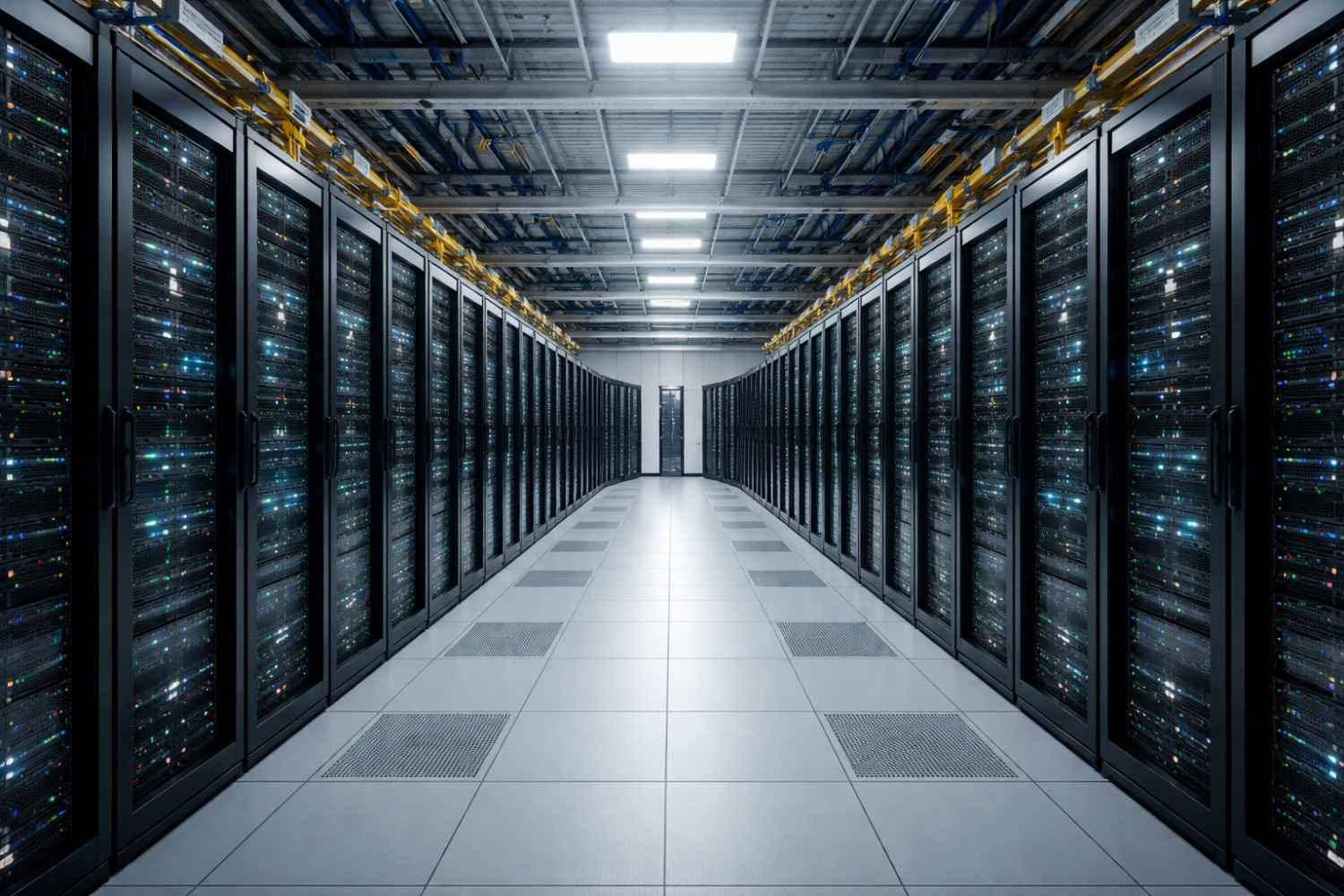
India’s data centre industry is poised for an unprecedented investment cycle, with installed capacity expected to increase five-fold to around 7.5 GW by March 2030, attracting investments of more than ₹3 lakh crore over the next four fiscals.
The expansion is being driven by rising demand for computing infrastructure from generative artificial intelligence (GenAI), enterprise digitalisation and growing data consumption, according to a report by Crisil Ratings.
However, the industry’s ability to translate this investment momentum into sustainable growth will depend on timely power connectivity, regulatory approvals and disciplined project execution.
Half of upcoming capacity already contracted
Despite the scale of the proposed expansion, demand visibility remains strong. Nearly half of the upcoming capacity is already committed under long-term contracts, reducing the risk of speculative development and providing revenue certainty to developers.
Hyperscalers are driving much of this demand through cloud adoption and compute-intensive GenAI workloads. Long-term commitments from these customers are also helping developers secure cash flows even before projects become operational.
India enjoys cost advantage over Asian peers
India’s competitive development costs are strengthening its position as a preferred data centre destination.
Crisil Ratings Director Anand Kulkarni said development costs in India are around one-fifth lower than in several competing Asia-Pacific markets because of more competitive land, construction and labour costs.
Combined with lower electricity tariffs, this translates into rentals that are 30-35% lower than in peer markets.
The availability of large campuses powered by renewable energy also aligns with the sustainability objectives of global hyperscalers, further improving India’s attractiveness as a data centre investment destination.
Power demand poses infrastructure challenge
The rapid expansion, however, is expected to put considerable pressure on power infrastructure in key data centre locations.
Around three-fourths of the upcoming 6 GW capacity is expected to be concentrated in Visakhapatnam, Mumbai and Hyderabad.
By fiscal 2030, the additional data centre capacity in these cities could be equivalent to around 80%, 60% and 20%, respectively, of their current peak electricity demand.
This concentration highlights the need for timely grid connectivity and transmission infrastructure augmentation to prevent power availability from becoming a constraint on capacity additions.
Long-term contracts improve cash flow visibility
Existing data centres in India are operating at around 90% utilisation, while more than 95% of the capacity currently under construction has already been contracted. This is expected to support faster cash flow generation as new facilities are commissioned.
The quality of contracted revenues has also improved, with contract tenures extending to 15-20 years from 10-12 years earlier.
Crisil Ratings Associate Director Nitin Bansal said longer contracts enhance cash flow visibility, while high customer migration costs and rising replacement capital expenditure could support customer retention.
However, developers will have to continuously upgrade existing facilities to accommodate next-generation GenAI workloads, particularly higher power density requirements and advanced cooling infrastructure.
Hyperscaler dependence raises pricing risks
The growing dominance of hyperscalers is another factor that could influence the industry’s profitability.
Hyperscaler-leased capacity is expected to account for 75-80% of the industry’s total capacity by fiscal 2030, compared with 60-65% in fiscal 2026.
While pricing has remained broadly stable so far, the substantial addition of new capacity could strengthen hyperscalers’ bargaining power. Any downward pressure on rentals could affect project returns and profitability.
The concentration of demand among a relatively small group of large customers also exposes developers to customer concentration risks.
High capital expenditure to keep debt elevated
From a credit perspective, the industry’s financial profile will be shaped by the balance between long-term contracted revenues and the high upfront borrowing requirements associated with data centre development.
Debt levels are expected to remain elevated over the medium term as capital expenditure typically precedes cash generation by 24-36 months.
However, the commissioning of facilities and subsequent improvement in utilisation should strengthen cash flows and gradually improve leverage levels.