


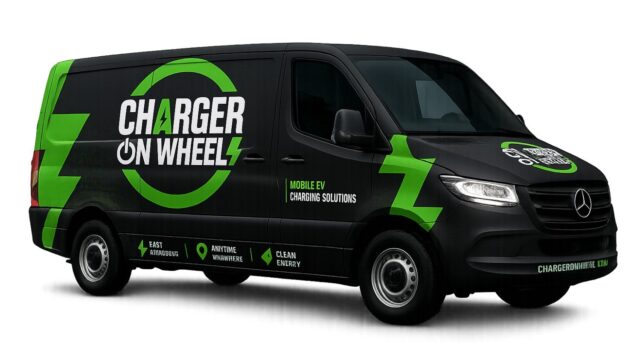
Charger on Wheels (COW), a Gurugram-founded electric vehicle (EV) charging company, is set to launch its doorstep mobile DC fast-charging services in Hyderabad this month, expanding its footprint beyond Gurugram as it targets growing demand for flexible charging solutions in urban residential communities.
The company has entered into a strategic business collaboration with Aparna Constructions and Estates Pvt Ltd to roll out mobile EV charging services across mutually agreed residential projects in Hyderabad. The arrangement will provide residents access to on-demand charging without requiring individual fixed charging installations.
The expansion comes as apartment complexes and gated communities increasingly face challenges in providing dedicated EV charging infrastructure due to parking constraints, space limitations and the electrical infrastructure requirements of conventional charging points.
Mobile charging addresses residential infrastructure constraints
Unlike conventional EV charging networks that require vehicle owners to travel to fixed charging stations, Charger on Wheels deploys mobile, self-powered charging units directly at the customer’s location.
Its charging solution uses battery energy storage systems (BESS) integrated with DC fast chargers, allowing EV owners to book charging slots and receive services at their doorstep.
The company’s latest mobile charging unit features a 92 kWh battery storage system and a 60 kW DC fast charger equipped with dual CCS2 connectors, enabling simultaneous charging of two vehicles.
The model is designed to complement existing public and private charging infrastructure, particularly in residential developments where installing individual charging points may be difficult.
Charger on Wheels Founder and CEO Anil Kumar said the collaboration with Aparna Constructions marked an important milestone in expanding access to EV charging.
“As EV adoption grows, convenient charging access will become an increasingly important consideration for residential communities. Our mobile charging model offers an additional way to address this requirement, particularly in developments where installing individual charging points may be challenging,” he said.
T-Works incubation to support technology development
Alongside its Hyderabad market expansion, Charger on Wheels has commenced physical incubation at T-Works, the state’s prototyping and hardware innovation centre, following the signing of an incubation agreement.
T-Works will support the company through incubation facilities, technical mentorship and access to its wider innovation network.
The association is expected to strengthen the company’s product development, engineering and innovation capabilities as it works towards scaling its mobile charging technology.
The company has also demonstrated its mobile EV charging solution to the management of the Indian School of Business (ISB) at the T-Works premises.
In a separate engagement, it showcased its technology at the Indian Green Building Council (IGBC) office in Hyderabad under the council’s Innovation Initiative. Discussions are underway to explore potential collaborations around sustainable mobility and green infrastructure.
Charger on Wheels also has strategic backing from Exicom Tele-Systems Ltd, strengthening its position in India’s EV charging and energy storage ecosystem.
Targets 70 mobile charging units by March 2027
Charger on Wheels currently operates in Gurugram, where it has deployed three mobile charging units and serves more than 280 active customers.
The company handles approximately 70 charging sessions a day, with each mobile unit capable of delivering around 23-24 sessions daily.
Having commenced operations in January 2026, COW recorded revenue of ₹1.1 crore in FY26 and is targeting revenue of ₹30-35 crore in FY27.
It plans to deploy more than 70 mobile charging units by March 2027, significantly expanding its operational capacity.
The company is also targeting a presence in five Indian cities in 2026, 25 cities by 2027 and 100 cities by 2028. Over the next five years, it aims to establish operations in five countries.
Expanding beyond residential communities
Beyond apartment complexes, the company plans to extend its services to real estate developers, automotive dealerships, commercial vehicle fleets and original equipment manufacturers (OEMs).
Its mobile charging model is intended to address multiple use cases, including charging requirements at residential communities, vehicle dealerships and commercial locations where conventional charging infrastructure may not be readily available.
The company is also exploring the integration of solar power and renewable electricity into its energy ecosystem. By combining solar generation, battery storage and intelligent energy management, it aims to develop a more sustainable and energy-efficient mobile charging network.
“Our focus is on making EV charging more convenient and accessible, especially for people who may not have the option of installing a charger at their homes. We believe mobile charging can complement the existing infrastructure and offer a practical solution for residential communities as electric mobility continues to grow,” Anil Kumar said.
Mobile charging as an alternative to fixed infrastructure
The company’s expansion strategy comes amid the gradual growth of India’s electric mobility ecosystem, which requires charging solutions suited to different consumer segments and urban infrastructure conditions.
While conventional charging stations remain important for public and highway charging networks, mobile charging offers an alternative for consumers who lack dedicated parking or the ability to install private charging equipment.
For real estate developers, such solutions could provide an additional EV amenity without requiring extensive modifications to existing electrical infrastructure.
Charger on Wheels is seeking to build a nationwide mobile charging network by expanding its fleet, technology capabilities, team and manufacturing or assembly infrastructure over the next three years.
Its longer-term ambition is to make charging available wherever vehicles are parked, positioning mobile energy delivery as a complementary layer in India’s evolving EV infrastructure.