


Researchers at the National Institute of Technology (NIT) Rourkela have secured a patent for a smart electric vehicle (EV) charging technology designed to improve charging efficiency, grid stability and battery life by integrating solar power, conventional electricity supply, batteries and supercapacitors.
The innovation addresses key challenges associated with the expansion of EV charging infrastructure, including sudden spikes in electricity demand, fluctuations in renewable energy generation and the degradation of energy storage batteries caused by frequent charging and discharging cycles.
The patented technology, developed by a team from NIT Rourkela’s Department of Electrical Engineering, uses an improved control mechanism to manage electricity flows between different energy sources and EV charging stations.
The patent application number is 202531101758, dated October 22, 2025.
Hybrid energy storage to improve battery life
The research team comprises Prof. Pravat Kumar Ray, Professor, Prof. Arnab Ghosh, Associate Professor, and Dr. Anindya Bharatee, Research Graduate, at NIT Rourkela.
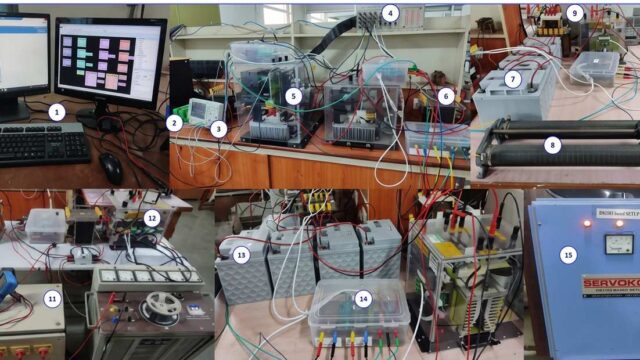
The proposed system is a solar-powered EV charging microgrid integrating solar panels, the conventional electricity grid and a hybrid energy storage arrangement combining batteries and supercapacitors.
One of the key innovations is an improved mixed droop control technique, which automatically distributes power between the energy storage components depending on changing electricity demand and supply conditions.
Under this arrangement, batteries handle sustained and relatively slower power requirements, while supercapacitors respond to sudden fluctuations by absorbing or releasing electricity rapidly.
This division of responsibilities reduces the stress caused by frequent current fluctuations on batteries, potentially extending their operational life and improving the reliability of the charging infrastructure.
Prof. Pravat Kumar Ray, Professor, Electrical Engineering, NIT Rourkela, said batteries in the developed microgrid handle sustained electricity demands, while supercapacitors respond to sudden fluctuations. Combining the two helps prevent stressful current fluctuations from damaging batteries.
Supports two-way electricity flows
The technology also incorporates controls for managing system voltage, regulating electricity supplied for EV charging according to battery charge levels and controlling electricity flowing from vehicles back to the grid.
The latter capability is particularly relevant to Vehicle-to-Grid (V2G) technology, which allows EV batteries to supply electricity to the power grid when required.
While conventional Grid-to-Vehicle (G2V) charging involves drawing electricity from the grid, V2G enables EVs to function as distributed energy storage resources. Managing both directions of electricity flow requires sophisticated control mechanisms to maintain grid stability and operational safety.
The NIT Rourkela system is designed to facilitate both G2V and V2G operations while accommodating variations in solar power generation and charging demand.
Prototype tested under simulated conditions
The researchers have developed a prototype and evaluated its performance by simulating changes in solar energy generation and electricity demand.
The next phase involves scaling up the prototype for higher-power EV charging applications and integrating advanced battery management and energy optimisation algorithms.
Prof. Arnab Ghosh, Associate Professor, Department of Electrical Engineering, NIT Rourkela, said the team plans to explore grid-forming control, multiple EV integration and real-time field trials. The objective is to develop an industry-ready smart charging solution with improved reliability, energy efficiency and grid-support capabilities.
Potential applications across charging infrastructure
The innovation comes amid the expansion of India’s EV ecosystem and the need to develop charging infrastructure that can accommodate higher electricity demand without placing additional stress on local distribution networks.
The integration of renewable energy with hybrid storage systems could also help charging stations manage fluctuations in solar power generation and reduce their dependence on conventional grid electricity.
Once scaled up and commercialised, the technology could be deployed across residential, commercial, institutional and public EV charging facilities.
With India pursuing EV adoption to reduce crude oil imports, curb transport-related pollution and achieve its net-zero emissions target by 2070, innovations that improve the reliability and economics of charging infrastructure could play an important role in supporting the country’s electric mobility transition.