


The Jawaharlal Institute of Postgraduate Medical Education & Research (JIPMER), Puducherry, has commissioned seven healthcare, research and student infrastructure initiatives involving a combined investment of ₹172.27 crore, strengthening its capacity in advanced medical treatment, biomedical research and patient care.
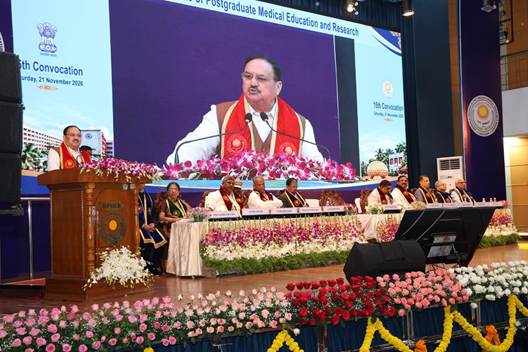
Union Minister for Health and Family Welfare and Chemicals and Fertilisers, Jagat Prakash Nadda, dedicated the facilities to the nation on Friday. He also attended JIPMER’s 15th convocation, where 816 students received degrees and medals and endowment prizes were presented across 88 award categories.
The newly inaugurated facilities cover advanced biomedical research, cancer treatment, cardiac care, diagnostic imaging, student accommodation and affordable medicines.
Advanced cancer and cardiac care receive major investments
A major component of the investment is the ₹35 crore spent on strengthening cancer treatment infrastructure at JIPMER’s Regional Cancer Centre.
This includes a Varian TrueBeam High-Energy Linear Accelerator costing ₹26 crore and an Advanced 4D CT Simulator involving an investment of ₹9 crore.
The TrueBeam system will support advanced radiotherapy techniques, including intensity-modulated radiation therapy (IMRT), volumetric modulated arc therapy (VMAT), stereotactic radiosurgery and stereotactic body radiotherapy. These technologies enable more precise targeting of tumours while minimising radiation exposure to surrounding healthy tissues.
The accelerator is expected to handle around 70 patients a day.
The 4D CT Simulator will facilitate accurate tumour localisation, assessment of respiratory movement and precision radiotherapy planning. It is integrated with the TrueBeam system to improve treatment accuracy.
Another major investment is the state-of-the-art Cardiac Catheterisation Laboratory Complex, involving approximately ₹60 crore.
The complex comprises Biplane and Single-plane Catheterisation Laboratories, a 16-bed Post-Catheterisation Cardiac Critical Care Unit and a dedicated Radial Suite. The critical care unit’s capacity has been doubled from eight to 16 beds.
The facility is expected to strengthen the management of complex cardiac conditions in both children and adults.
Research infrastructure gets ₹30 crore boost
JIPMER has also established a Centre for Research, Innovation and Entrepreneurship at an investment of ₹30.28 crore to strengthen its multidisciplinary biomedical research capabilities.
The centre will house advanced facilities in genomics, proteomics and metabolomics, along with platforms for flow cytometry, cell culture, confocal microscopy and advanced imaging.
The initiative aims to encourage collaborative research and accelerate the translation of scientific discoveries into practical healthcare solutions.
Another diagnostic facility inaugurated was a 64-slice CT scanner at JIPMER’s Multi-Speciality Consulting Unit in Yanam, involving an investment of ₹4.73 crore.
The scanner will improve access to advanced diagnostic imaging for patients in Yanam and surrounding areas, reducing the need for referrals to distant healthcare centres.
Student accommodation and affordable medicines
The institute has commissioned Dhanvantari House, a 400-bed boys’ hostel constructed at a cost of ₹42.26 crore.
The G+7-storey building has 200 double-bed rooms, an air-conditioned dining hall, a reading room, passenger lifts, solar water heating facilities and accessibility features.
JIPMER has also opened three AMRIT Pharmacy outlets at the Super Speciality Block, SSB Annex Block and Regional Cancer Centre Annex Block.
The pharmacies will provide medicines, surgical consumables and implants at affordable prices, offering savings of up to 50% and helping reduce patients’ out-of-pocket healthcare expenditure.
Nadda highlights expansion of India’s healthcare infrastructure
Nadda said the government was committed to strengthening universal health coverage through expanded access to healthcare, improved public health infrastructure and affordable medical services.
He said the seven initiatives represented investments in the health and future of the people, covering advanced biomedical research, modern diagnostics, precision cancer treatment, cardiac care, educational infrastructure and access to medicines.
He particularly highlighted the Centre for Research, Innovation and Entrepreneurship as an important step towards strengthening India’s biomedical research ecosystem and converting scientific discoveries into healthcare solutions.
Nadda also welcomed JIPMER’s plans to establish a Multi-Organ Transplantation Centre and a dedicated Centre for Trauma Care and Rehabilitation at Sedarapet. He said the proposed facilities could significantly expand access to specialised healthcare in the region, particularly for underserved communities.
He appreciated JIPMER’s contribution to making advanced medical treatment accessible to economically vulnerable sections through Ayushman Bharat and other public healthcare programmes.
Medical colleges increase to 863, MBBS seats to 1.43 lakh
At the convocation, Nadda highlighted the expansion of India’s medical education infrastructure, noting that the number of AIIMS had increased from six to 23, while medical colleges had grown from 387 to 863.
The number of MBBS seats has increased from 51,000 to 1.43 lakh, he said.
The government is working towards adding another 75,000 undergraduate and postgraduate medical seats by 2029, in line with Prime Minister Narendra Modi’s vision, while maintaining quality standards and ensuring an appropriate balance between undergraduate and postgraduate education.
He also highlighted the government’s efforts to strengthen healthcare delivery across preventive, primary, secondary and tertiary care through Ayushman Arogya Mandirs, the Pradhan Mantri Ayushman Bharat Health Infrastructure Mission (PM-ABHIM), Ayushman Bharat PM-JAY and the Ayushman Bharat Digital Mission.
According to Nadda, Ayushman Bharat PM-JAY has facilitated more than 13 crore hospitalisations and contributed to reducing India’s out-of-pocket healthcare expenditure from 64% to 42%.
He urged graduating doctors to embrace digital healthcare solutions, including e-prescriptions and digital health records, and contribute to building a stronger healthcare ecosystem.
JIPMER records over 46,800 surgeries in FY26
Nadda praised JIPMER’s achievements in advanced medical care, particularly in organ donation and transplantation, robotic surgery and complex cancer treatment.
He noted that the institute had performed more than 46,815 surgeries during 2025-26, underlining its growing role as a major tertiary healthcare centre.
Congratulating the graduating students, he described the convocation as a transition from learning to leadership and urged the young doctors to recognise their responsibilities towards society.
He emphasised that medical education was made possible through the collective contributions of parents, teachers, faculty members and public institutions, and called upon graduates to serve patients with compassion, dedication and commitment.
Puducherry Lieutenant Governor K. Kailashnathan described JIPMER as the pride of Puducherry and a centre of excellence in medical education and healthcare. He highlighted its contribution to public health services in Puducherry and neighbouring states and urged graduates to use their knowledge and skills to serve underserved communities.