


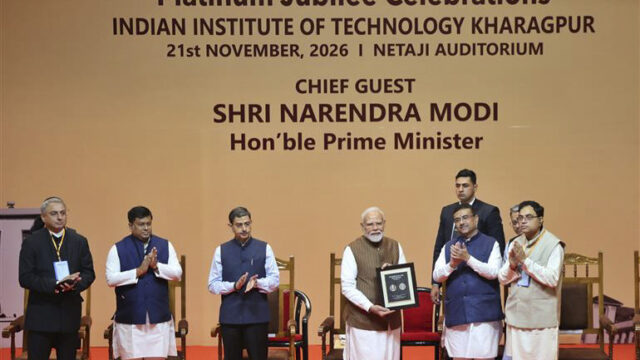
Prime Minister Narendra Modi has called upon IIT Kharagpur students and alumni to challenge conventional thinking and drive India’s ambition of becoming a developed nation, saying that the country’s journey from self-rule to self-reliance will be central to building Viksit Bharat.
Addressing the Platinum Jubilee celebrations of the Indian Institute of Technology (IIT) Kharagpur in West Bengal, Modi said the institution had played a significant role in India’s transformation over the past 75 years, contributing to the country’s industrial, infrastructure, space, atomic energy and information technology sectors.
Congratulating students, faculty, staff and alumni, he described IIT Kharagpur as the country’s first IIT and an institution that had consistently responded to the nation’s changing technological and economic needs.
From freedom to self-reliance
Highlighting the historical significance of the campus, Modi noted that IIT Kharagpur stands on the site of a former detention camp where freedom fighters were imprisoned during British rule.
He drew a parallel between the freedom struggle and India’s current development ambitions, saying the aspiration for self-rule had evolved into a determination to achieve technological and economic self-reliance.
He said the institute’s graduates had contributed to India’s industrial development, space and atomic energy programmes, software industry and global technology companies.
Semiconductor mission demonstrates India’s ambition
Emphasising the need to overcome what he termed ‘limiting beliefs’, Modi said nations could realise their potential only by challenging assumptions about what was possible.
He cited India’s Semiconductor Mission as an example, recalling scepticism over the country’s ability to enter an industry dominated by other nations for decades.
However, within four years of the initiative, several semiconductor facilities had begun operations or development across the country, and India had started exporting chips, he said.
Modi also noted that former IIT Kharagpur students were leading and executing several semiconductor projects.
He said India would have missed the opportunity had it accepted the argument that the country was too late to enter semiconductor manufacturing.
Poverty reduction and inclusive growth
The Prime Minister also referred to poverty reduction initiatives undertaken over the past 12 years, saying government programmes aimed at improving the ease of living for the poor had delivered significant results.
Citing a recent World Bank report, he said around 50 crore people in India had moved out of poverty over 12 to 13 years.
He described the achievement as evidence of the impact of challenging conventional thinking and expanding opportunities.
Modi expressed confidence that IIT Kharagpur’s 75-year legacy, research capabilities and entrepreneurial talent would contribute significantly to India’s innovation ecosystem and its ambition of becoming a developed economy.
He urged students to pursue ambitious goals and take responsibility for addressing the country’s technological and developmental challenges.