


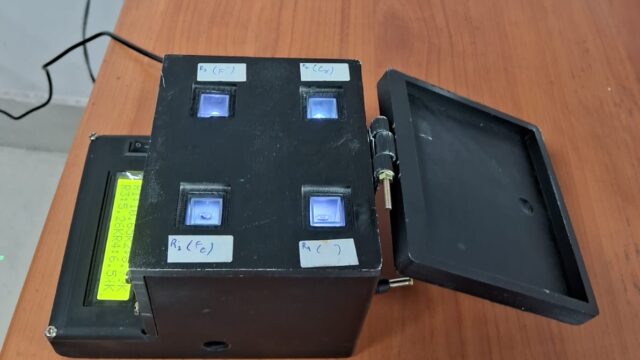
Researchers at the Indian Institute of Technology (IIT) Guwahati have developed a low-cost portable optical sensing device that can instantly detect multiple toxicants in water and other biological samples, offering a significant boost to India’s efforts to ensure safe drinking water under the Jal Jeevan Mission.
Named E-Eye, the point-of-care testing device enables on-site detection of contaminants, eliminating the need for expensive laboratory-based equipment. Developed at a cost of around ₹3,500, the device can test samples for approximately ₹2 per sample, making it an affordable solution for large-scale water quality monitoring.
The innovation addresses one of the key challenges under the Government of India’s Jal Jeevan Mission—maintaining the quality of drinking water sourced from diverse locations that may contain heavy metals, harmful bacteria and other toxic substances.
Detects multiple contaminants
Working as an electronic eye, E-Eye uses optical sensing technology to detect toxicants by analysing colour changes produced during a chemical reaction. The intensity of the colour corresponds to the concentration of contaminants, which the device converts into digital data and displays instantly. The recorded information can also be transmitted wirelessly to water treatment facilities for further monitoring.
According to the researchers, the device successfully detects arsenic, lead, iron, chromium, fluoride and Escherichia coli (E. coli) bacteria with high accuracy.
Laboratory evaluations showed that E-Eye delivers results comparable to standard UV-Visible spectrophotometers and Atomic Absorption Spectrophotometers (AAS) while offering the added advantage of portability and digital integration.
Affordable alternative to laboratory testing
Unlike conventional laboratory instruments, which are expensive and require skilled operators, E-Eye has been designed for direct field deployment. This allows authorities and industries to monitor water quality at the source, enabling faster detection and response to contamination.
The researchers said the device’s manufacturing cost could be reduced further through large-scale commercial production, making it suitable for widespread deployment across rural and urban areas.
Wide-ranging applications
Beyond drinking water analysis, E-Eye has demonstrated the ability to detect toxicants in environmental and biological samples, vegetables, food products, tea, herbal products, soil and milk.
The research team has tested more than 2,700 samples, reporting consistently accurate results across different applications.
Commercialisation plans underway
The project was supported through a research grant from the Ministry of Electronics and Information Technology (MeitY). To commercialise the technology, the researchers have established a startup, ENVIONIX Labs Pvt. Ltd., and are exploring technology transfer opportunities with industry partners.
The team is also working on integrating solar panels into the device to make it self-sustaining while enabling cloud connectivity for remote monitoring and data management.
Research published in IEEE Sensors Journal
The findings have been published in the IEEE Sensors Journal. The research was led by Prof. Tapas K. Mandal of the Department of Chemical Engineering and Prof. Harshal B. Nemade of the Department of Electronics and Electrical Engineering at IIT Guwahati, along with researchers from IIT Guwahati, KIIT Bhubaneswar and Ramakrishna Mission Residential College, Kolkata.
Prof. Tapas K. Mandal said the device operates on the Beer-Lambert law, combining optical sensing with digital electronics to provide accurate quantitative measurements of multiple contaminants.
Prof. Harshal B. Nemade said the innovation has significant commercial and public-sector potential, with applications in government water quality programmes, food and herbal product manufacturing, and industrial effluent monitoring.
The development marks an important step towards affordable, indigenous smart sensing technologies that can strengthen environmental monitoring, public health, industrial compliance and sustainable resource management across India