


India’s personal mobility financing market is undergoing a structural shift, with outstanding two-wheeler loans reaching ₹1.76 lakh crore and average passenger vehicle loan sizes rising 49% to ₹8.2 lakh in the seven years to June 2026, as consumers increasingly rely on formal credit to finance vehicle purchases.
The changing borrowing patterns reflect two distinct trends: two-wheeler finance is evolving beyond its traditional role as a first credit product, while passenger vehicle buyers are moving towards higher-value cars and longer repayment tenures.
According to TransUnion CIBIL’s Shifting Gears 2026 – Credit Drives Today’s Mobility report, which analysed personal vehicle financing between the first half of 2019 and the first half of 2026, the expansion of credit access is bringing younger consumers and borrowers from semi-urban and rural areas into the formal mobility finance market.
Two-wheeler loans move beyond first-time borrowers
Two-wheeler financing is increasingly attracting consumers with established credit histories rather than serving predominantly as an entry point into formal borrowing.
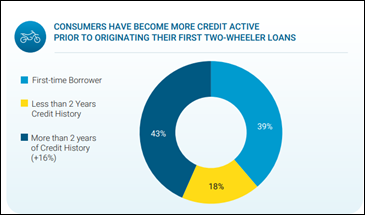
First-time borrowers accounted for 39% of two-wheeler loan originations in the first half of 2026, down 19 percentage points from 2019. Meanwhile, borrowers with more than two years of credit history represented 43% of originations, an increase of 16 percentage points over the same period.
The shift indicates that an increasing proportion of two-wheeler buyers already have experience with formal credit when they seek vehicle financing.
The outstanding two-wheeler loan portfolio reached ₹1.76 lakh crore in June 2026, 3.2 times its June 2019 level. The active borrower base nearly doubled to 3.3 crore from 1.7 crore over the same period.
Asset quality also improved. The share of outstanding balances overdue by more than 90 days fell to 1.4% in June 2026 from 2.7% in June 2019, its lowest level during the period examined by the report.
Young and rural borrowers drive two-wheeler finance
The reach of two-wheeler credit extends well beyond metropolitan markets. Borrowers from semi-urban and rural areas accounted for 64% of originations in the first half of 2026, while 43% of borrowers were aged 30 or younger.
Two-wheeler finance is also increasingly associated with other forms of consumer borrowing. In the first half of 2026, 32% of two-wheeler loan consumers held consumption-oriented credit products such as personal loans, consumer durable loans and credit cards, compared with 22% in the corresponding period of 2019.
The report’s borrower-tracking analysis indicates that vehicle financing can mark the beginning of a broader credit relationship.
Of the consumers who took a two-wheeler loan in the second half of 2022, 68% originated another credit product within the following three years. The proportion rose to 84% among first-time two-wheeler borrowers who already had at least two years of credit history.
Their subsequent borrowing extended beyond vehicle finance to products including personal loans, credit cards, car loans and home loans, with some credit relationships developing within 12 to 18 months.
“Two-wheelers are closely linked with how young India studies, works and earns,” said TransUnion CIBIL MD & CEO, Bhavesh Jain.
He said personal mobility could expand opportunities for students, young professionals, gig economy workers and entrepreneurs. The increasing share of borrowers with established credit histories and their subsequent adoption of other credit products showed that two-wheeler finance was becoming part of a longer customer journey, rather than remaining limited to the initial mobility requirement.
Average car loan rises to ₹8.2 lakh
Passenger vehicle financing is experiencing a parallel shift towards higher-value purchases, driven by consumer preference for SUVs and feature-rich cars, as well as rising vehicle prices.
The average passenger vehicle loan amount increased 49% to ₹8.2 lakh in the first half of 2026 from the corresponding period of 2019.
The average repayment tenure also lengthened by five months to 62 months, reflecting the growing role of extended repayment periods in making higher-value vehicles more affordable for borrowers.
Non-banking financial companies (NBFCs) remained the largest category of passenger vehicle lenders, accounting for 37% of the market. Private banks followed with a 26% share. NBFCs increased their share by four percentage points between 2019 and 2026.
The active passenger vehicle borrower base reached 2.5 crore in June 2026, 1.7 times the June 2019 level.
Despite the expansion in lending, portfolio quality improved. The share of outstanding passenger vehicle loan balances overdue by more than 90 days declined by 95 basis points to 0.5% over the period.
The combination of larger average loans, longer repayment tenures and lower delinquency indicates how passenger vehicle financing is evolving alongside changing consumer preferences and a wider base of borrowers.
Rural markets gain share in car ownership
The transition from two-wheelers to cars is also gaining traction beyond India’s major cities.
Gen Z and younger Millennials are increasingly represented among first-time car buyers and consumers upgrading from two-wheelers. Older Millennials, meanwhile, are more prominent among repeat car buyers and those financing higher-value vehicles.
Rural originations among consumers moving from two-wheelers to cars grew at a compound annual growth rate (CAGR) of 15% from 2019, nearly twice the 8% CAGR recorded for overall auto-loan originations.
The trend suggests that the shift towards car ownership is extending into markets where two-wheelers have traditionally played a more prominent role in personal mobility.
Premiumisation is also spreading beyond metropolitan centres. Semi-urban and rural consumers accounted for 51% of borrowers taking another higher-value car loan in the first half of 2026, up six percentage points from 2019.
The figures point to a widening geographical base for higher-value vehicle purchases, with financing helping consumers move up the ownership ladder.
Credit information becomes more important
The changing composition of borrowers is increasing the importance of credit information in vehicle lending.
First-time car buyers, consumers upgrading from two-wheelers, repeat buyers and customers purchasing more expensive vehicles can have substantially different borrowing histories and financial profiles. Assessing these differences is becoming more relevant as the market expands across age groups and geographies.
“Car ownership is increasingly being shaped by a combination of aspiration and affordability,” Jain said, adding that larger loans and longer repayment tenures were helping consumers finance higher-value and feature-rich vehicles.
He said premiumisation was extending beyond larger cities, reflecting changing ownership aspirations across India. Credit information, he added, could help lenders better understand borrowers’ financial profiles and support more informed and responsible lending decisions.
India’s mobility finance market is thus evolving on two fronts: two-wheeler loans are connecting an expanding pool of consumers to a wider range of credit products, while passenger vehicle financing is supporting the shift towards higher-value ownership.
For lenders, the challenge will be to sustain this expansion while assessing borrowers’ repayment capacity and maintaining portfolio quality. For consumers, the growing reach of formal finance is widening access to personal mobility, although larger loans and longer repayment periods also make affordability an important consideration.