


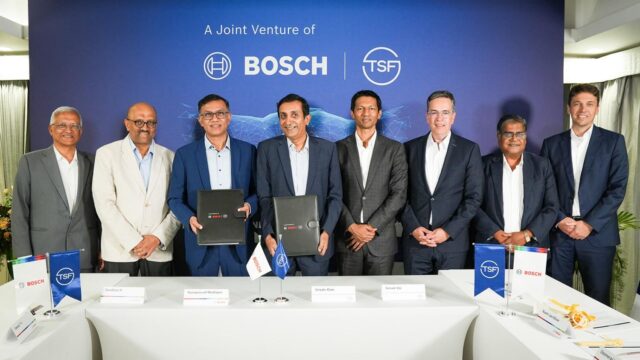
The newly announced joint venture between Bosch Ltd and TSF Group companies Brakes India and Wheels India could mark a significant shift in how India’s commercial vehicle industry approaches braking, suspension and motion management systems in the coming years.
While the announcement focuses on air systems for commercial vehicles, the larger significance lies in the industry’s transition from conventional mechanical systems to electronically controlled and software-driven vehicle architectures.
Why air systems matter in commercial vehicles
Air systems form the backbone of heavy commercial vehicles, supporting critical functions such as braking, suspension, parking brakes and vehicle stability.
Traditionally, these systems have largely operated through mechanical and pneumatic hardware. However, the growing push towards connected, automated and electric commercial vehicles is increasing the need for intelligent air management systems capable of integrating software, sensors and electronics.
The proposed joint venture aims to develop electronically controlled modules for air compression, air processing, air suspension and air parking brakes. These technologies are expected to play a central role in improving vehicle safety, ride quality, fuel efficiency and predictive maintenance capabilities.
Strategic fit for Bosch and TSF Group
For Bosch, the partnership expands its commercial vehicle motion management portfolio at a time when global mobility systems are rapidly becoming software-centric.
Bosch Ltd President of the Bosch Group in India and Managing Director Guruprasad Mudlapur said the joint venture represents a decisive step towards building advanced and intelligent air systems for global commercial vehicle customers.
Bosch Ltd Joint Managing Director and President – Bosch Mobility India Sandeep Nelamangala said the commercial vehicle industry is moving from mechanical hardware towards software-driven architecture, making air systems an important portfolio extension for Bosch.
For TSF Group companies, the JV strengthens their positioning in next-generation commercial vehicle systems.
Brakes India Pvt Ltd Managing Director Sriram Viji said the partnership would help create a more integrated system-level approach for OEMs while enabling the company to support future mobility through electronically controlled air braking systems.
Wheels India Ltd Chairman & Managing Director Srivats Ram highlighted the company’s three-decade experience in air suspension systems for buses and said the collaboration with Bosch would help advance electronic air suspension systems for global markets.
Potential impact on India’s CV ecosystem
The JV could have broader implications for India’s commercial vehicle supply chain and OEM ecosystem.
First, it signals deeper localisation of advanced commercial vehicle technologies that have traditionally depended heavily on imports or global suppliers.
Second, the partnership combines Bosch’s software, electronics and global mobility expertise with TSF Group’s manufacturing scale and established OEM relationships in India’s commercial vehicle market.
Third, the development aligns with rising demand for safer, more efficient and digitally managed commercial vehicles, especially as fleet operators increasingly prioritise uptime, predictive diagnostics and total cost optimisation.
The venture may also strengthen India’s role in the global commercial vehicle component supply chain, with the companies indicating that supply chain operations for global markets will be managed jointly through Bosch, Brakes India and Wheels India entities.
What lies ahead
The joint venture is expected to commence operations by the end of 2026, subject to regulatory approvals.
Industry observers believe the collaboration reflects a larger transformation underway in the commercial vehicle sector, where software, electronics and intelligent control systems are becoming as important as mechanical engineering.
As commercial vehicles evolve towards connected and automated platforms, integrated air systems could emerge as a critical technology layer, and the Bosch-TSF partnership appears aimed at positioning both groups at the centre of that transition.