


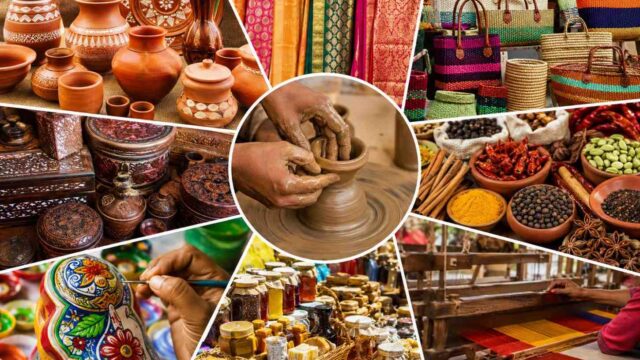
The Indian government’s flagship One District One Product (ODOP) initiative has expanded to cover 1,244 unique products across 773 districts, as the government intensifies efforts to promote local manufacturing, strengthen market access and boost exports through a range of policy interventions.
The Department for Promotion of Industry and Internal Trade (DPIIT), which anchors the initiative, said the products have been identified by respective state and Union territory governments to showcase the unique economic strengths of each district and promote balanced regional development.
Market access receives major push
The government has undertaken multiple initiatives to improve the visibility and commercial reach of ODOP products. These include facilitating participation in domestic and international trade fairs, conducting capacity-building programmes and onboarding sellers to the Government e-Marketplace (GeM) through the dedicated ODOP Bazaar.
More than 500 ODOP product categories covering over 1,300 products are currently available for procurement on GeM. In addition, more than 10 States have launched dedicated e-commerce platforms to market and sell ODOP products.
Financial support through PM Ekta Malls
Under the Scheme for Special Assistance to States for Capital Investment (SASCI), the Centre provides financial assistance of up to ₹200 crore to each state and Union territories with legislatures, Delhi, Jammu & Kashmir and Puducherry, through 50-year interest-free loans for establishing PM Ekta Malls (Unity Malls).
These malls are intended to promote the sale of ODOP products alongside Geographical Indication (GI) products and local handicrafts.
Food processing scheme aligned with ODOP
The Ministry of Food Processing Industries has integrated the ODOP approach into the Pradhan Mantri Formalisation of Micro Food Processing Enterprises (PMFME) Scheme.
The scheme offers a 35% credit-linked capital subsidy of up to ₹10 lakh for eligible projects, seed capital support for Self Help Group members, entrepreneurship development and product-specific training, assistance for common infrastructure and incubation centres, and branding and marketing support.
It also provides a 50% grant for common branding, packaging, quality standardisation and food safety compliance.
Export ecosystem strengthened
The government’s ‘Districts as Export Hubs’ initiative has identified export-potential products and services in 734 districts.
To facilitate implementation, State Export Promotion Committees and District Export Promotion Committees have been constituted across all 36 States and Union Territories. So far, 249 District Export Action Plans have been adopted to streamline value chains from production to exports.
The PMFME Scheme has also strengthened convergence with other ministries and agencies. The government has identified 24 common ODOP product clusters in collaboration with the Agricultural and Processed Food Products Export Development Authority (APEDA) and seven fish and marine product clusters with the Marine Products Export Development Authority (MPEDA) to improve branding, market access and export promotion.
Taking local products global
To promote ODOP products internationally, the government has collaborated with the Ministry of External Affairs and Indian Missions abroad to organise exhibitions, buyer-seller meets and promotional events.
ODOP Walls showcasing district-specific products have been established at Indian Missions overseas. In addition, three international retail stores—two in Singapore and one in Kuwait—are selling ODOP products.
The government has also included ODOP products as official gifts during bilateral and multilateral meetings to enhance their visibility in global markets.
While the initiative has contributed to improving market access, promoting entrepreneurship and supporting employment generation, the government said district-wise export data under the ODOP programme is not maintained centrally.
The details were shared by Minister of State for Commerce and Industry Jitin Prasada in a written reply in the Rajya Sabha.