


India’s indigenous steel slag road technology can reduce road construction costs by around 40% while delivering up to four times the strength of conventional roads, Union Minister of State (Independent Charge) for Science & Technology and Earth Sciences Jitendra Singh said.
The technology, developed by CSIR-Central Road Research Institute (CSIR-CRRI), uses processed steel slag, a by-product of steel manufacturing, as an aggregate for road construction. Besides reducing the dependence on naturally mined aggregates, suitable applications can extend the maintenance cycle to about 15 years, according to the Minister.
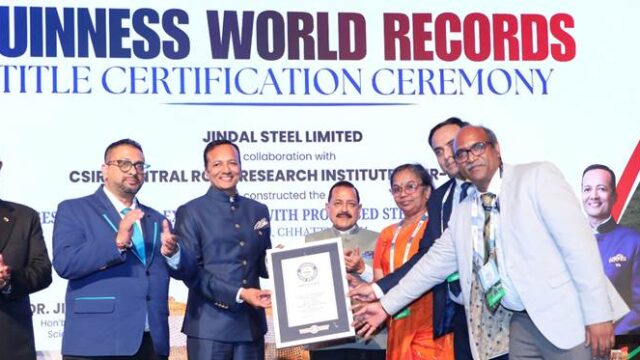
Jitendra Singh was speaking at the conferment of a Guinness World Record for the “World’s Longest Road Built with Processed Steel Slag Aggregates”. The 1.85-km road at Raigarh, Chhattisgarh, was jointly developed by CSIR-CRRI and Jindal Steel.
From industrial waste to infrastructure
The Raigarh project demonstrates how an industrial by-product can be converted into a resource for large-scale infrastructure. The initiative aligns with the Government’s broader “Waste to Wealth” and circular economy objectives, while reducing the need for natural aggregates sourced through mining and quarrying.
Jitendra Singh said India’s expanding network of highways, expressways, industrial corridors, ports and urban infrastructure will require increasing quantities of construction material. Steel slag technology offers a potential solution by addressing both waste utilisation and resource conservation.
The Minister called for the technology to move “from one project to many projects, from one State to many States”, with adoption extending beyond the Ministry of Road Transport and Highways to Railways, other government departments, State Governments and private infrastructure developers.
Proven across demanding projects
The technology has already been deployed in several applications. A major demonstration was undertaken at Hazira, Gujarat, where processed steel slag aggregates were used for a six-lane road connecting an industrial area with Hazira Port.
On the NH-66 Mumbai-Goa Highway, around 80,000 tonnes of steel slag were processed into aggregates for a one-kilometre, four-lane road section. The technology has also been deployed for heavy-duty road infrastructure in Arunachal Pradesh, including the strategic border region.
At Hazira Port, a 1.1-km steel slag road connects the multi-purpose berth with the coal yard, demonstrating its potential for industrial and logistics infrastructure.
Tougher roads for changing traffic
Jitendra Singh said stronger and more durable roads could be particularly valuable in regions that face difficult terrain and heavy rainfall. In parts of the Northeast, road construction is often restricted to a few months because of prolonged monsoons, while roads built during one season can face damage before the next construction cycle.
He also pointed to the changing traffic profile of rural roads. Roads initially built mainly for village connectivity and light vehicles can eventually carry heavy trucks as surrounding areas become industrialised. Higher-strength road technology can help address such changes in traffic loads.
40-km Odisha project next
The Guinness World Record is now being followed by a much larger implementation. Dr N. Kalaiselvi, Secretary, DSIR and Director General, CSIR, said CSIR-CRRI has received a work order for a 40-km road in Odisha from Jindal Steel’s Angul plant.
She said the partnership is now poised to surpass its own 1.85-km record, taking the technology from a demonstration-scale achievement towards substantially larger deployment.
The project also saw the signing of a Technology Transfer Agreement between CSIR-CRRI and Jindal Steel, the launch of the “Steel Grit” brand and the release of a scientific documentary.
Scaling indigenous technology
Jitendra Singh said the Guinness record should be viewed as the beginning rather than the destination. The real measure of success, he said, would be widespread replication wherever the technology is technically and economically suitable.
The initiative brings together scientific research, industry and infrastructure development, demonstrating how indigenous technology can convert industrial waste into an economically valuable construction resource.
With the 40-km Odisha project in the pipeline, steel slag road technology is now moving from a single record-setting project towards larger national adoption, potentially lowering infrastructure costs while improving road durability and reducing dependence on natural aggregates.