


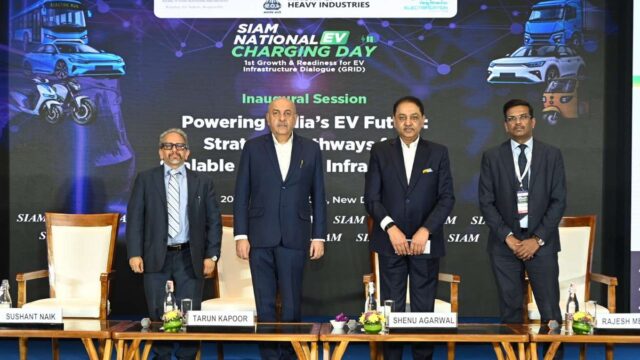
The Society of Indian Automobile Manufacturers (SIAM) has launched National EV Charging Day to accelerate the development of India’s electric vehicle (EV) charging infrastructure, with industry leaders and policymakers calling for greater coordination, reliable charging facilities and increased investments to support the country’s electric mobility transition.
The first National EV Charging Day, organised under SIAM’s Electrification initiative, was marked by the inaugural Growth & Readiness for EV Infrastructure Dialogue (GRID 2026) in New Delhi, with the support of the Ministry of Heavy Industries.
Themed ‘Powering India’s EV Future: Strategic Pathways for Scalable Charging Infrastructure’, the dialogue brought together government officials, state representatives, automobile manufacturers, charging point operators and infrastructure companies to discuss the challenges and opportunities in expanding the country’s EV charging network.
The discussions highlighted a critical requirement for India’s electric mobility ambitions: charging infrastructure must expand in tandem with EV adoption, with greater emphasis on operational reliability, accessibility, grid capacity and commercial viability.
Infrastructure must go beyond installation numbers
Union Minister for Heavy Industries and Steel H. D. Kumaraswamy said charging infrastructure was the backbone of electric mobility but cautioned that the number of charging stations sanctioned or installed should not be the sole measure of progress.
He stressed that charging stations must be operational, offer adequate capacity, be easy to locate and access, and provide convenient payment options.
India’s charging infrastructure ambitions should extend beyond metropolitan areas to smaller towns, rural regions, industrial districts, tourism circuits and emerging economic corridors, he said.
Advisor to the Prime Minister Tarun Kapoor said reliability, regular maintenance and reasonable tariffs would be crucial to encouraging wider consumer adoption.
He called for collaboration among vehicle manufacturers, charging point operators, oil marketing companies and electricity distribution companies to develop infrastructure catering to passenger and commercial vehicles, including electric trucks, three-wheelers and buses.
EV penetration rises to 8.2%
SIAM President and Managing Director and CEO, Ashok Leyland Ltd, Shenu Agarwal, highlighted the rapid progress in India’s electric mobility transition.
EV penetration in India has increased from 0.7% in FY20 to 8.2% in FY26, indicating a significant shift from early adoption towards mainstream acceptance, he said.
However, the rising number of electric vehicles also creates an expanding requirement for charging facilities.
Agarwal identified five priorities for scaling up the charging ecosystem: power availability, space for charging facilities, coverage across vehicle segments, technology platforms and partnerships.
He said India’s policy direction, clean power base and growing EV market provided a foundation for building a dependable charging network.
Chairman, SIAM Electric Mobility Group and Global Head – Government and Corporate Affairs and Chief Corporate Affairs Officer, Tata Motors Ltd, Sushant Naik, said the focus of India’s electrification journey must now extend beyond vehicle adoption to the development of supporting infrastructure.
He described National EV Charging Day as the beginning of a movement to bring government, industry and infrastructure players together to accelerate the transition.
PM E-DRIVE supports charging infrastructure expansion
Government initiatives and policy interventions to expand the charging network featured prominently in the discussions.
Ministry of Heavy Industries Additional Secretary Hanif Qureshi said government guidelines envisaged a car charging station every 25 km along highways and charging facilities for buses and trucks every 100 km.
Under the PM E-DRIVE scheme, around 9,000 chargers are being set up, while approximately ₹900 crore has been sanctioned to various state governments for charging infrastructure, he said.
He pointed out that charging requirements would vary across vehicle segments and operating environments. Electric trucks deployed in mining, steel and port operations, for instance, would require infrastructure designed around their specific operational needs.
Qureshi also emphasised the need for coordination between central and state governments, local bodies and private companies, particularly in identifying suitable land and securing electricity connections.
The expansion of charging facilities would also require simultaneous strengthening of electricity distribution networks.
States play a critical role in deployment
A dedicated session on state-led strategies examined implementation challenges and approaches adopted by different states to expand charging infrastructure.
Representatives from Delhi, Uttar Pradesh, Tamil Nadu and Kerala shared their experiences, highlighting the importance of charging network uptime, consumer accessibility, land availability and state-level policy support.
The discussions underlined that the pace of deployment would depend significantly on how effectively states address local implementation challenges, including land identification, electricity connections and coordination among government agencies.
The participation of Guidance Tamil Nadu also brought attention to the state’s efforts to strengthen its electric mobility ecosystem.
Investments and partnerships key to scaling up
A separate industry leadership discussion examined investment opportunities, technological innovation and emerging business models that could make EV charging infrastructure commercially sustainable.
SIAM Director General Rajesh Menon and Executive Director (Technical) Atanu Ganguli participated in the deliberations along with representatives from Chargezone, Statiq, Tata Power, Bharat Heavy Electricals Ltd (BHEL), Ather Energy and JSW MG Motor India.
The participation of automobile manufacturers, charging operators, power companies and equipment manufacturers reflected the increasingly interconnected nature of the EV infrastructure business.