


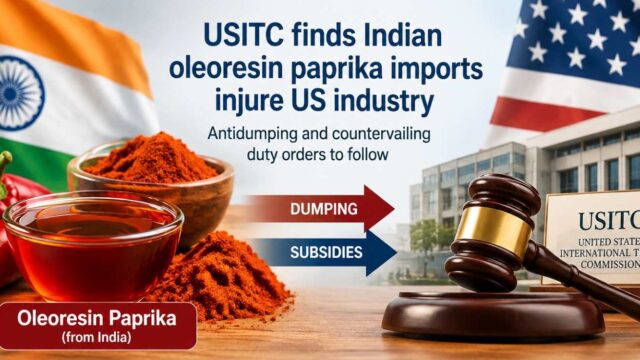
The United States International Trade Commission (USITC) has determined that imports of oleoresin paprika from India are materially injuring the US industry, clearing the way for antidumping and countervailing duty orders on the Indian product.
The final affirmative determination follows a trade investigation launched in 2025 after US producer Rezolex alleged that Indian oleoresin paprika was being sold in the US at less than fair value and benefited from government subsidies. The USITC had issued a preliminary affirmative determination in August 2025, finding a reasonable indication of material injury to the US industry.
What is oleoresin paprika?
Oleoresin paprika is a concentrated liquid extract obtained from dried and ground Capsicum peppers. Unlike paprika used as a spice, the product covered by the US investigation is primarily used as a natural colouring additive in food and other applications.
Its red and orange colours are derived mainly from pigments such as capsorubin and beta-carotene. The product can be oil- or water-based and is traded according to factors including colour intensity, concentration and weight.
India has a significant presence in this specialised value-added segment. US import data cited by the Commerce Department show that US imports from India were about 2.23 million kg worth $56.4 million in 2024, compared with 2.59 million kg worth $68.0 million in 2022.
What has the US decided?
The US Department of Commerce issued final affirmative determinations in August 2026, finding dumping margins of 5.78% for Synthite Industries, 4.24% for Mane Kancor Ingredients and 5.08% for all other producers/exporters.
Commerce also determined subsidy rates of 25.42% for Synthite, 18.67% for Mane Kancor and 21.90% for all others. After subsidy offsets, however, the listed cash-deposit rates for the antidumping determination were shown as zero.
The USITC’s September 18 affirmative injury determination is the final step required for the US trade-remedy orders to proceed.
Potential impact on Indian exporters
The immediate impact will be felt by Indian producers and exporters supplying the US market. The imposition of trade-remedy duties can raise the landed cost of Indian oleoresin paprika and potentially affect exporters’ pricing, margins and competitiveness.
The issue is particularly relevant for companies with significant exposure to the US market. Synthite Industries and Mane Kancor were specifically identified in Commerce’s final determinations.
However, the overall impact on India’s spice exports is likely to be much narrower because the investigation covers a specialised value-added paprika extract rather than conventional paprika or the broader spice trade.
Could supply chains shift?
US buyers could seek alternative suppliers or negotiate lower export prices with Indian producers to absorb part of the additional trade costs. Indian exporters, in turn, could look to expand sales in other markets or increase processing efficiency to protect competitiveness.
The case also highlights a broader trade risk for India’s processed food and ingredient exporters: products that move up the value chain can increasingly become subject to trade-remedy investigations when domestic producers in destination markets allege dumping or subsidisation.
For India, the financial exposure from this particular case is relatively limited compared with major commodity trade disputes, but the precedent could matter for other specialised food ingredients and processed agricultural products entering the US market.
The US investigation began with a June 2025 petition by Rezolex. Commerce subsequently investigated both alleged dumping and government subsidies, while the USITC was responsible for determining whether the US industry suffered material injury from the imports.