


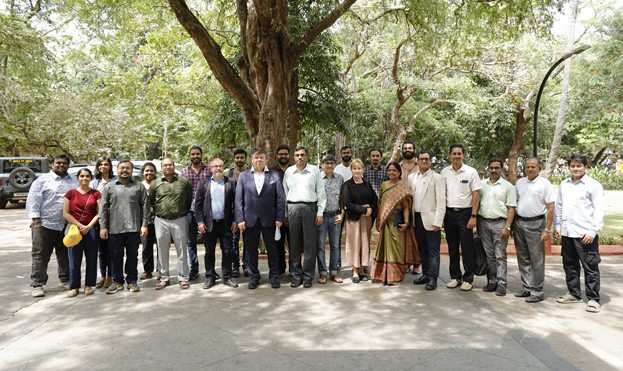
The Indian Institute of Technology Madras has entered into a strategic partnership with the Finnish Meteorological Institute to establish VAYYU, a virtual research centre dedicated to advancing understanding of aerosol – meteorology interactions, Himalayan atmosphere–cryosphere dynamics, and urban air quality.
Formalised through a memorandum of understanding signed in Chennai, the collaboration brings together IIT Madras leaders including V Kamakoti, Shanti Pawan, Manu Santhanam and Chandan Sarangi, alongside FMI leadership comprising Petteri Taalas, Hannele Korhonen and Rakesh K Hooda.
VAYYU will focus on advanced simulations and state-of-the-art observations to quantify how aerosols influence regional hydro-climate, accelerate Himalayan snow and glacier melt, and affect air quality in Indian megacities. The centre aims to deliver robust climate-risk assessments and policy-relevant tools that support sustainable development and climate resilience.
Welcoming the initiative, Prof. Kamakoti underscored the importance of global collaboration in climate monitoring and research. Prof. Taalas noted that the MoU builds on more than three years of joint work on Himalayan aerosols, expanding cooperation on challenges of global significance.
The partnership has also drawn strong diplomatic support. Hemant H. Kotalwar described VAYYU as a milestone in Indo-Finnish science diplomacy, combining IIT Madras’ modelling strengths with FMI’s climate expertise to address aerosol-driven risks to monsoons and urban health. Kimmo Lähdevirta highlighted Finland’s commitment to collaborative climate science, noting the centre’s potential to inform joint policies that enhance regional resilience.
VAYYU builds on two major international initiatives. The €10 million CryoSCOPE project investigates aerosol impacts on Himalayan glaciers and hydrology through advanced monitoring in Kargil, while the CO-ENHANCIN project has enabled a ₹5 crore urban observatory in Chennai, providing high-resolution data for air-quality assessment and local weather prediction.
Beyond research, the centre emphasises human capital development through student and faculty exchanges, winter schools, internships, and specialised workshops, reinforcing IIT Madras’ global engagement in climate action and next-generation environmental research