


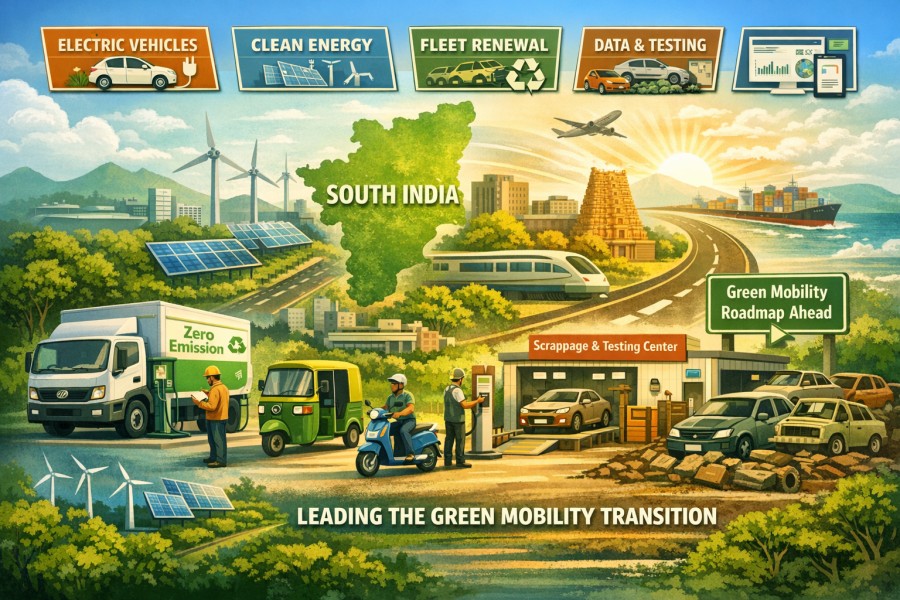
South India is well positioned to lead India’s next phase of green mobility transformation, combining industrial strength, policy momentum and execution capability to decarbonise transport while driving competitiveness and job creation, according to a new report released at the CII Green Mobility Summit in Chennai.
Titled Accelerating India’s Green Mobility Transition: Pathways for South India, the report highlights transport as one of India’s fastest-growing sources of emissions, contributing 12–13% of energy-related CO₂ output and growing at a compound annual rate of 6–7%. With urbanisation, freight movement and personal mobility set to rise sharply, the report underscores the urgency of shifting from incremental actions to outcome-driven implementation.
Prepared by Kearney, the report positions South India’s strong manufacturing base, supplier ecosystem and policy readiness as a launchpad to demonstrate scalable green mobility solutions across cities, industrial corridors and logistics routes.
Freight and Fleet Renewal Hold the Key
While road transport accounts for nearly 90% of transport-related emissions, the report points out that a disproportionate share comes from freight. Medium and heavy commercial vehicles constitute less than 5% of the vehicle fleet but contribute nearly 40% of road transport emissions. Targeting these high-impact segments, along with other high-utilisation fleets, could deliver 20–30% of the transport-sector emissions abatement required by 2030.
However, the report cautions that real progress will depend on moving beyond “activity metrics” such as vehicles sold or chargers installed, towards “outcome metrics” including vehicle uptime, operational reliability, enforcement linkage and credible data systems that track actual emissions reduction.
Economics Turning Favourable, But Execution Gaps Remain
The report notes that green mobility economics are increasingly supportive. Battery costs have declined by nearly 85–90% since 2010, and several high-usage electric mobility segments, two-wheelers, three-wheelers and select four-wheelers, are already approaching or achieving total cost of ownership parity. Accelerated localisation of battery cells and components could further improve affordability and supply-chain resilience.
A key “next unlock” for South India, however, lies in accelerating fleet renewal and scrappage enforcement. The report flags that southern states lag the national average on vehicle testing and scrappage outcomes, with only 17–18% of planned Automated Testing Station (ATS) capacity currently operational. ATS facilities account for less than a quarter of fitness tests, with the majority still conducted through legacy systems—limiting the pace of emissions reduction.
From Ambition to Outcomes
“Green mobility is no longer a niche agenda—it is a competitiveness and clean-air imperative,” said Nithin Chandra, Senior Partner at Kearney. He added that South India can lead the next phase by pairing ecosystem strength with measurable outcomes, including reliable infrastructure, high-impact fleet transitions and effective scrappage implementation.
Shovik Banerjee, Partner at Kearney, said India’s biggest gains will come from targeting segments where emissions are concentrated. “The opportunity is clear: align incentives, enable deployment and track outcomes so adoption translates into real emissions reduction,” he said.
Tamil Nadu Poised to Set the Benchmark
The report concludes that the coming decade will favour regions that combine policy clarity with disciplined capital allocation and decisive execution. Within the Southern region, Tamil Nadu is positioned to set a national benchmark for sustainable mobility transformation through a clear, execution-led roadmap anchored around four strategic priorities: prioritising high-impact freight and fleet segments, deploying demand-led infrastructure in high-usage corridors, operationalising scrappage reform through robust testing and enforcement, and institutionalising data as a single source of truth for monitoring adoption and emissions outcomes.